
World
Rare Fabergé Egg Expected to Fetch Over $26 Million at Auction

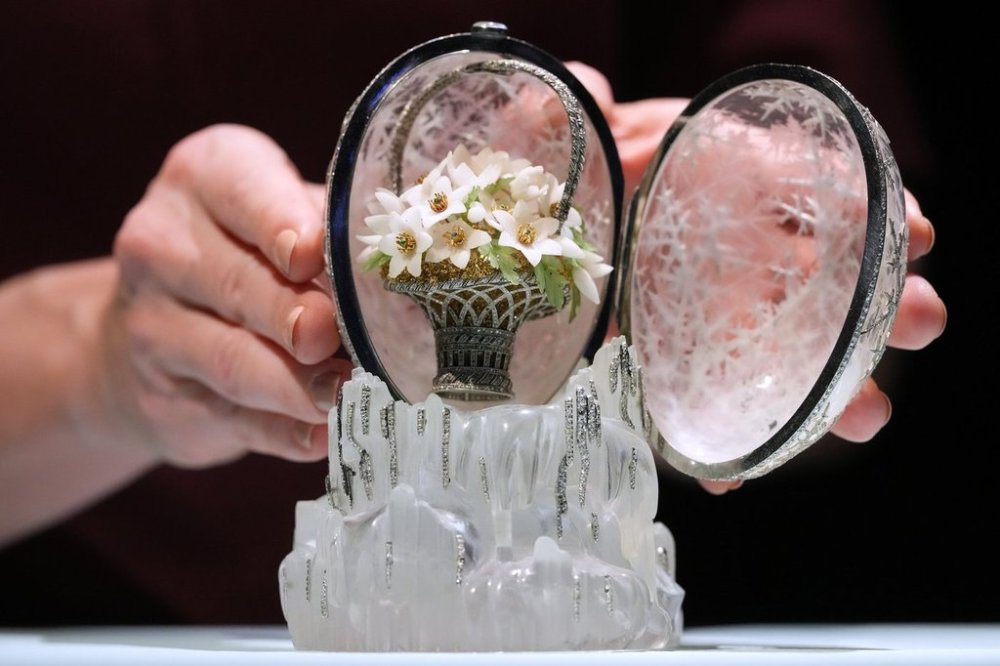
A rare crystal and diamond Fabergé egg, originally crafted for Russia’s royal family, is set to go to auction with an estimated value exceeding £20 million (approximately $26.4 million). The auction will take place at Christie’s headquarters in London on Tuesday. This exquisite piece, known as the Winter Egg, is one of only seven remaining in private collections, highlighting its unique status in the art world.
The Winter Egg stands at 10 centimeters tall and is made from finely carved rock crystal adorned with a delicate snowflake design crafted from platinum and 4,500 tiny diamonds. Its interior reveals a diminutive basket filled with quartz flowers, symbolizing spring. Margo Oganesian, the head of Christie’s Russian art department, described the egg as akin to a luxurious Kinder Surprise chocolate, emphasizing its allure. She referred to it as the “Mona Lisa” of decorative arts, a testament to its exceptional craftsmanship and design.
Commissioned by Czar Nicholas II in 1913 for his mother, Dowager Empress Maria Feodorovna, the Winter Egg was designed by Alma Pihl, one of only two female designers involved in the creation of these iconic pieces. The other egg designed by Pihl is currently owned by the British royal family.
The tradition of gifting Fabergé eggs began with Czar Alexander III, who presented one to his wife each Easter. This cherished custom was continued by his successor, Czar Nicholas II, who expanded the practice to include gifts for both his wife and mother. Between 1885 and 1917, the Fabergé workshop produced over 50 eggs for the imperial family, each uniquely crafted and containing hidden surprises.
The Romanov dynasty ruled Russia for three centuries before being overthrown during the 1917 revolution. Tragically, Czar Nicholas II and his family were executed in 1918, leading to the subsequent sale of many royal possessions. The Winter Egg was acquired by a London dealer for 450 pounds during the 1920s when the cash-strapped Communist authorities sold off Russia’s artistic treasures.
The egg remained lost for two decades before it resurfaced in a 1994 auction at Christie’s, where it sold for more than 7 million Swiss francs (approximately $5.6 million2002, fetching $9.6 million. The upcoming auction is anticipated to surpass the record of $18.5 million set in 2007 for another Fabergé egg made for the Rothschild banking family.
Currently, there are 43 surviving imperial Fabergé eggs, with most residing in museums, making this auction a significant event for collectors and art enthusiasts alike. The sale of the Winter Egg not only represents a remarkable opportunity for investment but also serves as a connection to a rich historical legacy.

Meta Plans Major Layoffs as AI Costs Surge

Alberta’s Referendum Could Pave Way for U.S. Statehood

Minooka District 201 Plans Enhanced Bilingual Support for Students

Canmore Approves Multiple Development Permits for New Projects

Remembering Bradly Castillo Shearsmith: A Life of Friendship and Joy

BIS Urges Watchdogs to Integrate Synthetic Risk Transfers in Stress Tests

Teva Transforms: Shifting Focus from Generics to Branded Success

Apple Launches AirPods Max 2 with Enhanced Audio Features

Ontario Ends Funding for Seven Supervised Injection Sites

Toyoake City Proposes Daily Two-Hour Smartphone Use Limit

Pedestrian Fatally Injured in Esquimalt Collision on August 14

B.C. Review Reveals Urgent Need for Rare-Disease Drug Reforms

Dark Adventure Game “Bye Sweet Carole” Set for October Release

Konami Revives Iconic Metal Gear Solid Delta Ahead of Release

Victoria’s Pop-Up Shop Shines Light on B.C.’s Wolf Cull

Jimmy Lai’s Defense Challenges Charges Under National Security Law

Snapmaker U1 Color 3D Printer Redefines Speed and Sustainability

Apple Expands Self-Service Repair Program to Canada
-
 Science11 months ago
Toyoake City Proposes Daily Two-Hour Smartphone Use Limit
-
 Top Stories11 months ago
Pedestrian Fatally Injured in Esquimalt Collision on August 14
-
 Health11 months ago
B.C. Review Reveals Urgent Need for Rare-Disease Drug Reforms
-
 Technology11 months ago
Dark Adventure Game “Bye Sweet Carole” Set for October Release
-
 Technology11 months ago
Konami Revives Iconic Metal Gear Solid Delta Ahead of Release
-
 Lifestyle11 months ago
Victoria’s Pop-Up Shop Shines Light on B.C.’s Wolf Cull
-
 World11 months ago
Jimmy Lai’s Defense Challenges Charges Under National Security Law
-
 Technology11 months ago
Snapmaker U1 Color 3D Printer Redefines Speed and Sustainability
-
 Technology11 months ago
Apple Expands Self-Service Repair Program to Canada
-

 Technology11 months ago
AION Folding Knife: Redefining EDC Design with Premium Materials
-

 Technology11 months ago
Solve Today’s Wordle Challenge: Hints and Answer for August 19
-

 Business11 months ago
Gordon Murray Automotive Unveils S1 LM and Le Mans GTR at Monterey