
Science
Japanese Researchers Claim Breakthrough in Dark Matter Detection

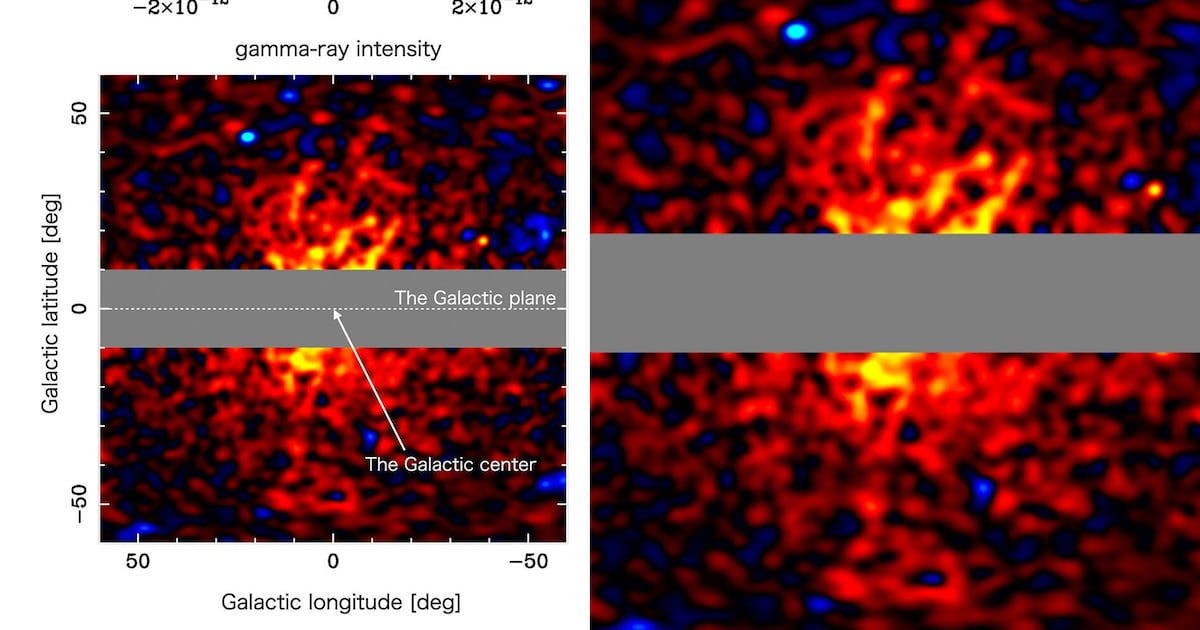
Researchers at the University of Tokyo have potentially made a significant breakthrough in the quest to understand dark matter, a phenomenon that has puzzled scientists for decades. Utilizing data from NASA’s Fermi Gamma-ray Space Telescope, the team believes they have detected specific gamma rays associated with dark matter interactions.
Dark matter was first identified in the 1930s by Swiss astronomer Fritz Zwicky, who described it as an “invisible glue that holds the universe together.” Although it cannot be directly observed, dark matter is thought to comprise the majority of the universe’s mass. Scientists typically study it indirectly, examining its gravitational effects on visible matter, such as galaxies. Since dark matter neither absorbs, reflects, nor emits light, its direct detection has remained elusive.
A prevalent theory suggests that dark matter consists of weakly interacting massive particles (WIMPs). These particles are theorized to be heavier than protons and interact minimally with other forms of matter. When two WIMPs collide, they are expected to annihilate each other, producing detectable particles like gamma rays.
Potential Detection of Dark Matter
The research team, led by astronomer and astrophysicist Tomonori Totani, concentrated their efforts on regions with high dark matter density, such as the center of the Milky Way galaxy. After years of searching, they reported their findings in the Journal of Cosmology and Astroparticle Physics.
Totani stated, “We detected gamma rays with a photon energy of 20 gigaelectronvolts (20 billion electronvolts), extending in a halo-like structure toward the center of the Milky Way galaxy.” He further noted that the gamma-ray emissions closely resemble the expected shape from a dark matter halo.
This detection is particularly significant because the observed gamma rays do not align with conventional astronomical phenomena or emissions. Totani expressed optimism regarding the implications of their findings: “If this is correct, to the extent of my knowledge, it would mark the first time humanity has ‘seen’ dark matter.” He added that this discovery could indicate the existence of a new particle not currently accounted for in the standard model of particle physics, representing a major advancement in both astronomy and physics.
Expert Opinions on the Findings
Despite the excitement surrounding these results, the findings must undergo verification through independent analyses by other researchers. Yonatan Kahn, an assistant professor of physics at the University of Toronto, highlighted the importance of establishing observational evidence for dark matter. He remarked, “What this paper is purporting to show is they saw signatures of dark matter particles that were annihilating to other particles that we are then able to observe with this telescope.”
Kahn expressed caution regarding the consistency of Totani’s findings with previous searches that have examined similar regions of the galaxy and energy ranges but did not yield definitive conclusions. “The general idea has definitely been tried before, and so it’s not necessarily an entirely new data set nor a new observational technique,” he noted. “It’s a new analysis that needs to be checked against existing literature.”
The ongoing investigation into dark matter continues to capture the attention of scientists worldwide. As researchers strive to unlock the mysteries of the universe, these new findings from Tokyo may pave the way for future breakthroughs in our understanding of the cosmos.

Fem Tech: A New Frontier in Women’s Health or Corporate Exploitation?

Ottawa Charge Coach Carla MacLeod Reveals Breast Cancer Diagnosis

French Firm Atelier Bois d’ici Launches Family-Friendly Tiny XXL Home

Moss Street Market Faces Disruption from Custodian Shortage

Arms Producers Surge to Record Revenue of $679 Billion in 2024

Surrey Schools Honors 243 Retirees at Celebratory Dinner

Ontario’s Healthcare Faces Crisis: Lessons from UK’s Privatization

Thanksgiving Mass Unites Community in Spirit of Gratitude

Wabanaki Artifacts Spark Innovative Collaboration at UNB

Toyoake City Proposes Daily Two-Hour Smartphone Use Limit

B.C. Review Reveals Urgent Need for Rare-Disease Drug Reforms

Pedestrian Fatally Injured in Esquimalt Collision on August 14

Dark Adventure Game “Bye Sweet Carole” Set for October Release

Jimmy Lai’s Defense Challenges Charges Under National Security Law

Victoria’s Pop-Up Shop Shines Light on B.C.’s Wolf Cull

Konami Revives Iconic Metal Gear Solid Delta Ahead of Release

Apple Expands Self-Service Repair Program to Canada

Snapmaker U1 Color 3D Printer Redefines Speed and Sustainability
-
 Science3 months ago
Toyoake City Proposes Daily Two-Hour Smartphone Use Limit
-
 Health3 months ago
B.C. Review Reveals Urgent Need for Rare-Disease Drug Reforms
-
 Top Stories3 months ago
Pedestrian Fatally Injured in Esquimalt Collision on August 14
-
 Technology3 months ago
Dark Adventure Game “Bye Sweet Carole” Set for October Release
-
 World3 months ago
Jimmy Lai’s Defense Challenges Charges Under National Security Law
-
 Lifestyle3 months ago
Victoria’s Pop-Up Shop Shines Light on B.C.’s Wolf Cull
-
 Technology3 months ago
Konami Revives Iconic Metal Gear Solid Delta Ahead of Release
-
 Technology3 months ago
Apple Expands Self-Service Repair Program to Canada
-
 Technology3 months ago
Snapmaker U1 Color 3D Printer Redefines Speed and Sustainability
-

 Technology3 months ago
AION Folding Knife: Redefining EDC Design with Premium Materials
-

 Technology3 months ago
Solve Today’s Wordle Challenge: Hints and Answer for August 19
-

 Business3 months ago
Gordon Murray Automotive Unveils S1 LM and Le Mans GTR at Monterey