
Science
Scientists Uncover Mechanism Behind Lightning Sparks Using Laser Technique

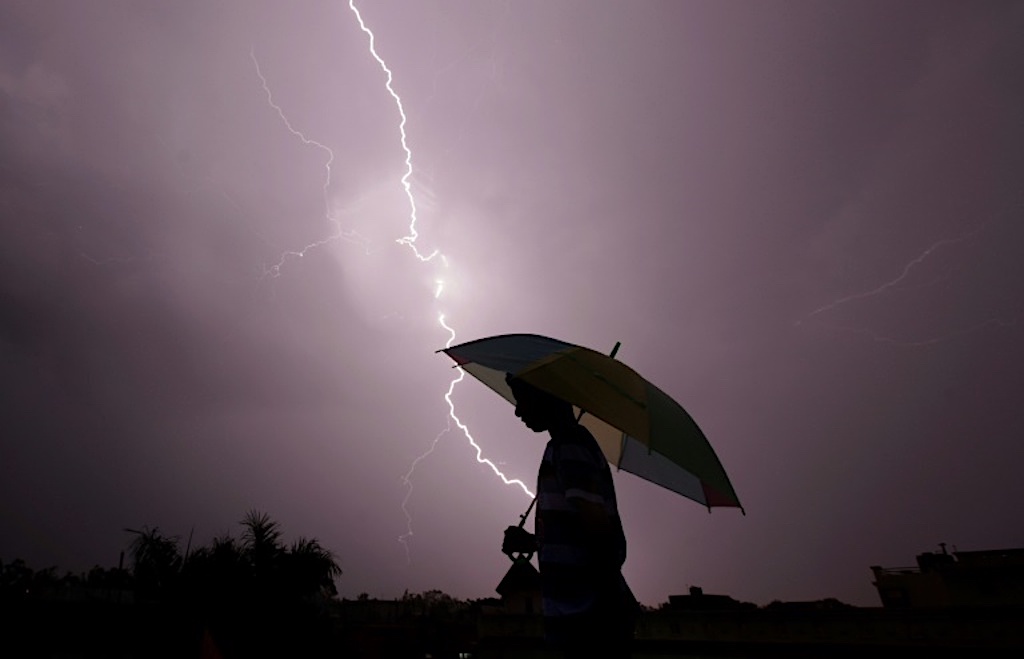
Scientists from Austria have developed a groundbreaking technique that may illuminate the mysterious origins of lightning. By using precisely aligned laser beams, they can trap and analyze a single aerosol particle, observing how it charges and discharges. This innovative method offers new insights into the electrical processes that may occur within storm clouds, potentially revealing the initial spark that ignites lightning.
Aerosols, which are tiny droplets or solid particles suspended in the air, play a crucial role in atmospheric processes. They range from visible substances like pollen to microscopic viruses. The researchers focused on understanding how ice crystals within clouds accumulate charge. To do this, they created models using small, transparent silica spheres, which mimic the behavior of real atmospheric aerosols.
The technique employs a pair of intersecting laser beams, an approach known as “optical tweezers.” This setup allows scientists to stabilize and electrically charge a single particle. As the beams converge, they generate a concentrated point of light that suspends the aerosol, enabling detailed observation. When a particle is successfully trapped, a bright green flash indicates its capture, providing immediate visual confirmation.
Through this method, the researchers discovered that aerosol particles can gain charge via a process called “two-photon excitation.” Normally, these particles carry little to no net charge. However, when two photons collide with a particle simultaneously, they can eject an electron, transforming the particle into a positively charged entity. Continuous exposure to the laser leads to an increase in charge, allowing scientists to monitor the particle’s transition from neutral to highly charged states.
As the charge accumulates, the particle also experiences sudden discharges, hinting at behaviors similar to those in thunderstorm clouds. In these clouds, a complex mix of ice crystals and larger ice chunks collide, exchanging electrical charges. Over time, this leads to an imbalance that can result in lightning.
The implications of this research are significant. It suggests that the electric fields within clouds might not be strong enough to initiate lightning independently, supporting the hypothesis that the initial spark may arise from charged ice crystals. This is a critical aspect in understanding the complex processes that lead to lightning formation.
The findings were published in the journal Physical Review Letters under the title “Using Optical Tweezers to Simultaneously Trap, Charge, and Measure the Charge of a Microparticle in Air.” This research not only enhances our understanding of atmospheric science but also contributes to the broader field of electrical phenomena in nature, opening new avenues for future exploration.

Australia Enacts Social Media Ban for Under-16s to Combat Harm

BC Lawmakers Propose Increased Access to Nicotine Pouches

Location Feature on X Platform Fuels Political Controversy

Alberta and B.C. Eye New Pipeline Despite Environmental Concerns

Brian Walshe’s Trial Begins in Wife Ana’s Disappearance Case

Brandon University Hosts Holiday Events and Performances This Week

Fem Tech: A New Frontier in Women’s Health or Corporate Exploitation?

Ottawa Charge Coach Carla MacLeod Reveals Breast Cancer Diagnosis

French Firm Atelier Bois d’ici Launches Family-Friendly Tiny XXL Home

Toyoake City Proposes Daily Two-Hour Smartphone Use Limit

B.C. Review Reveals Urgent Need for Rare-Disease Drug Reforms

Pedestrian Fatally Injured in Esquimalt Collision on August 14

Dark Adventure Game “Bye Sweet Carole” Set for October Release

Jimmy Lai’s Defense Challenges Charges Under National Security Law

Victoria’s Pop-Up Shop Shines Light on B.C.’s Wolf Cull

Konami Revives Iconic Metal Gear Solid Delta Ahead of Release

Apple Expands Self-Service Repair Program to Canada

Snapmaker U1 Color 3D Printer Redefines Speed and Sustainability
-
 Science3 months ago
Toyoake City Proposes Daily Two-Hour Smartphone Use Limit
-
 Health3 months ago
B.C. Review Reveals Urgent Need for Rare-Disease Drug Reforms
-
 Top Stories3 months ago
Pedestrian Fatally Injured in Esquimalt Collision on August 14
-
 Technology3 months ago
Dark Adventure Game “Bye Sweet Carole” Set for October Release
-
 World3 months ago
Jimmy Lai’s Defense Challenges Charges Under National Security Law
-
 Lifestyle3 months ago
Victoria’s Pop-Up Shop Shines Light on B.C.’s Wolf Cull
-
 Technology3 months ago
Konami Revives Iconic Metal Gear Solid Delta Ahead of Release
-
 Technology3 months ago
Apple Expands Self-Service Repair Program to Canada
-
 Technology3 months ago
Snapmaker U1 Color 3D Printer Redefines Speed and Sustainability
-

 Technology3 months ago
AION Folding Knife: Redefining EDC Design with Premium Materials
-

 Technology3 months ago
Solve Today’s Wordle Challenge: Hints and Answer for August 19
-

 Business3 months ago
Gordon Murray Automotive Unveils S1 LM and Le Mans GTR at Monterey