
World
Trump Appoints Army Secretary for Crucial Russia-Ukraine Negotiations

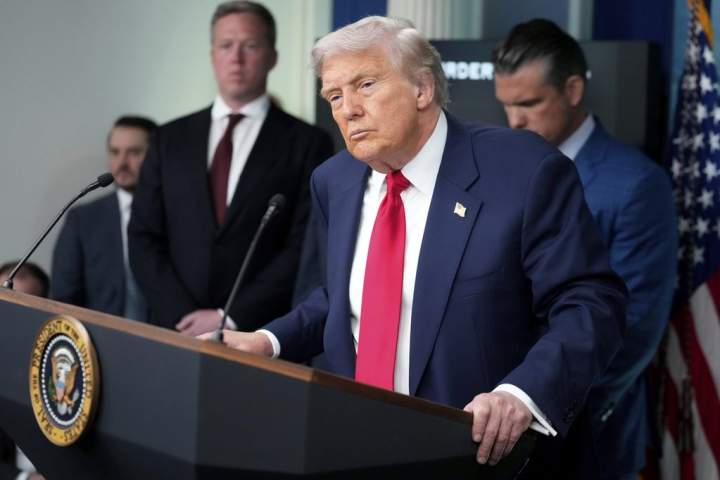
In a surprising move, Army Secretary Dan Driscoll has been appointed as a key negotiator in the Trump administration’s efforts to resolve the ongoing conflict between Russia and Ukraine. This appointment, announced just days ago, has elevated Driscoll from managing military logistics to engaging in high-stakes diplomacy.
Driscoll, a veteran of the Iraq War and a former venture capitalist, quickly transitioned from presenting U.S. President Donald Trump‘s proposal to Ukrainian President Volodymyr Zelenskyy in Kyiv to negotiations with Russian officials in the United Arab Emirates. His recent activities included discussions in Abu Dhabi on May 1 and 2, 2023, aimed at reaching a ceasefire agreement.
The administration’s confidence in Driscoll’s capabilities was evident through Trump’s statements on social media, where he noted that “my team has made tremendous progress.” He further indicated that he had directed his Special Envoy Steve Witkoff to meet with President Vladimir Putin in Moscow while Driscoll engaged with Ukrainian leaders.
Driscoll’s appointment is unexpected, given that his confirmation hearing in February focused primarily on modernizing U.S. Army systems and enhancing military recruitment. According to a U.S. official who spoke on condition of anonymity, Driscoll was initially scheduled to visit Ukraine to gain insights into its military use of drones rather than to negotiate peace.
Upon arriving in Kyiv, Driscoll met with Zelenskyy, expressing admiration for the resilience of Ukrainian forces. He remarked, “When we the Army look and see how well you guys have done, it’s remarkable.” Following this meeting, Driscoll traveled to Geneva to further discuss the peace proposal with top negotiators before heading to Abu Dhabi.
The rapid evolution of Driscoll’s role has raised eyebrows among experts, who view it as a bold but uncertain strategy by the Trump administration. Max Bergmann, director of the Europe, Russia and Eurasia Program at the Center for Strategic and International Studies, stated, “I think what is helpful from this administration is its willingness to throw out ideas and try things.”
Despite his inexperience in international negotiations, Driscoll’s close ties with Vice President JD Vance may provide him with leverage. Bergmann noted that Driscoll’s relationship with Vance could facilitate communication and influence during the negotiations. “There is something to be said about having someone who is probably texting with the vice president and therefore has that political juice,” he added.
Concerns about Driscoll’s qualifications for such a critical role exist. Daniel Fried, a fellow at the Atlantic Council and former U.S. ambassador to Poland, emphasized the importance of having seasoned advisors in high-stakes negotiations. He remarked, “You don’t want to have someone who reaches a handshake deal with the Ukrainians or the Russians and doesn’t have the confidence of the upper reaches of the Trump administration.”
Driscoll’s background, while not indicative of a traditional diplomatic role, reveals his ambitions within politics. During his Senate confirmation hearing, he shared his journey from a public school student in North Carolina to an Army officer and now to Army Secretary. He emphasized his commitment to serving the soldiers, stating, “It is the American soldier to whom our national defense and prosperity are entrusted.”
Educated at the University of North Carolina at Chapel Hill, Driscoll graduated from the business school in three years and served as an armor officer for over three years, achieving the rank of first lieutenant during his deployment to Iraq from October 2009 to July 2010. His post-military career included work in venture capital and a run for Congress in North Carolina’s Republican primary in 2020, where he secured approximately 8% of the vote.
Driscoll’s negotiation experience has primarily revolved around military logistics, such as discussions regarding the Army’s use of a crucial live-fire training range in Hawaii. This issue has faced opposition from local communities and environmental activists, reflecting the complexities Driscoll has navigated in his role.
As Driscoll continues his negotiations in the Middle East, his effectiveness in navigating the intricacies of international diplomacy remains to be seen. His ability to bridge the gap between military leadership and diplomatic engagement will be closely monitored as the Trump administration seeks a resolution to one of the most protracted conflicts in Europe since World War II.

Fem Tech: A New Frontier in Women’s Health or Corporate Exploitation?

Ottawa Charge Coach Carla MacLeod Reveals Breast Cancer Diagnosis

French Firm Atelier Bois d’ici Launches Family-Friendly Tiny XXL Home

Moss Street Market Faces Disruption from Custodian Shortage

Arms Producers Surge to Record Revenue of $679 Billion in 2024

Surrey Schools Honors 243 Retirees at Celebratory Dinner

Ontario’s Healthcare Faces Crisis: Lessons from UK’s Privatization

Thanksgiving Mass Unites Community in Spirit of Gratitude

Wabanaki Artifacts Spark Innovative Collaboration at UNB

Toyoake City Proposes Daily Two-Hour Smartphone Use Limit

B.C. Review Reveals Urgent Need for Rare-Disease Drug Reforms

Pedestrian Fatally Injured in Esquimalt Collision on August 14

Dark Adventure Game “Bye Sweet Carole” Set for October Release

Jimmy Lai’s Defense Challenges Charges Under National Security Law

Victoria’s Pop-Up Shop Shines Light on B.C.’s Wolf Cull

Konami Revives Iconic Metal Gear Solid Delta Ahead of Release

Apple Expands Self-Service Repair Program to Canada

Snapmaker U1 Color 3D Printer Redefines Speed and Sustainability
-
 Science3 months ago
Toyoake City Proposes Daily Two-Hour Smartphone Use Limit
-
 Health3 months ago
B.C. Review Reveals Urgent Need for Rare-Disease Drug Reforms
-
 Top Stories3 months ago
Pedestrian Fatally Injured in Esquimalt Collision on August 14
-
 Technology3 months ago
Dark Adventure Game “Bye Sweet Carole” Set for October Release
-
 World3 months ago
Jimmy Lai’s Defense Challenges Charges Under National Security Law
-
 Lifestyle3 months ago
Victoria’s Pop-Up Shop Shines Light on B.C.’s Wolf Cull
-
 Technology3 months ago
Konami Revives Iconic Metal Gear Solid Delta Ahead of Release
-
 Technology3 months ago
Apple Expands Self-Service Repair Program to Canada
-
 Technology3 months ago
Snapmaker U1 Color 3D Printer Redefines Speed and Sustainability
-

 Technology3 months ago
AION Folding Knife: Redefining EDC Design with Premium Materials
-

 Technology3 months ago
Solve Today’s Wordle Challenge: Hints and Answer for August 19
-

 Business3 months ago
Gordon Murray Automotive Unveils S1 LM and Le Mans GTR at Monterey