
Lifestyle
Downtown Toronto Synagogue Unveils Vibrant Mural to Deter Graffiti

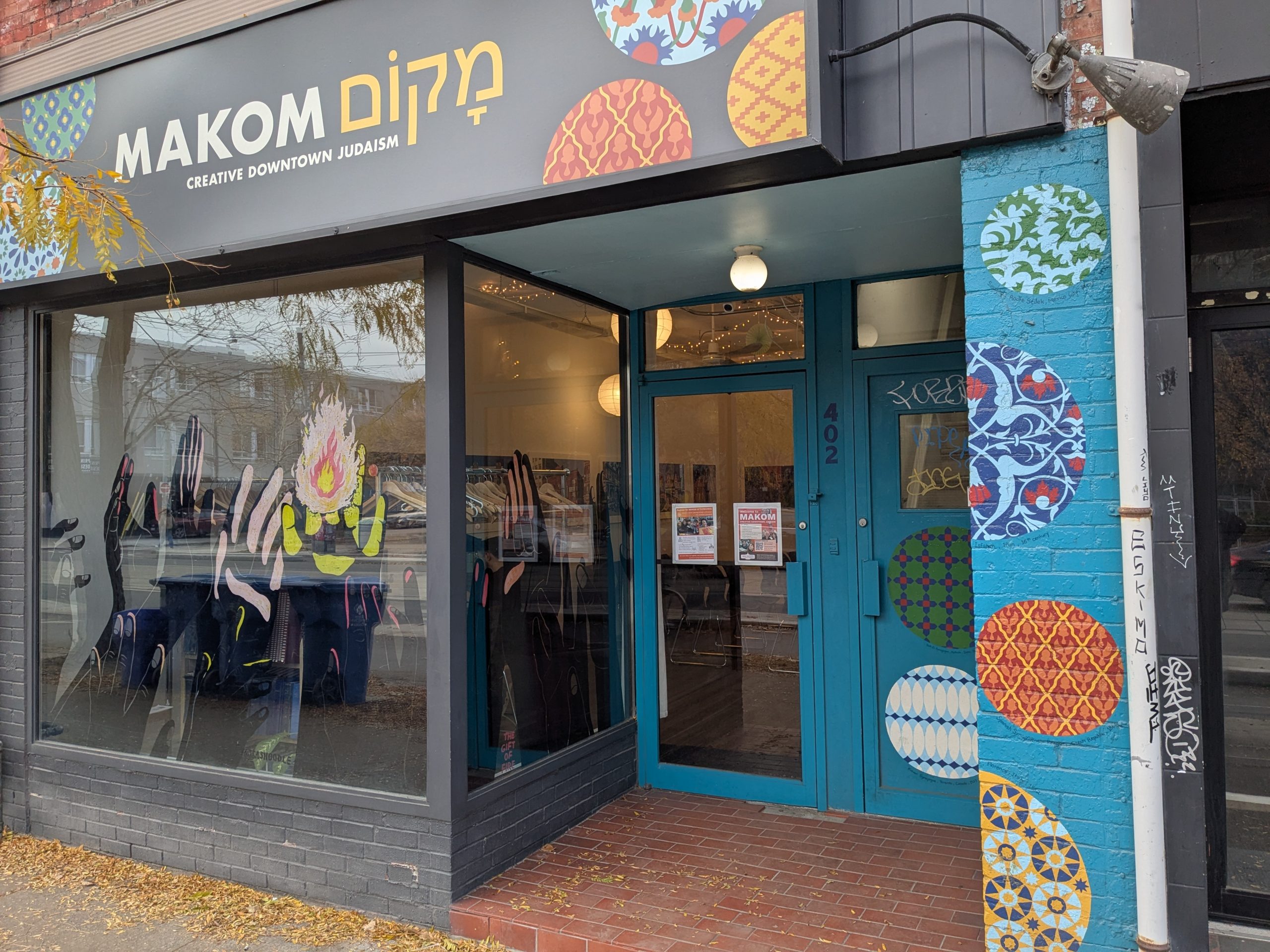
A downtown Toronto synagogue has transformed its exterior with a vibrant mural designed to deter graffiti and enhance the local streetscape. Located on College Street, the egalitarian congregation known as Makom has faced ongoing graffiti issues since it began renting its storefront space in 2016. To address this challenge, the congregation commissioned artist Talie Shalmon to create a mural that not only provides a visual deterrent but also reflects Jewish culture.
Shalmon’s hand-painted mural, completed in early 2024, features intricate patterns inspired by designs from synagogues worldwide, each encircled on a bright aqua-teal backdrop. The mural references a total of 15 synagogues, including the historic Kiever Synagogue in Toronto and Nusach Hoari in Montreal, along with other places of worship from as far as Morocco and Brazil. Each design is accompanied by notes detailing the synagogue’s name, location, and date of establishment, providing viewers with a rich context.
Rabbi Aaron Levy of Makom explained the mural’s significance, stating, “It’s really a way of situating Makom as a Jewish community in downtown Toronto that’s been around since 2009.” He emphasized that the mural not only beautifies the space but also serves as a symbolic connection to Jewish communities globally.
The mural reflects various historical periods and locations within the synagogues, showcasing patterns that range from the 5th century CE floor tile of the Ein Gedi synagogue to the 1927 stained glass window design of the Kiever synagogue. Rabbi Levy noted, “We wanted artwork that would both make it less likely that you’d be tagged all the time, and also that would present art to all passersby.”
In addition to the mural, Makom has implemented several security measures to combat graffiti, including installing security cameras, tempered glass, and outdoor lighting. The congregation received $15,000 in grant funding from Ontario’s Anti-Hate Security and Prevention (AHSP) program to support these initiatives, which aim to enhance safety and visibility on College Street. The program recently received a funding boost of an additional $12.75 million to further assist community organizations.
Rabbi Levy expressed concern over the potential for politically motivated or antisemitic graffiti in the future. He remarked, “College is a very active street with pedestrians and cyclists and cars. We’re a very visible and accessible Jewish community, and like many downtown buildings, we are getting tagged all the time with graffiti.”
Since the mural’s installation, Rabbi Levy reports an encouraging decline in graffiti incidents in the area it covers. “There’s been no graffiti where there’s a mural,” he stated, although he acknowledged some minor tagging persists on the door adjacent to Makom’s entryway.
Shalmon, who has been creating murals since 2015, shared her passion for public art. “I really like the idea of the art being out in the world where everybody can see it and enjoy it,” she said. For this project, she conducted extensive visual research into historical Jewish patterns, drawing inspiration from a book that showcases synagogues around the world.
“I wanted to show the diversity of synagogues all around the world,” Shalmon explained. “It’s not just patterns from one certain place because we wanted everyone to feel included and show the breadth of Jewish culture.”
In addition to the mural, another artwork titled “The Gift of Fire” by Sasha Semidotski, a Ukrainian illustrator now living in Toronto, was installed on the synagogue’s wide glass storefront. This piece depicts painted black hands surrounding a central fire, symbolizing warmth and community.
Shalmon’s mural has not only beautified the space but has also become a topic of conversation among community members. “It’s bright and colourful, and really adds a lot to the aesthetics of the entryway of Makom,” Rabbi Levy noted. “It’s very warm and inviting, and lots of people comment on it.”
The mural has also created connections between Shalmon and the local community. “Working there, I got to experience it, kind of showing how all the places represented on the wall would have been similar to Makom, as meeting places and places for people to connect,” she said.
As Makom continues to serve its community through various educational programs and services, the mural stands as a testament to resilience and creativity, showcasing how art can transform and protect spaces while fostering a sense of belonging.

Three Officers Injured in Gunfire Exchange with Suspect in Omaha

Stay Alert in Meetings: Expert Tips to Combat Sleepiness

Hamm Institute Welcomes Mark P. Mills as Distinguished Fellow

Dimmick School Third Graders Launch ‘Small School, Big Hearts’ Toy Drive

Quantum Computing Breakthrough Promises Faster Drug Development

Nurses Warn of More Manitoba Health Centres Facing Grey-Listing

Algoma Steel’s Planned Layoffs Confirmed by CEO Amid $500M Loan

Palestinian Women Enrich Book Club Amid Ongoing Conflict

Bank of Canada to Announce Final Interest Rate Update for 2025

Toyoake City Proposes Daily Two-Hour Smartphone Use Limit

B.C. Review Reveals Urgent Need for Rare-Disease Drug Reforms

Pedestrian Fatally Injured in Esquimalt Collision on August 14

Dark Adventure Game “Bye Sweet Carole” Set for October Release

Jimmy Lai’s Defense Challenges Charges Under National Security Law

Victoria’s Pop-Up Shop Shines Light on B.C.’s Wolf Cull

Konami Revives Iconic Metal Gear Solid Delta Ahead of Release

Apple Expands Self-Service Repair Program to Canada

Snapmaker U1 Color 3D Printer Redefines Speed and Sustainability
-
 Science3 months ago
Toyoake City Proposes Daily Two-Hour Smartphone Use Limit
-
 Health4 months ago
B.C. Review Reveals Urgent Need for Rare-Disease Drug Reforms
-
 Top Stories4 months ago
Pedestrian Fatally Injured in Esquimalt Collision on August 14
-
 Technology3 months ago
Dark Adventure Game “Bye Sweet Carole” Set for October Release
-
 World3 months ago
Jimmy Lai’s Defense Challenges Charges Under National Security Law
-
 Lifestyle4 months ago
Victoria’s Pop-Up Shop Shines Light on B.C.’s Wolf Cull
-
 Technology4 months ago
Konami Revives Iconic Metal Gear Solid Delta Ahead of Release
-
 Technology4 months ago
Apple Expands Self-Service Repair Program to Canada
-
 Technology4 months ago
Snapmaker U1 Color 3D Printer Redefines Speed and Sustainability
-

 Technology3 months ago
AION Folding Knife: Redefining EDC Design with Premium Materials
-

 Technology4 months ago
Solve Today’s Wordle Challenge: Hints and Answer for August 19
-

 Business4 months ago
Gordon Murray Automotive Unveils S1 LM and Le Mans GTR at Monterey