
Science
Astronomers Discover Black Hole Bursting with Unprecedented Energy

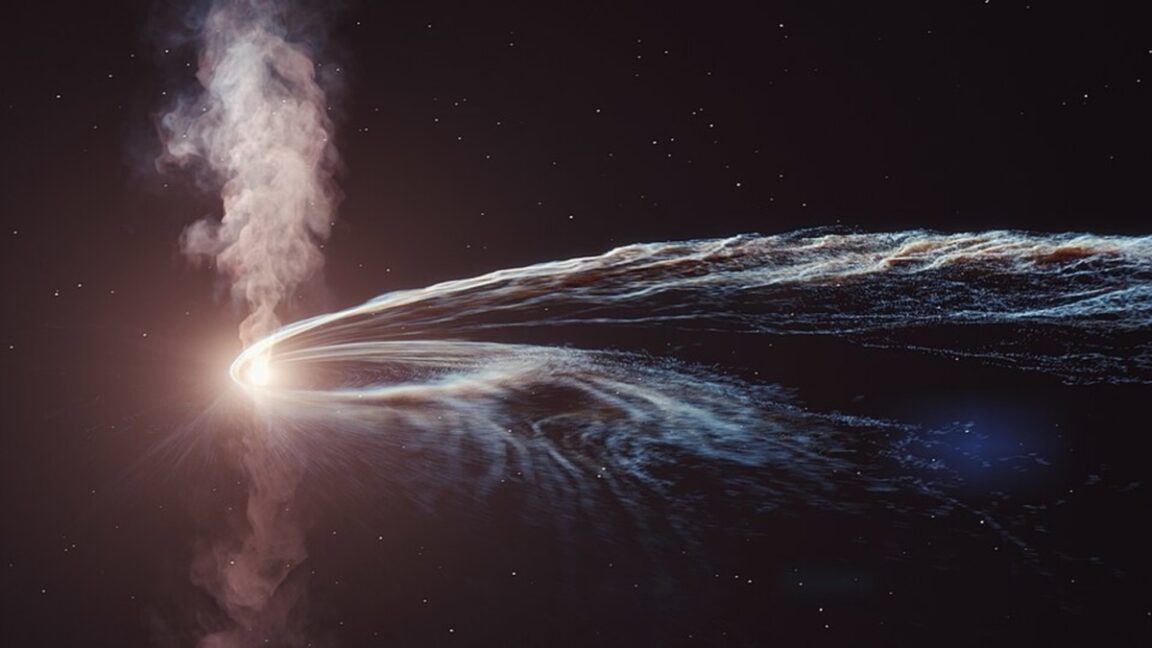
Astronomers have made a remarkable discovery regarding a black hole known as AT2018hyz, affectionately nicknamed “Jetty McJetface.” Initially observed in 2018, this black hole experienced a “tidal disruption event” (TDE) that faded, only to unexpectedly reemerge, emitting exceptionally bright radio waves. According to a recent study published in the Astrophysical Journal, this black hole has become 50 times brighter and is expected to continue increasing in brightness, possibly reaching its peak by 2027.
The phenomenon of a TDE occurs when a star approaches a black hole and is torn apart by its powerful gravitational forces, a process colloquially known as “spaghettification.” While a portion of the star’s mass is swallowed by the black hole, a significant amount is ejected outward, forming an accretion disk that emits X-rays and visible light. These jets of material serve as indirect indicators of a black hole’s presence.
Initially, when AT2018hyz was discovered, radio telescopes were unable to detect any outflow emissions in the early months following the TDE. As noted by Yvette Cendes, an astrophysicist at the University of Oregon and co-author of the study, this is true for approximately 80 percent of TDEs, leading astronomers to focus their efforts on other celestial events.
However, a few years later, data from the Very Large Array (VLA) revealed that Jetty had reignited, releasing material at an astonishing rate of 1.4 millijansky at 5 GHz. Since then, its brightness has grown exponentially, with estimates suggesting that its energy emissions could be as much as 100 trillion times greater than that of the fictional Death Star from the Star Wars saga.
The initial elusiveness of Jetty McJetface can be attributed to the directionality of its emissions. It appears that the black hole is producing a single jet that may not have been oriented towards Earth, complicating early detection efforts. Astronomers anticipate that further observations will clarify this once the energy peaks.
Cendes and her team are now actively searching for similar behavior in other high-energy TDEs. The existence of Jetty indicates that delayed outflows may be more common than previously thought, a finding that could reshape current understanding of these cosmic events. As Cendes aptly pointed out, “If you have an explosion, why would you expect there to be something years after the explosion happened when you didn’t see something before?”
The ongoing monitoring of AT2018hyz highlights the dynamic nature of black holes and the complexities involved in their study. Researchers are eager to explore the potential implications of these findings and what they may reveal about the life cycles of stars and the behavior of black holes in our universe.

Three Peel Regional Police Officers Suspended Amid Corruption Probe

Community Unit School District 300 Seeks New Principal for Jacobs High

Federal Government Allocates $15 Million for Prince Albert Centre

Canadian Wins $303,000 Lottery Prize and Announces Retirement

NASA Delays Artemis II Launch Due to Hydrogen Leak Concerns

GSK Shares Rise for Seven Consecutive Sessions, Up 22% This Year

Major Therapy Apps Expose User Data, Risking Privacy Breaches

Strengthening Business Dialogue: The Role of B.C. Chambers of Commerce

Ski Jumping Officials Deny Penis Enhancement Rumors Amid Controversy

Toyoake City Proposes Daily Two-Hour Smartphone Use Limit

Pedestrian Fatally Injured in Esquimalt Collision on August 14

Dark Adventure Game “Bye Sweet Carole” Set for October Release

B.C. Review Reveals Urgent Need for Rare-Disease Drug Reforms

Victoria’s Pop-Up Shop Shines Light on B.C.’s Wolf Cull

Jimmy Lai’s Defense Challenges Charges Under National Security Law

Konami Revives Iconic Metal Gear Solid Delta Ahead of Release

Snapmaker U1 Color 3D Printer Redefines Speed and Sustainability

Apple Expands Self-Service Repair Program to Canada
-
 Science6 months ago
Toyoake City Proposes Daily Two-Hour Smartphone Use Limit
-
 Top Stories6 months ago
Pedestrian Fatally Injured in Esquimalt Collision on August 14
-
 Technology6 months ago
Dark Adventure Game “Bye Sweet Carole” Set for October Release
-
 Health6 months ago
B.C. Review Reveals Urgent Need for Rare-Disease Drug Reforms
-
 Lifestyle6 months ago
Victoria’s Pop-Up Shop Shines Light on B.C.’s Wolf Cull
-
 World6 months ago
Jimmy Lai’s Defense Challenges Charges Under National Security Law
-
 Technology6 months ago
Konami Revives Iconic Metal Gear Solid Delta Ahead of Release
-
 Technology6 months ago
Snapmaker U1 Color 3D Printer Redefines Speed and Sustainability
-
 Technology6 months ago
Apple Expands Self-Service Repair Program to Canada
-

 Technology6 months ago
AION Folding Knife: Redefining EDC Design with Premium Materials
-

 Technology6 months ago
Solve Today’s Wordle Challenge: Hints and Answer for August 19
-

 Business6 months ago
Gordon Murray Automotive Unveils S1 LM and Le Mans GTR at Monterey