
Lifestyle
Vancouver’s SkyTrain Draws Inspiration from Vienna’s U-Bahn Design

When Metro Vancouver’s SkyTrain system was inaugurated on December 11, 1985, it showcased a revolutionary approach to urban transit. This fully automated, driverless rail system was among the largest of its kind globally at that time, coinciding with the anticipation of the Expo ’86 World’s Fair. The original line, now known as the Expo Line, was constructed in phases from 1982 to 1994, beginning with the route between Waterfront Station and New Westminster Station. Subsequent phases extended the line to Columbia Station in 1989, Scott Road Station in 1991, and King George Station in 1994.
The Expo and Millennium lines underwent significant reconfiguration in 2016 to prepare for the Evergreen extension, leading to changes in station classifications. Currently, the Expo Line is set to undergo its most substantial extension yet, with the Surrey-Langley SkyTrain extension adding 16 kilometers and eight new stations to the network.
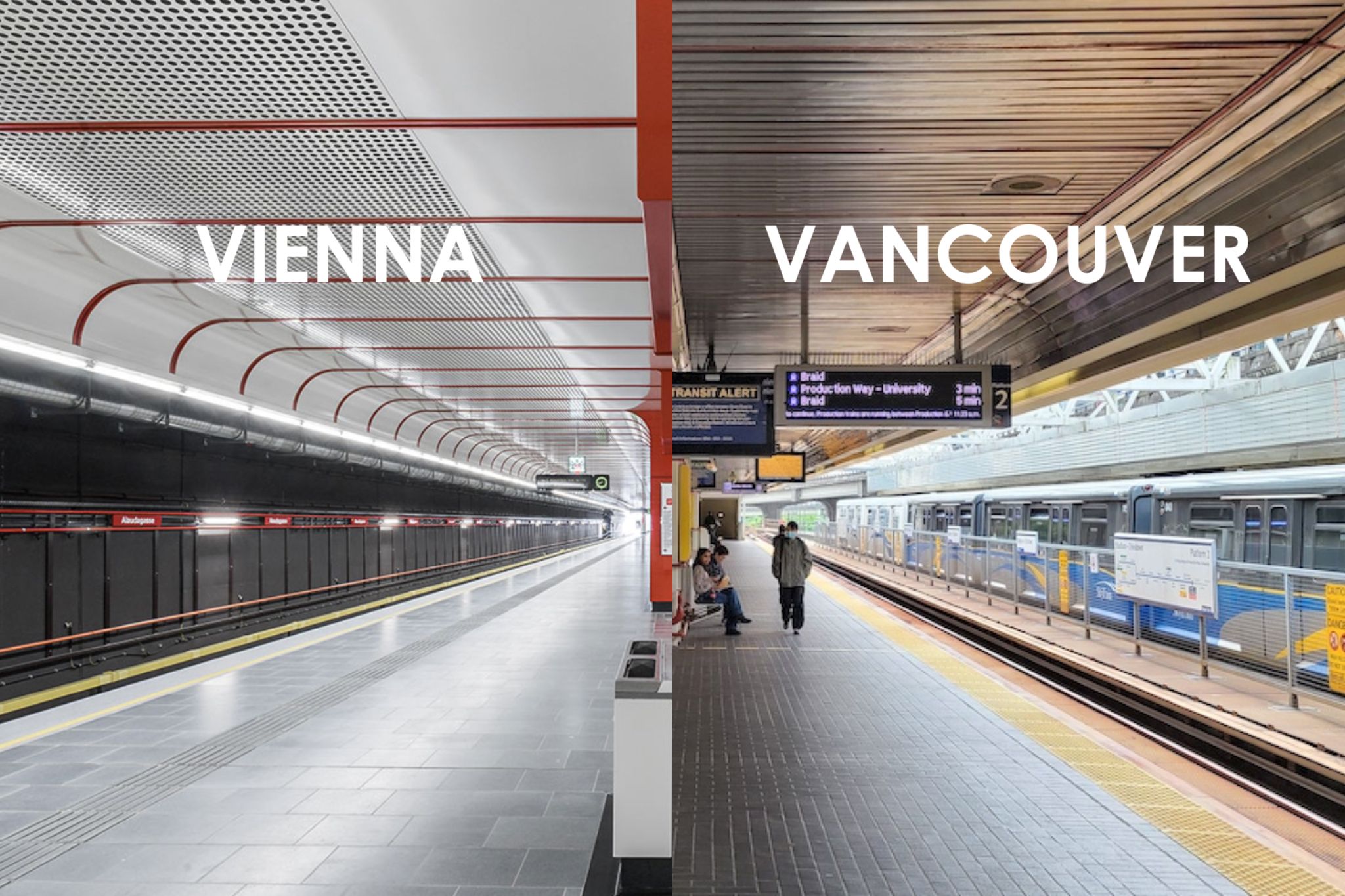
The architectural foundations of the original SkyTrain stations are often overshadowed by their technological achievements. Notably, the design of these stations drew inspiration from the European Vienna U-Bahn metro system. In the early 1980s, the provincial government, then operating through BC Transit, chose the Austrian architectural firm Architektengruppe U-Bahn (AGU) for the task. AGU had recently designed modern stations for the Vienna U-Bahn, and their influence is evident in the structure and aesthetics of Vancouver’s early SkyTrain stations.
European Influence on Vancouver’s Transit Design
Between 1982 and 1986, AGU collaborated closely with Vancouver-based Allen Parker & Associates to develop the design for the Expo Line’s initial stations. This partnership resulted in stations that were not only functional but also reflected a European design ethos, establishing a unique character for Vancouver’s public transit system. The minimalist, human-scaled design principles seen in Vienna’s U-Bahn stations contributed to efficient layouts and distinctive architectural features in Vancouver.
Photographic evidence, including images shared by local transit advocate Darryl Dela Cruz, highlights striking similarities between the two systems. Both feature standardized designs and materials that facilitated the rapid construction of the Expo Line, which extended 21 kilometers and included 15 stations to meet the deadlines for Expo ’86. The first station, Main Street-Science World, was completed in 1983, showcasing a prototype SkyTrain line.
While the visual elements of the early SkyTrain stations, such as rounded structural forms and hoop-truss architecture, remain evident today, they have not aged equally. Vienna’s original stations have been well-maintained, preserving their condition over decades. In contrast, Vancouver’s early stations exhibit signs of wear and dirt, with some of the original design elements disappearing during renovations, particularly at major stations like Commercial-Broadway and Metrotown.
Legacy and Future Directions in SkyTrain Design
Subsequent phases of the Expo Line and the Millennium Line took different design approaches. The original Millennium Line stations, built in the early 2000s, embraced a more diverse and expressive architectural style, resulting in unique station identities rather than a standardized template. Notably, Brentwood Town Centre Station, designed by Busby + Associates Architects, received accolades for its sophisticated glass structure and wooden elements.
Recent construction endeavors, including the Evergreen extension and the upcoming stations on the Surrey-Langley extension, reflect a return to more standardized designs, prioritizing functionality and cost-efficiency. The design philosophy aims to balance modern minimalism with contemporary aesthetics, ensuring stations are both inviting and practical.
Interestingly, the new Expo Line extension will incorporate unique colored glass panels at each station, enhancing passenger experience and providing informal wayfinding cues. Each color will resonate with the local landscape and history, creating a visually distinct identity for each station while maintaining a cohesive design approach.
As Vancouver’s SkyTrain system evolves, it continues to draw from its European roots while adapting to meet modern transit needs. This blend of past influences and future-oriented design ensures that the SkyTrain remains a vital component of Metro Vancouver’s public transportation network, shaping the region’s identity and urban landscape.

Chicago Bears Stun Packers with Overtime Comeback Victory

Australian PM Orders Review of Security Agencies After Bondi Attack

International Students at USask Face Tuition Hikes, Express Concerns

Bronte Village Condo Project Faces Receivership and Road Changes

LaSalle Firefighters Spread Holiday Cheer Through Toy Drive

Thunder Duo Max Delivers Immersive 5.1.2 Atmos Sound with Four Speakers

Calgary Flames Overpower Vegas Golden Knights 6-3 with Backlund’s Brilliance

Australian PM Orders Review After Deadly Bondi Beach Attack

International Students at USask Face Tuition Hikes, Express Concerns

Toyoake City Proposes Daily Two-Hour Smartphone Use Limit

Pedestrian Fatally Injured in Esquimalt Collision on August 14

B.C. Review Reveals Urgent Need for Rare-Disease Drug Reforms

Dark Adventure Game “Bye Sweet Carole” Set for October Release

Jimmy Lai’s Defense Challenges Charges Under National Security Law

Victoria’s Pop-Up Shop Shines Light on B.C.’s Wolf Cull

Konami Revives Iconic Metal Gear Solid Delta Ahead of Release

Apple Expands Self-Service Repair Program to Canada

Snapmaker U1 Color 3D Printer Redefines Speed and Sustainability
-
 Science4 months ago
Toyoake City Proposes Daily Two-Hour Smartphone Use Limit
-
 Top Stories4 months ago
Pedestrian Fatally Injured in Esquimalt Collision on August 14
-
 Health4 months ago
B.C. Review Reveals Urgent Need for Rare-Disease Drug Reforms
-
 Technology4 months ago
Dark Adventure Game “Bye Sweet Carole” Set for October Release
-
 World4 months ago
Jimmy Lai’s Defense Challenges Charges Under National Security Law
-
 Lifestyle4 months ago
Victoria’s Pop-Up Shop Shines Light on B.C.’s Wolf Cull
-
 Technology4 months ago
Konami Revives Iconic Metal Gear Solid Delta Ahead of Release
-
 Technology4 months ago
Apple Expands Self-Service Repair Program to Canada
-
 Technology4 months ago
Snapmaker U1 Color 3D Printer Redefines Speed and Sustainability
-

 Technology4 months ago
AION Folding Knife: Redefining EDC Design with Premium Materials
-

 Technology4 months ago
Solve Today’s Wordle Challenge: Hints and Answer for August 19
-

 Business4 months ago
Gordon Murray Automotive Unveils S1 LM and Le Mans GTR at Monterey