
World
Carney’s Alberta Energy Deal Aims to Strengthen Canada’s Trade Position

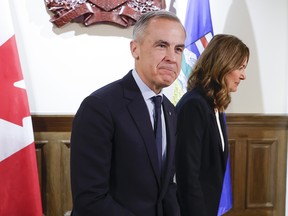
The Canadian government has announced a new energy deal with Alberta, which includes plans for an oil pipeline to the West Coast. Prime Minister Mark Carney is seeking to establish a new export route as a strategic move to enhance Canada’s leverage in trade negotiations with the United States. This initiative raises two critical questions: how will it affect U.S. President Donald Trump and his administration’s tariff policies, and will the proposed pipeline ultimately be constructed?
Some analysts suggest that increasing oil exports to Asia could empower Canada in future discussions with the White House. According to Heather Exner-Pirot, a senior fellow at the Macdonald-Laurier Institute, the potential for higher oil prices driven by competition from Asian buyers might incentivize the United States to negotiate more favorably. “If I were the United States, I’d have a little bit of fear of missing out,” she stated, indicating that this could lead to more cooperative trade relations.
Economic Implications of the Pipeline
Martha Hall Findlay, director of the School of Public Policy at the University of Calgary, echoed these sentiments, asserting that additional energy export options would bolster Canada-U.S. trade ties. She emphasized that the ability to export oil to Asia could compel American buyers to offer better prices, enhancing Canada’s economic standing.
Support for the pipeline extends beyond Canadian analysts. Andrew Hale, a senior policy analyst at the conservative think tank Heritage Foundation, remarked that a pipeline to the West Coast could significantly alter Canada-U.S. relations. “If you’re going to tariff all of our stuff, and then expect us to impose the same tariffs on China, that’s unreasonable,” he noted, suggesting that a new pipeline could empower Canada in negotiations.
The proposed pipeline is viewed as a means to access a growing demand for oil in Asia, potentially doubling non-U.S. exports by 2035. Proponents argue that this would complement U.S. exports rather than replace them, enhancing Canada’s economic footprint as global markets shift focus from the Atlantic to the Pacific.
Challenges and Opposition
Despite optimistic projections, opposition from environmental groups and First Nations communities poses a significant challenge to Carney’s ambitions. Opposition is particularly strong in British Columbia, where concerns over oil spills and environmental degradation are prevalent. The Assembly of First Nations recently voted unanimously to call for the withdrawal of the pipeline deal, reflecting deep-rooted apprehensions among Indigenous leaders.
David Tindall, a sociology professor at the University of British Columbia, pointed out that while public polling may show support for new pipelines, the local sentiment in British Columbia is cautious. “There’s a lot of talk about the risk of oil spills,” he noted, indicating that community concerns could hinder the project’s progress.
Even among supporters, there is acknowledgment of the complexities involved. “The producers aren’t going to enhance production if they don’t know they have egress, and the pipeliners aren’t going to build a pipeline unless they know the producers are going to increase production,” Hall Findlay explained, highlighting a classic “chicken and egg” dilemma.
Time may be an ally for Carney, as recent announcements from companies like Enbridge regarding expansions indicate a growing industry momentum. Exner-Pirot expressed optimism about the future of the pipeline, suggesting completion could be achievable by 2031.
While the energy deal presents an opportunity for Canada to enhance its trade relations and assert itself as a reliable energy supplier, the path forward remains fraught with obstacles. Balancing economic aspirations with environmental responsibilities and community concerns will be crucial as Carney navigates this complex landscape.

Meta Plans Major Layoffs as AI Costs Surge

Alberta’s Referendum Could Pave Way for U.S. Statehood

Minooka District 201 Plans Enhanced Bilingual Support for Students

Canmore Approves Multiple Development Permits for New Projects

Remembering Bradly Castillo Shearsmith: A Life of Friendship and Joy

BIS Urges Watchdogs to Integrate Synthetic Risk Transfers in Stress Tests

Teva Transforms: Shifting Focus from Generics to Branded Success

Apple Launches AirPods Max 2 with Enhanced Audio Features

Ontario Ends Funding for Seven Supervised Injection Sites

Toyoake City Proposes Daily Two-Hour Smartphone Use Limit

Pedestrian Fatally Injured in Esquimalt Collision on August 14

B.C. Review Reveals Urgent Need for Rare-Disease Drug Reforms

Dark Adventure Game “Bye Sweet Carole” Set for October Release

Konami Revives Iconic Metal Gear Solid Delta Ahead of Release

Victoria’s Pop-Up Shop Shines Light on B.C.’s Wolf Cull

Jimmy Lai’s Defense Challenges Charges Under National Security Law

Snapmaker U1 Color 3D Printer Redefines Speed and Sustainability

Apple Expands Self-Service Repair Program to Canada
-
 Science12 months ago
Toyoake City Proposes Daily Two-Hour Smartphone Use Limit
-
 Top Stories12 months ago
Pedestrian Fatally Injured in Esquimalt Collision on August 14
-
 Health12 months ago
B.C. Review Reveals Urgent Need for Rare-Disease Drug Reforms
-
 Technology12 months ago
Dark Adventure Game “Bye Sweet Carole” Set for October Release
-
 Technology12 months ago
Konami Revives Iconic Metal Gear Solid Delta Ahead of Release
-
 Lifestyle12 months ago
Victoria’s Pop-Up Shop Shines Light on B.C.’s Wolf Cull
-
 World12 months ago
Jimmy Lai’s Defense Challenges Charges Under National Security Law
-
 Technology12 months ago
Snapmaker U1 Color 3D Printer Redefines Speed and Sustainability
-
 Technology12 months ago
Apple Expands Self-Service Repair Program to Canada
-

 Technology12 months ago
AION Folding Knife: Redefining EDC Design with Premium Materials
-

 Technology12 months ago
Solve Today’s Wordle Challenge: Hints and Answer for August 19
-

 Business12 months ago
Gordon Murray Automotive Unveils S1 LM and Le Mans GTR at Monterey