
Education
McGill’s Osler Library Showcases Rare Early Medical Books

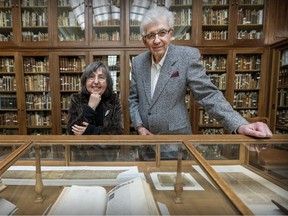
McGill University’s Osler Library of the History of Medicine has unveiled a rare exhibition featuring early medical texts, including three editions of Pliny’s *Historia naturalis*. These editions, published in Germany during the 15th century, are remarkable not only for their content but also for their intricate hand-decorations, which were crafted by talented Italian artisans for affluent buyers. The exhibition, which runs until April 2, offers visitors a glimpse into the rich history of medical literature that remains largely unknown to the public in Montreal.
Curator Brenda Dunn-Lardeau, an associate professor of medieval and Renaissance literature at Université du Québec à Montréal, emphasized the significance of these texts during a recent tour. “Here we have a very, very precious Pliny cluster,” she remarked. Recognized as a foundational work in natural science, Pliny’s writings were essential resources for medical professionals of the time.
Dr. Rolando Del Maestro, director of McGill’s Neurosurgical Simulation and Artificial Intelligence Learning Centre, highlighted the importance of these texts in the context of modern education. He presented a modern reproduction of the *Fasciculus Medicina*, an Italian translation from 1493 that features woodcuts depicting a physician’s library with Pliny’s work prominently displayed. “It’s rather amazing,” Del Maestro noted, referring to the historical connection between the original texts and their modern significance.
Historical Context and Impact
The exhibition also serves as a tribute to William Osler, a prominent physician often regarded as the “father of modern medicine.” Upon his death in 1919, Osler bequeathed thousands of volumes, including numerous incunabula, to McGill University, establishing a library that has become a cornerstone of medical education. Osler’s contributions to the field included promoting humanism in medicine, advocating for a patient-centered approach that emphasized the importance of direct interaction between doctors and patients.
Incunabula, defined as books printed before 1500, represent a pivotal moment in the history of publishing. According to Dunn-Lardeau, these texts emerged during a time of significant experimentation and innovation in printing. While the majority of early printed works were religious texts, approximately one-quarter were medical, underscoring the importance of scientific literature in this era.
The Osler Library holds one of Canada’s largest collections of incunabula, with nearly 300 items, many of which are drawn from its own archives and McGill’s department of rare books and special collections. Dunn-Lardeau focused on illuminated and illustrated texts for this exhibition, aiming to showcase the artistry involved in their creation.
The Art of Illumination
With the rise of the printing press, the production of books transitioned from ornate handwritten manuscripts to mass-produced editions. Wealthy buyers often sought to personalize their plain copies by commissioning illuminators to decorate them. This process included intricate illustrations, decorative borders, and personalized insignias, transforming these incunabula into luxury items. Dunn-Lardeau remarked on the cultural significance of this trend, noting that the attention given to scientific texts reflected a broader respect for knowledge beyond religious or literary works.
Research into the artisans responsible for these decorations has been a key focus for Dunn-Lardeau. While many illuminators did not sign their work, she has successfully linked some pieces, such as a finely decorated edition of Pliny, to known artists based on stylistic traits and color choices. Another intriguing mystery remains: Osler commissioned a young woman to illuminate a 1478 copy of Celsus’s *De medicina liber*, but her identity remains unknown.
Dunn-Lardeau aims to compile a catalogue of all incunabula in Quebec, as various smaller collections exist at other universities and institutions. The Osler Library, however, stands out as the most significant repository of early medical texts in the province.
Mary Hague-Yearl, the head librarian at the Osler, expressed the exhibition’s dual purpose of showcasing the library’s treasures and enriching scholarly understanding. “There is something that is deeply touching about interacting with those materials,” she stated, emphasizing the connection between the past and present in medical history.
The Osler Library houses over 100,000 items, including rare manuscripts and historical documents, such as the correspondence of Osler and other key figures in medicine. Dr. Mario Molina, a physician and member of the library’s board, referred to it as “one of the finest medical-historical libraries in North America.” He noted that its significance extends beyond its collection; it serves as a vital resource for researchers and medical professionals from around the globe.
Despite its extensive offerings, the Osler Library faces challenges common to many cultural institutions, including limited funding. The library relies on philanthropy to support its operations, as Osler’s original bequest did not include a substantial endowment. Recently, the library raised $4 million to secure the head librarian’s position in perpetuity, ensuring continued access to its valuable resources.
In an age increasingly dominated by artificial intelligence and genomic medicine, the relevance of historical medical texts becomes more pronounced. Molina remarked, “We’ve forgotten that disease is only a part of this. Illness is the whole experience that that person has.” He stressed the importance of understanding the human aspect of medicine, a principle championed by Osler and reflective of ancient Greek philosophy.
Dr. David Wolf, a professor at Cornell University and president-elect of the American Osler Society, advocates for the digitization of such texts to improve accessibility. However, he warns that vital contextual elements may be lost in the process. Exhibitions like the one at the Osler Library play a crucial role in promoting the values Osler espoused, bridging the gap between historical knowledge and contemporary medical practice.
The ongoing commitment to preserving and showcasing these early medical texts highlights the importance of understanding the foundations of medicine and the enduring legacy of figures like Osler. As the field continues to evolve, the lessons of the past remain invaluable for future generations of medical professionals.

Meta Plans Major Layoffs as AI Costs Surge

Alberta’s Referendum Could Pave Way for U.S. Statehood

Minooka District 201 Plans Enhanced Bilingual Support for Students

Canmore Approves Multiple Development Permits for New Projects

Remembering Bradly Castillo Shearsmith: A Life of Friendship and Joy

BIS Urges Watchdogs to Integrate Synthetic Risk Transfers in Stress Tests

Teva Transforms: Shifting Focus from Generics to Branded Success

Apple Launches AirPods Max 2 with Enhanced Audio Features

Ontario Ends Funding for Seven Supervised Injection Sites

Toyoake City Proposes Daily Two-Hour Smartphone Use Limit

Pedestrian Fatally Injured in Esquimalt Collision on August 14

B.C. Review Reveals Urgent Need for Rare-Disease Drug Reforms

Dark Adventure Game “Bye Sweet Carole” Set for October Release

Konami Revives Iconic Metal Gear Solid Delta Ahead of Release

Jimmy Lai’s Defense Challenges Charges Under National Security Law

Victoria’s Pop-Up Shop Shines Light on B.C.’s Wolf Cull

Snapmaker U1 Color 3D Printer Redefines Speed and Sustainability

Apple Expands Self-Service Repair Program to Canada
-
 Science11 months ago
Toyoake City Proposes Daily Two-Hour Smartphone Use Limit
-
 Top Stories11 months ago
Pedestrian Fatally Injured in Esquimalt Collision on August 14
-
 Health11 months ago
B.C. Review Reveals Urgent Need for Rare-Disease Drug Reforms
-
 Technology11 months ago
Dark Adventure Game “Bye Sweet Carole” Set for October Release
-
 Technology11 months ago
Konami Revives Iconic Metal Gear Solid Delta Ahead of Release
-
 World11 months ago
Jimmy Lai’s Defense Challenges Charges Under National Security Law
-
 Lifestyle11 months ago
Victoria’s Pop-Up Shop Shines Light on B.C.’s Wolf Cull
-
 Technology11 months ago
Snapmaker U1 Color 3D Printer Redefines Speed and Sustainability
-
 Technology11 months ago
Apple Expands Self-Service Repair Program to Canada
-

 Technology11 months ago
AION Folding Knife: Redefining EDC Design with Premium Materials
-

 Technology11 months ago
Solve Today’s Wordle Challenge: Hints and Answer for August 19
-

 Business11 months ago
Gordon Murray Automotive Unveils S1 LM and Le Mans GTR at Monterey