
World
Japan and US Conduct Joint Air Exercise Amid Rising Tensions

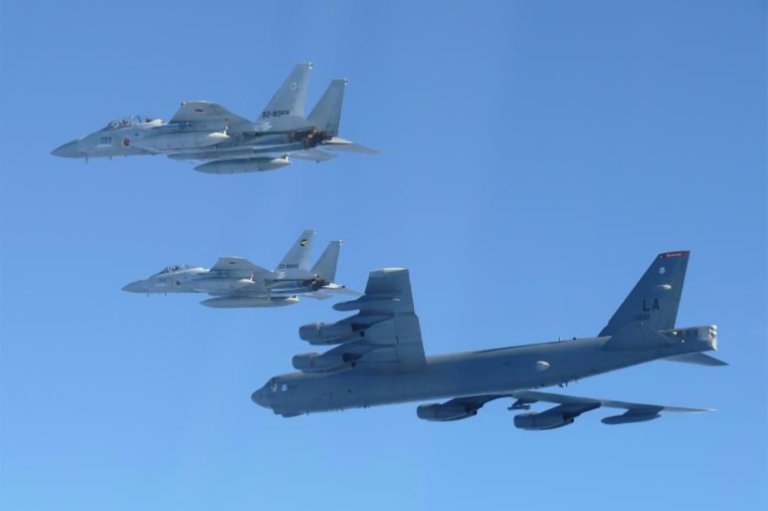
Japan conducted a joint air exercise with the United States on March 13, 2024, as a demonstration of military readiness, following recent patrols by China and Russia in the region. This operation took place amid escalating diplomatic tensions between Tokyo and Beijing, particularly after remarks made by Japanese officials regarding Taiwan.
The Japanese Joint Chiefs of Staff reported that the exercise involved two US B-52 bombers, three Japanese F-35 fighter jets, and three F-15s. It aimed to affirm the commitment of both nations to counter any unilateral attempts to alter the regional status quo by force. The statement emphasized the “strong resolve” of Japan and the United States to maintain security in the face of growing challenges.
On March 12, a day prior to the joint exercise, two Russian Tu-95 nuclear-capable bombers had flown from the Sea of Japan to meet with two Chinese H-6 bombers in the East China Sea. The two groups conducted a joint flight around Japan, prompting the Japanese Self-Defense Forces to scramble fighter jets in response.
Japanese Prime Minister Sanae Takaichi faced backlash from Beijing last month after suggesting that Japan would take military action in the event of a Chinese attack on Taiwan. This statement amplified existing tensions, as China views Taiwan as part of its territory and has not ruled out the use of force to assert its claims.
Japan’s latest military exercise coincided with heightened scrutiny of China’s military maneuvers. On March 9, a Chinese J-15 fighter jet reportedly locked radar onto Japanese aircraft over international waters near Okinawa, prompting the Japanese Air Force to scramble jets for a response. A spokesperson for the US State Department criticized China’s actions, stating, “China’s actions are not conducive to regional peace and stability.”
In the wake of these incidents, Tokyo summoned Beijing’s ambassador to express concerns over the radar lock incident, which both countries have provided differing accounts of. The Chinese Foreign Ministry accused Japan of intruding into its training area and claimed that Japan’s actions were provoking tensions.
Takaichi’s remarks regarding Taiwan have generated particular alarm in China, leading to speculation about the level of support Japan can expect from its ally, the United States. Reports suggest that Tokyo is seeking stronger public backing from US officials concerning its stance on Taiwan’s sovereignty.
In light of the recent developments, NATO Secretary-General Mark Rutte expressed concern over the joint Chinese-Russian military activities, labeling them “regrettable.” Following a video conference with Japanese Defence Minister Shinjiro Koizumi, Rutte affirmed that security in the Indo-Pacific and Euro-Atlantic regions are interconnected.
On March 12, South Korea also reported that Russian and Chinese warplanes had encroached upon its air defense identification zone, prompting a similar response from Seoul, which deployed fighter jets. The joint drills between China and Russia have been described as routine exercises according to both countries, aimed at enhancing military cooperation.
As tensions continue to mount in the region, the recent joint air exercise highlights the strengthening military collaboration between Japan and the United States, underscoring their commitment to addressing security threats posed by both China and Russia.

Meta Plans Major Layoffs as AI Costs Surge

Alberta’s Referendum Could Pave Way for U.S. Statehood

Minooka District 201 Plans Enhanced Bilingual Support for Students

Canmore Approves Multiple Development Permits for New Projects

Remembering Bradly Castillo Shearsmith: A Life of Friendship and Joy

BIS Urges Watchdogs to Integrate Synthetic Risk Transfers in Stress Tests

Teva Transforms: Shifting Focus from Generics to Branded Success

Apple Launches AirPods Max 2 with Enhanced Audio Features

Ontario Ends Funding for Seven Supervised Injection Sites

Toyoake City Proposes Daily Two-Hour Smartphone Use Limit

Pedestrian Fatally Injured in Esquimalt Collision on August 14

B.C. Review Reveals Urgent Need for Rare-Disease Drug Reforms

Dark Adventure Game “Bye Sweet Carole” Set for October Release

Konami Revives Iconic Metal Gear Solid Delta Ahead of Release

Victoria’s Pop-Up Shop Shines Light on B.C.’s Wolf Cull

Jimmy Lai’s Defense Challenges Charges Under National Security Law

Snapmaker U1 Color 3D Printer Redefines Speed and Sustainability

Apple Expands Self-Service Repair Program to Canada
-
 Science11 months ago
Toyoake City Proposes Daily Two-Hour Smartphone Use Limit
-
 Top Stories11 months ago
Pedestrian Fatally Injured in Esquimalt Collision on August 14
-
 Health11 months ago
B.C. Review Reveals Urgent Need for Rare-Disease Drug Reforms
-
 Technology11 months ago
Dark Adventure Game “Bye Sweet Carole” Set for October Release
-
 Technology11 months ago
Konami Revives Iconic Metal Gear Solid Delta Ahead of Release
-
 Lifestyle11 months ago
Victoria’s Pop-Up Shop Shines Light on B.C.’s Wolf Cull
-
 World11 months ago
Jimmy Lai’s Defense Challenges Charges Under National Security Law
-
 Technology11 months ago
Snapmaker U1 Color 3D Printer Redefines Speed and Sustainability
-
 Technology11 months ago
Apple Expands Self-Service Repair Program to Canada
-

 Technology11 months ago
AION Folding Knife: Redefining EDC Design with Premium Materials
-

 Technology11 months ago
Solve Today’s Wordle Challenge: Hints and Answer for August 19
-

 Business11 months ago
Gordon Murray Automotive Unveils S1 LM and Le Mans GTR at Monterey