
Business
Ontario Shifts Focus to Battery Storage Amid EV Supply Chain Challenges

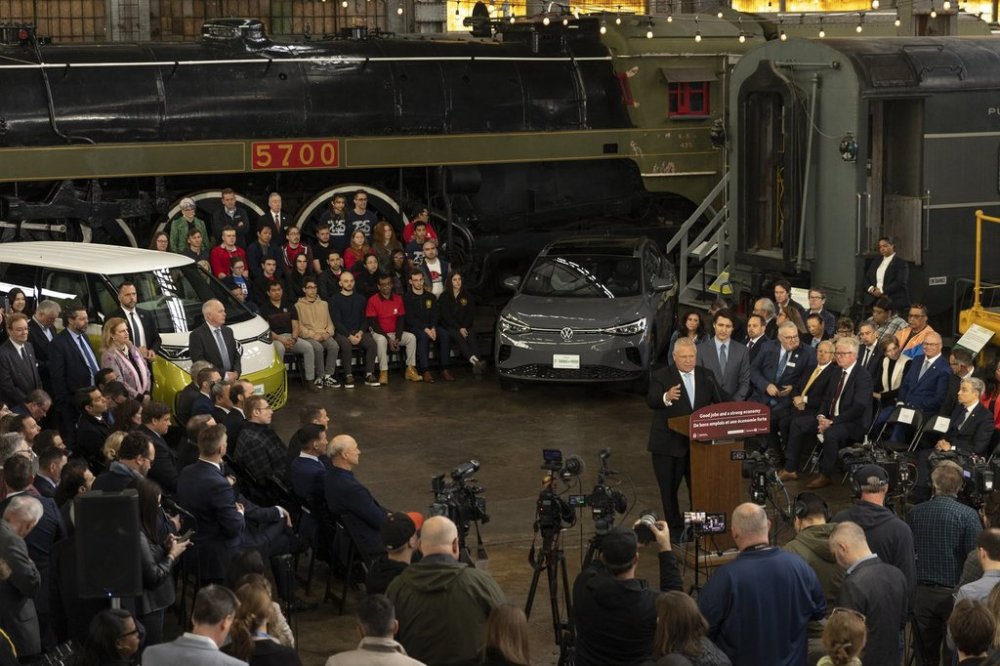
Ontario’s strategy for establishing a comprehensive electric vehicle (EV) supply chain is facing significant hurdles. Premier Doug Ford had once envisioned a robust framework that would see electric vehicles produced entirely within the province. However, recent delays and cancellations by manufacturers necessitate a pivot towards alternative battery solutions to sustain the industry.
Initially, the provincial government, alongside federal authorities, secured commitments for three major electric vehicle battery plants in Ontario—investments totaling billions of dollars. The aim was not only to manufacture batteries locally but also to source components and minerals from within the province. Yet, several manufacturers have since postponed or abandoned their plans, undermining that vision.
Manufacturers Delay Plans Amid Market Uncertainty
Recent developments have cast doubt on Ontario’s ambitions. Honda postponed its plans for an EV battery plant and vehicle assembly in Alliston due to reduced market demand. Similarly, Umicore has halted its intentions for a cathode facility in eastern Ontario. General Motors ceased production of its BrightDrop electric delivery vans in Ingersoll, while Ford opted to prioritize its gas-powered F-Series trucks over electric models in Oakville.
The auto industry in Ontario could face further challenges due to a new trade agreement between Canada and China, which eliminates 100 percent tariffs on Chinese EVs. This move could allow cheaper Chinese vehicles into the Canadian market, potentially boosting overall demand for EVs and providing a long-term benefit to domestic manufacturers, according to some analysts.
Despite the global surge in EV demand, domestic sales in Canada remain sluggish, largely due to uncertainties surrounding federal rebates and trade relations with the United States. This environment has weakened investor confidence, complicating Ontario’s quest for a thriving EV sector.
Stellantis Adapts with Battery Storage Solutions
In a strategic shift, Stellantis is adapting its approach at the NextStar Energy facility in Windsor, Ontario. Although construction and production had begun on EV batteries, the company is now pivoting towards manufacturing batteries for energy storage. Danies Lee, CEO of NextStar, expressed optimism regarding future EV demand, stating that current market needs are shifting towards batteries for storage and other applications, including artificial intelligence.
“As an EV battery manufacturer, we faced a huge setback due to the market conditions, but as a battery manufacturer that deals with all the different applications, it’s a great opportunity,” Lee noted.
Ontario’s Economic Development Minister Vic Fedeli highlighted that this pivot aligns with the provincial government’s goals, maintaining support for the transition towards battery storage. He emphasized that the minerals required for these batteries will still be sourced from Ontario, along with components produced locally. For instance, Asahi Kasei‘s separator facility in the Niagara Region is proceeding as planned, further contributing to the supply chain.
Fedeli clarified that the government is not seeking to intervene to bolster the EV market directly. Instead, he stated, “These are multi-billion dollar, multinational companies who’ve made choices on what to build, and the market has to be there for them.” His comments reflect a pragmatic approach to attracting investment and creating jobs, regardless of the specific products being manufactured.
Just over a year ago, Fedeli expressed strong confidence in Ontario’s EV supply chain, citing continuous yearly growth in electric vehicle sales. Yet, the current landscape presents a stark contrast, prompting a reevaluation of the province’s priorities.
Long-term Prospects for Battery Storage
Experts believe that the demand for electric vehicles will eventually align with global trends, which have seen substantial increases in sales. Joanna Kyriazis, director of policy and strategy at Simon Fraser University, noted that worldwide EV sales broke records in 2025, with significant growth in markets such as China and the European Union.
Sam Fiorani, vice-president of global vehicle forecasting at AutoForecast Solutions, remarked that while the immediate need for EV manufacturing capacity may be limited, investments in battery production will require alternative avenues for profitability in the interim. “Battery and stationary storage is a good idea in the short term,” Fiorani stated.
Even Volkswagen, which is advancing its PowerCo facility in St. Thomas, Ontario, recognizes the potential for storage solutions. The company has indicated that its standardized cell technology can serve both automotive and stationary energy storage applications, showcasing a strategic flexibility in its operations.
Looking ahead, the Royal Bank of Canada’s John Stackhouse emphasized the strategic importance of battery storage technologies. He pointed out that Ontario’s electricity demand is expected to grow by 75 percent by 2050, driven partly by the EV sector and new data centers. Battery storage can provide a reliable electricity supply and stabilize pricing, benefiting various businesses in the province.
“There could be a double win there for Ontario, both through battery storage and the eventual growth of EVs,” Stackhouse concluded, suggesting a potential path forward for the province amidst current challenges.
This report is based on information from The Canadian Press, first published on January 20, 2026.

Meta Plans Major Layoffs as AI Costs Surge

Alberta’s Referendum Could Pave Way for U.S. Statehood

Minooka District 201 Plans Enhanced Bilingual Support for Students

Canmore Approves Multiple Development Permits for New Projects

Remembering Bradly Castillo Shearsmith: A Life of Friendship and Joy

BIS Urges Watchdogs to Integrate Synthetic Risk Transfers in Stress Tests

Teva Transforms: Shifting Focus from Generics to Branded Success

Apple Launches AirPods Max 2 with Enhanced Audio Features

Ontario Ends Funding for Seven Supervised Injection Sites

Toyoake City Proposes Daily Two-Hour Smartphone Use Limit

Pedestrian Fatally Injured in Esquimalt Collision on August 14

B.C. Review Reveals Urgent Need for Rare-Disease Drug Reforms

Dark Adventure Game “Bye Sweet Carole” Set for October Release

Konami Revives Iconic Metal Gear Solid Delta Ahead of Release

Jimmy Lai’s Defense Challenges Charges Under National Security Law

Victoria’s Pop-Up Shop Shines Light on B.C.’s Wolf Cull

Snapmaker U1 Color 3D Printer Redefines Speed and Sustainability

Apple Expands Self-Service Repair Program to Canada
-
 Science11 months ago
Toyoake City Proposes Daily Two-Hour Smartphone Use Limit
-
 Top Stories11 months ago
Pedestrian Fatally Injured in Esquimalt Collision on August 14
-
 Health11 months ago
B.C. Review Reveals Urgent Need for Rare-Disease Drug Reforms
-
 Technology11 months ago
Dark Adventure Game “Bye Sweet Carole” Set for October Release
-
 Technology11 months ago
Konami Revives Iconic Metal Gear Solid Delta Ahead of Release
-
 World11 months ago
Jimmy Lai’s Defense Challenges Charges Under National Security Law
-
 Lifestyle11 months ago
Victoria’s Pop-Up Shop Shines Light on B.C.’s Wolf Cull
-
 Technology11 months ago
Snapmaker U1 Color 3D Printer Redefines Speed and Sustainability
-
 Technology11 months ago
Apple Expands Self-Service Repair Program to Canada
-

 Technology11 months ago
AION Folding Knife: Redefining EDC Design with Premium Materials
-

 Technology11 months ago
Solve Today’s Wordle Challenge: Hints and Answer for August 19
-

 Business11 months ago
Gordon Murray Automotive Unveils S1 LM and Le Mans GTR at Monterey