
World
Carney Responds to Trump’s Critique in Ongoing Diplomatic Tensions

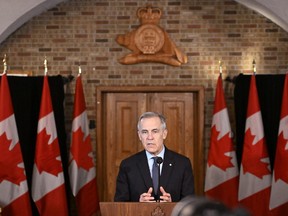
Tensions between Canada and the United States escalated further as former Bank of England Governor Mark Carney addressed comments made by Donald Trump during a speech in Quebec City on March 14, 2024. Following a clash at the World Economic Forum in Davos, Carney firmly rejected Trump’s assertion that Canada’s survival depends on the U.S. Carney declared, “Canada doesn’t live because of the United States. Canada thrives because we are Canadian.” This statement, not included in the prepared text for reporters, highlighted Carney’s intent to adopt a more nationalistic tone amid ongoing diplomatic discussions.
Carney’s speech emphasized Canada’s historical significance, referencing the Plains of Abraham and the 1759 battle between British and French forces. He portrayed Canada as a nation that can showcase diversity as a strength, stating, “In a time of rising populism and ethnic nationalism, Canada can show how diversity can be a strength, not a weakness.” The remarks served as a critique of Trump’s administration, suggesting a stark contrast to the current political climate in the U.S.
In Davos, Carney criticized what he described as the abandonment of a rules-based international order by powerful nations, implying that the U.S. is among those failing to uphold these principles. “The powerful have their power. But we have something, too – the capacity to stop pretending, to name reality,” he asserted. While he did not mention Trump by name, the implications were clear.
Trump responded to Carney’s remarks, reiterating his belief that Canada benefits significantly from its relationship with the U.S. “Canada gets a lot of freebies from us. By the way, they should be grateful also,” Trump stated. He emphasized that Canada “lives because of the United States,” urging Carney to remember this in future statements.
The exchange reflects the ongoing strain in U.S.-Canada relations, particularly over trade agreements and national security. While Canada has historically relied on its proximity to the U.S. for security, recent events have raised questions about the future of this relationship.
During the same week, U.S. Commerce Secretary Howard Lutnick criticized Carney’s comments regarding a pivot towards China, questioning the viability of such a strategy. “China’s delighted to sell to him. But do you think China is going to open their economy to accept exports from Canada? This is the silliest thing I’ve ever seen,” Lutnick contended. His remarks illustrate the skepticism among U.S. officials regarding Canada’s economic strategies.
As discussions around the United States-Mexico-Canada Agreement (USMCA) loom, Lutnick expressed concern about Carney’s approach, suggesting that it may hinder future negotiations. “When USMCA gets renegotiated… do you think the president of the United States is going to say you should keep having the second-best deal in the world?” he asked, alluding to Canada’s trade position.
As the summer approaches, the prospect of renewed negotiations remains uncertain. Carney’s recent speeches indicate a willingness to challenge U.S. policies openly, suggesting a potential shift in Canada’s diplomatic approach. The exchange of words between the two governments underscores a complex relationship marked by both collaboration and contention, as both nations navigate their respective political landscapes.

Meta Plans Major Layoffs as AI Costs Surge

Alberta’s Referendum Could Pave Way for U.S. Statehood

Minooka District 201 Plans Enhanced Bilingual Support for Students

Canmore Approves Multiple Development Permits for New Projects

Remembering Bradly Castillo Shearsmith: A Life of Friendship and Joy

BIS Urges Watchdogs to Integrate Synthetic Risk Transfers in Stress Tests

Teva Transforms: Shifting Focus from Generics to Branded Success

Apple Launches AirPods Max 2 with Enhanced Audio Features

Ontario Ends Funding for Seven Supervised Injection Sites

Toyoake City Proposes Daily Two-Hour Smartphone Use Limit

Pedestrian Fatally Injured in Esquimalt Collision on August 14

B.C. Review Reveals Urgent Need for Rare-Disease Drug Reforms

Dark Adventure Game “Bye Sweet Carole” Set for October Release

Konami Revives Iconic Metal Gear Solid Delta Ahead of Release

Jimmy Lai’s Defense Challenges Charges Under National Security Law

Victoria’s Pop-Up Shop Shines Light on B.C.’s Wolf Cull

Snapmaker U1 Color 3D Printer Redefines Speed and Sustainability

Apple Expands Self-Service Repair Program to Canada
-
 Science11 months ago
Toyoake City Proposes Daily Two-Hour Smartphone Use Limit
-
 Top Stories11 months ago
Pedestrian Fatally Injured in Esquimalt Collision on August 14
-
 Health11 months ago
B.C. Review Reveals Urgent Need for Rare-Disease Drug Reforms
-
 Technology11 months ago
Dark Adventure Game “Bye Sweet Carole” Set for October Release
-
 Technology11 months ago
Konami Revives Iconic Metal Gear Solid Delta Ahead of Release
-
 World11 months ago
Jimmy Lai’s Defense Challenges Charges Under National Security Law
-
 Lifestyle11 months ago
Victoria’s Pop-Up Shop Shines Light on B.C.’s Wolf Cull
-
 Technology11 months ago
Snapmaker U1 Color 3D Printer Redefines Speed and Sustainability
-
 Technology11 months ago
Apple Expands Self-Service Repair Program to Canada
-

 Technology11 months ago
AION Folding Knife: Redefining EDC Design with Premium Materials
-

 Technology11 months ago
Solve Today’s Wordle Challenge: Hints and Answer for August 19
-

 Business11 months ago
Gordon Murray Automotive Unveils S1 LM and Le Mans GTR at Monterey