
World
Relatives of Venezuelan Political Prisoners Launch Hunger Strike

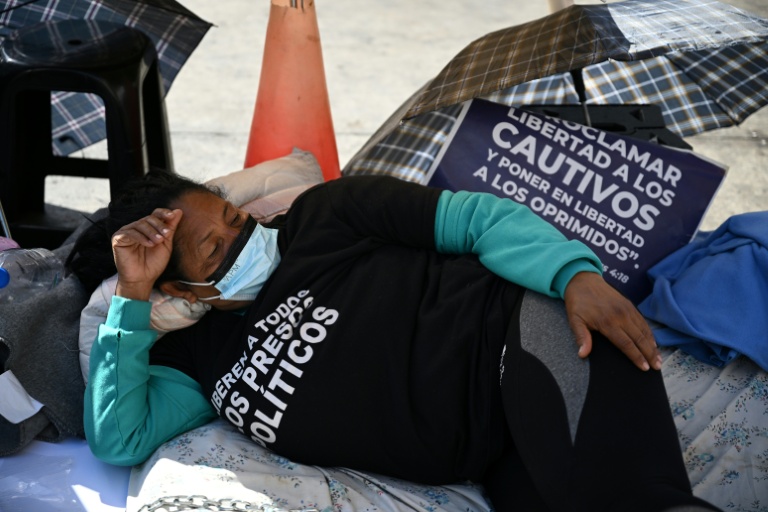
Relatives of political prisoners in Venezuela initiated a hunger strike on March 15, 2024, outside a national police facility in Caracas. This protest follows the release of 17 detainees, as discussions continue over a proposed amnesty law aimed at addressing the long-standing issue of political imprisonment in the country.
About ten women, donning face masks, laid down in a line at the entrance to the facility, known as Zone 7. Many appeared exhausted, with one participant sharing, “Sleeping eases the hunger,” while another, Evelin Quiaro, a mother of a political prisoner, expressed hope that their efforts would lead to broader releases. Quiaro’s son has been detained since November on charges related to terrorism, and she noted that her last meal was consumed around 01:00.
In a social media announcement earlier that morning, Jorge Rodriguez, the President of the National Assembly, confirmed the release of the prisoners but did not disclose their identities. He urged Venezuelans to “continue this path of peace for the construction of democratic coexistence.”
The Context of the Hunger Strike
The amnesty law is central to the reforms introduced by acting President Delcy Rodriguez, who has taken the reins following the ousting of longtime leader Nicolas Maduro during a U.S. special forces operation on January 3, 2024. This legislation aims to redress nearly three decades of state repression by covering all charges against dissidents who opposed both Maduro and his predecessor, Hugo Chavez, over the past 27 years.
The proposed amnesty would encompass charges such as “treason,” “terrorism,” and spreading “hate,” which have been used to justify the imprisonment of political opponents. Despite an initial approval of the bill, lawmakers postponed its adoption after failing to reach a consensus on its implementation. A contentious clause requiring beneficiaries to appear in court for amnesty was a significant point of conflict, leading to an agreement to continue discussions on February 19, 2024.
International Pressure and Domestic Response
U.S. pressure has played a pivotal role in the political landscape of Venezuela. Following her ascension to power with the backing of former U.S. President Donald Trump, Rodriguez has faced increasing demands from Washington to release political prisoners. The U.S. administration has also taken control of Venezuela’s oil sales, signaling a potential shift in profit-sharing dynamics.
According to the non-governmental organization Foro Penal, a total of 431 political prisoners have been conditionally released, while 644 remain incarcerated. As the political climate evolves post-Maduro, the atmosphere of fear that once dominated is beginning to lift, allowing thousands of opposition supporters to rally in Caracas. These demonstrators are calling for the release of all remaining political prisoners, indicating a growing movement for change within the country.
As the situation unfolds, the hunger strike represents a desperate plea from families affected by political incarceration, highlighting the ongoing struggle for human rights and democratic reform in Venezuela.

Meta Plans Major Layoffs as AI Costs Surge

Alberta’s Referendum Could Pave Way for U.S. Statehood

Minooka District 201 Plans Enhanced Bilingual Support for Students

Canmore Approves Multiple Development Permits for New Projects

Remembering Bradly Castillo Shearsmith: A Life of Friendship and Joy

BIS Urges Watchdogs to Integrate Synthetic Risk Transfers in Stress Tests

Teva Transforms: Shifting Focus from Generics to Branded Success

Apple Launches AirPods Max 2 with Enhanced Audio Features

Ontario Ends Funding for Seven Supervised Injection Sites

Toyoake City Proposes Daily Two-Hour Smartphone Use Limit

Pedestrian Fatally Injured in Esquimalt Collision on August 14

B.C. Review Reveals Urgent Need for Rare-Disease Drug Reforms

Dark Adventure Game “Bye Sweet Carole” Set for October Release

Konami Revives Iconic Metal Gear Solid Delta Ahead of Release

Victoria’s Pop-Up Shop Shines Light on B.C.’s Wolf Cull

Jimmy Lai’s Defense Challenges Charges Under National Security Law

Snapmaker U1 Color 3D Printer Redefines Speed and Sustainability

Apple Expands Self-Service Repair Program to Canada
-
 Science11 months ago
Toyoake City Proposes Daily Two-Hour Smartphone Use Limit
-
 Top Stories11 months ago
Pedestrian Fatally Injured in Esquimalt Collision on August 14
-
 Health11 months ago
B.C. Review Reveals Urgent Need for Rare-Disease Drug Reforms
-
 Technology11 months ago
Dark Adventure Game “Bye Sweet Carole” Set for October Release
-
 Technology11 months ago
Konami Revives Iconic Metal Gear Solid Delta Ahead of Release
-
 Lifestyle11 months ago
Victoria’s Pop-Up Shop Shines Light on B.C.’s Wolf Cull
-
 World11 months ago
Jimmy Lai’s Defense Challenges Charges Under National Security Law
-
 Technology11 months ago
Snapmaker U1 Color 3D Printer Redefines Speed and Sustainability
-
 Technology11 months ago
Apple Expands Self-Service Repair Program to Canada
-

 Technology11 months ago
AION Folding Knife: Redefining EDC Design with Premium Materials
-

 Technology11 months ago
Solve Today’s Wordle Challenge: Hints and Answer for August 19
-

 Business11 months ago
Gordon Murray Automotive Unveils S1 LM and Le Mans GTR at Monterey