
Education
Kamloops Residential School Search Identifies New Focus Areas

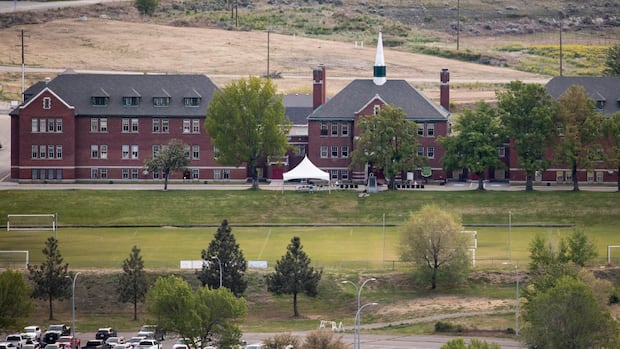
The Tk̓emlúps te Secwépemc First Nation has announced significant developments in its ongoing investigation into the former Kamloops Indian Residential School. Recent assessments have ruled out certain areas on the grounds as unlikely sites for unmarked graves, while other locations have emerged as “the primary focus” for further searches. This announcement follows nearly five years since the First Nation revealed preliminary findings indicating approximately 200 potential unmarked graves at the site, igniting a nationwide movement among Indigenous communities and raising awareness of the tragic legacy of residential schools in Canada.
In a statement released on February 17, 2024, the First Nation acknowledged the investigation’s complexity, stating, “We are making progress and will continue adapting our methodologies and information as it advances.” The ongoing search employs advanced technologies including ground-penetrating radar and a LiDAR (Light Detection and Ranging) scanner, which utilizes rapid laser pulses to create detailed 3D representations of the terrain. Additionally, specialized dog teams trained to detect historic human remains have been deployed to assist in the investigation.
The findings from these various methods have revealed overlaps in certain areas, which are now prioritized for further investigation. While the exact locations of these focus areas have not been disclosed, Tk̓emlúps te Secwépemc has reported that some of the surveys produced “signatures that resemble burials” in specific spots, while others have been ruled out as potential burial sites.
Access to historical records remains a challenge for the investigation. The First Nation is utilizing documents from the Catholic Church, which operated the school from 1890 to 1969, as well as records from provincial and federal governments, the latter of which managed the institution as a day school until its closure in 1978. Difficulties in obtaining these records have arisen due to governmental restrictions and slow response times, complicating the search efforts.
The controversy surrounding excavation at former residential school sites continues to evoke strong opinions. Some survivors advocate for leaving human remains undisturbed, while others believe that exhumation could provide closure and allow for proper memorialization of the victims.
The former Kamloops Indian Residential School, where Tk̓emlúps te Secwépemc’s findings first came to light, has since been designated as a national historic site. More than 150,000 Indigenous children were forcibly placed in residential schools across Canada from the 1870s until 1997, and the National Centre for Truth and Reconciliation estimates that around 4,100 of these children died at various institutions, although the true number is likely significantly higher.
In light of the sensitivity of the investigation, Tk̓emlúps te Secwépemc has emphasized its commitment to consensus-building among the numerous First Nations whose ancestors attended the institution. “Each [nation] upholds its own cultural and spiritual protocols for how ancestral remains must be treated,” the statement noted. The First Nation recognizes that achieving full consensus may not be possible, but it is determined to respect the diverse traditions and beliefs surrounding this sensitive topic.
Support resources are available for individuals affected by the trauma associated with residential schools. A national Indian Residential School Crisis Line has been established, offering emotional and crisis referral services. Survivors and those impacted can reach the 24-hour support line at 1-866-925-4419.
As the investigation continues to evolve, the Tk̓emlúps te Secwépemc First Nation remains committed to uncovering the truth and honoring the memories of those lost to the residential school system.

Meta Plans Major Layoffs as AI Costs Surge

Alberta’s Referendum Could Pave Way for U.S. Statehood

Minooka District 201 Plans Enhanced Bilingual Support for Students

Canmore Approves Multiple Development Permits for New Projects

Remembering Bradly Castillo Shearsmith: A Life of Friendship and Joy

BIS Urges Watchdogs to Integrate Synthetic Risk Transfers in Stress Tests

Teva Transforms: Shifting Focus from Generics to Branded Success

Apple Launches AirPods Max 2 with Enhanced Audio Features

Ontario Ends Funding for Seven Supervised Injection Sites

Toyoake City Proposes Daily Two-Hour Smartphone Use Limit

Pedestrian Fatally Injured in Esquimalt Collision on August 14

B.C. Review Reveals Urgent Need for Rare-Disease Drug Reforms

Dark Adventure Game “Bye Sweet Carole” Set for October Release

Konami Revives Iconic Metal Gear Solid Delta Ahead of Release

Victoria’s Pop-Up Shop Shines Light on B.C.’s Wolf Cull

Jimmy Lai’s Defense Challenges Charges Under National Security Law

Snapmaker U1 Color 3D Printer Redefines Speed and Sustainability

Apple Expands Self-Service Repair Program to Canada
-
 Science11 months ago
Toyoake City Proposes Daily Two-Hour Smartphone Use Limit
-
 Top Stories11 months ago
Pedestrian Fatally Injured in Esquimalt Collision on August 14
-
 Health11 months ago
B.C. Review Reveals Urgent Need for Rare-Disease Drug Reforms
-
 Technology11 months ago
Dark Adventure Game “Bye Sweet Carole” Set for October Release
-
 Technology11 months ago
Konami Revives Iconic Metal Gear Solid Delta Ahead of Release
-
 Lifestyle11 months ago
Victoria’s Pop-Up Shop Shines Light on B.C.’s Wolf Cull
-
 World11 months ago
Jimmy Lai’s Defense Challenges Charges Under National Security Law
-
 Technology11 months ago
Snapmaker U1 Color 3D Printer Redefines Speed and Sustainability
-
 Technology11 months ago
Apple Expands Self-Service Repair Program to Canada
-

 Technology11 months ago
AION Folding Knife: Redefining EDC Design with Premium Materials
-

 Technology11 months ago
Solve Today’s Wordle Challenge: Hints and Answer for August 19
-

 Business11 months ago
Gordon Murray Automotive Unveils S1 LM and Le Mans GTR at Monterey