
Education
Vancouver Approves Olympic Village Elementary School for 630 Students

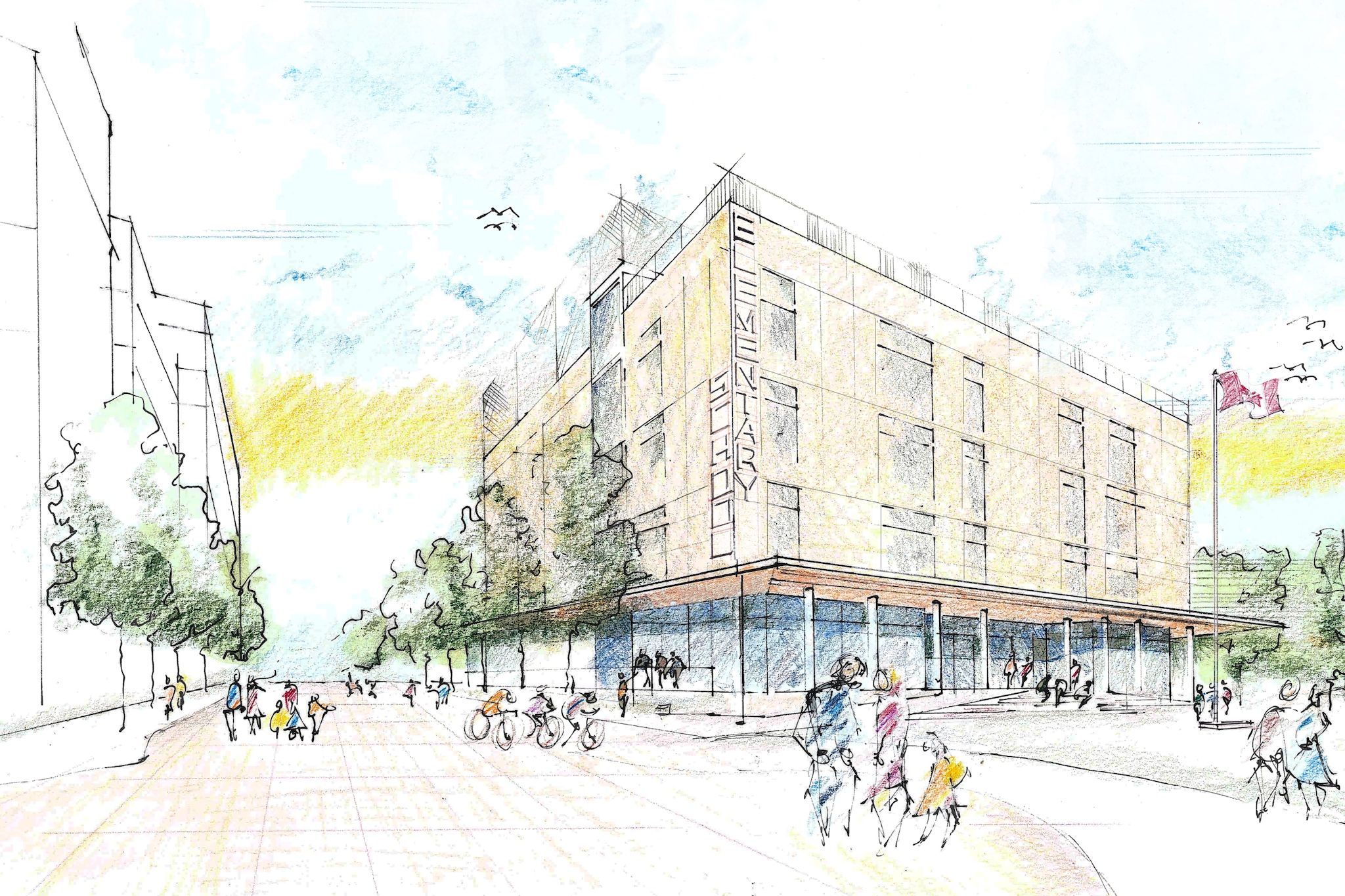
The Vancouver City Council has unanimously approved a rezoning application for the long-anticipated Olympic Village Elementary School, paving the way for a facility that will accommodate 630 students. The decision, made on October 19, 2023, allows for an additional storey, raising the school building from two to three stories, to meet the growing demand in one of the city’s fastest-developing neighbourhoods.
The site, located on the waterfront at Hinge Park, has been designated for educational use in the Southeast False Creek Official Community Plan (OCP) since the early 2000s. While the recent vote did not change the land’s designated use for a school, it permits the extra height necessary to increase student capacity. This adjustment reflects the significant changes in the area since the original vision of a “complete community” was established to support the Vancouver Olympic Village for the 2010 Winter Games.
City officials acknowledged the frustration experienced by local families due to school overcrowding. “We recognize that this school represents a large change for the neighbourhood, but it also represents the conclusion of decades of planning work,” stated staff from the Vancouver School Board during a public hearing. They highlighted the challenges families face when schools exceed capacity, emphasizing the stress and uncertainty this brings in a city already grappling with affordability issues.
Downtown Vancouver has seen persistent pressure on school capacity, with nearby schools like Simon Fraser Elementary facing significant enrolment challenges. Currently, there are approximately 800 more elementary students than the combined capacity of the four closest schools. In 2025 alone, more than 250 kindergarten students were assigned to schools outside their designated catchments due to space limitations.
School Board staff noted that students from grades one to seven have expressed a desire for a school within their own neighbourhood. The approved school will occupy a 29,000 sq. ft. grassy area at Hinge Park, featuring a total of 85,000 sq. ft. of floor space, which will include a gymnasium, multi-purpose rooms, and before- and after-school care facilities. Plans also include a rooftop outdoor play area.
Due to challenging geotechnical conditions and the proximity to water, the design will not include underground parking. Instead, the project will provide four accessible parking spaces at ground level. The provincial government has allocated $150 million for construction, with strict conditions tied to the specific site and capacity. The goal is to have the school operational by 2029.
City staff clarified that the recent vote focused solely on allowing for the additional storey rather than the establishment of a school in the area. Some council members acknowledged concerns raised during public hearings regarding traffic and access to adjacent green spaces at Hinge Park. To address these issues, amendments were approved to relocate the pick-up/drop-off area south to West 1st Avenue, which is wider than Columbia Street, reducing potential congestion.
The Vancouver School Board aims to utilize the remaining grassy area as an outdoor play space dedicated to students, while still ensuring public access to the park. City councillor Sarah Kirby-Yung emphasized the importance of balancing urban development with green space conservation. “Once you lose parkland, you never get it back,” she stated. She highlighted the support for the school while acknowledging differing opinions on its size.
Despite some opposition to the school’s capacity, proponents argue it is essential for providing immediate relief for local schools and preparing for future demands as residential developments continue in the area. According to councillor Peter Meiszner, overcrowding has visible consequences, stating that many families are forced to send their children to schools outside their catchment areas.
Mayor Ken Sim underscored the need for long-term planning in a city projected to see significant population growth over the next decade. “We have to make decisions not based on the next two years or five years. We have to take at least a 30-year view,” he remarked, recalling past instances where facilities were initially deemed overbuilt but later proved essential.
Looking ahead, additional school capacity is expected to become available in September 2026, when Seaside Elementary School opens in Coal Harbour. This new school, part of a mixed-use development, will accommodate 317 students and include a childcare facility for 64 children, further addressing the educational needs of Vancouver’s growing population.

Meta Plans Major Layoffs as AI Costs Surge

Alberta’s Referendum Could Pave Way for U.S. Statehood

Minooka District 201 Plans Enhanced Bilingual Support for Students

Canmore Approves Multiple Development Permits for New Projects

Remembering Bradly Castillo Shearsmith: A Life of Friendship and Joy

BIS Urges Watchdogs to Integrate Synthetic Risk Transfers in Stress Tests

Teva Transforms: Shifting Focus from Generics to Branded Success

Apple Launches AirPods Max 2 with Enhanced Audio Features

Ontario Ends Funding for Seven Supervised Injection Sites

Toyoake City Proposes Daily Two-Hour Smartphone Use Limit

Pedestrian Fatally Injured in Esquimalt Collision on August 14

B.C. Review Reveals Urgent Need for Rare-Disease Drug Reforms

Dark Adventure Game “Bye Sweet Carole” Set for October Release

Konami Revives Iconic Metal Gear Solid Delta Ahead of Release

Jimmy Lai’s Defense Challenges Charges Under National Security Law

Victoria’s Pop-Up Shop Shines Light on B.C.’s Wolf Cull

Snapmaker U1 Color 3D Printer Redefines Speed and Sustainability

Apple Expands Self-Service Repair Program to Canada
-
 Science11 months ago
Toyoake City Proposes Daily Two-Hour Smartphone Use Limit
-
 Top Stories11 months ago
Pedestrian Fatally Injured in Esquimalt Collision on August 14
-
 Health11 months ago
B.C. Review Reveals Urgent Need for Rare-Disease Drug Reforms
-
 Technology11 months ago
Dark Adventure Game “Bye Sweet Carole” Set for October Release
-
 Technology11 months ago
Konami Revives Iconic Metal Gear Solid Delta Ahead of Release
-
 World11 months ago
Jimmy Lai’s Defense Challenges Charges Under National Security Law
-
 Lifestyle11 months ago
Victoria’s Pop-Up Shop Shines Light on B.C.’s Wolf Cull
-
 Technology11 months ago
Snapmaker U1 Color 3D Printer Redefines Speed and Sustainability
-
 Technology11 months ago
Apple Expands Self-Service Repair Program to Canada
-

 Technology11 months ago
AION Folding Knife: Redefining EDC Design with Premium Materials
-

 Technology11 months ago
Solve Today’s Wordle Challenge: Hints and Answer for August 19
-

 Business11 months ago
Gordon Murray Automotive Unveils S1 LM and Le Mans GTR at Monterey