
Business
Global Markets Surge as Wall Street Hits Record Highs

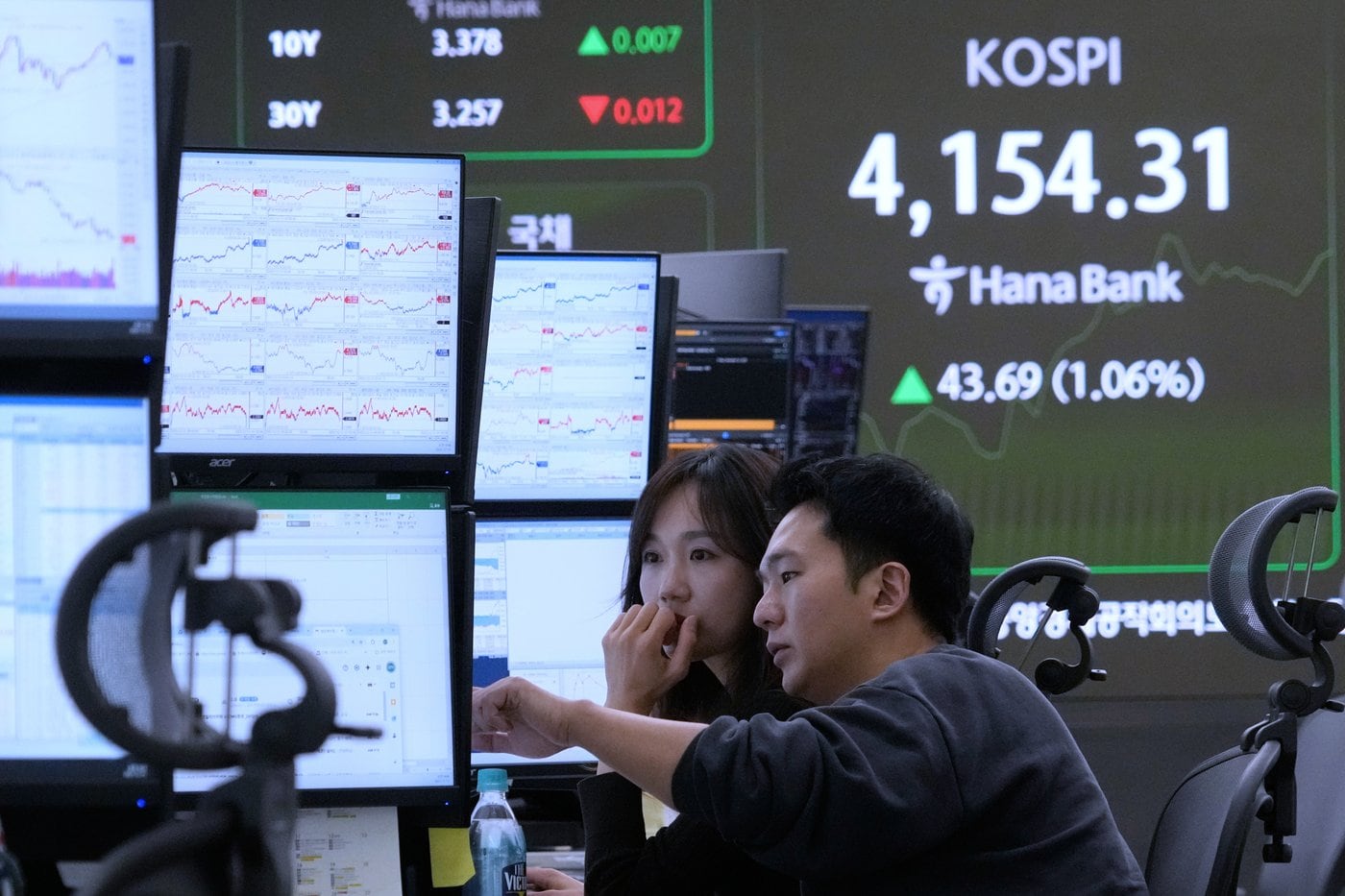
World shares experienced a notable increase on Friday, propelled by Wall Street’s recent ascent to record highs. This surge occurred despite ongoing concerns surrounding a potential bubble in artificial intelligence (AI) technology, particularly following a significant sell-off of shares in Oracle. The futures for the S&P 500 dipped slightly by less than 0.1 percent, while the Dow Jones Industrial Average saw a rise of 0.3 percent.
In early trading across Europe, Germany’s DAX index gained nearly 0.6 percent to reach 24,427.67. Britain’s FTSE 100 climbed 0.4 percent, closing at 9,737.25, and France’s CAC 40 also rose by 0.4 percent to 8,141.66. Japan’s Nikkei 225 index reflected a strong performance, surging 1.4 percent to 50,836.55, recovering from losses seen in the previous session. This rebound comes as investors remain cautious ahead of the Bank of Japan’s policy meeting next week, where an interest rate hike is anticipated. Technology shares have played a significant role in driving these broad gains, with Softbank Group rising 3.9 percent after an initial spike of 6 percent.
In Asia, Hong Kong’s Hang Seng index advanced by 1.8 percent to 25,976.79, while the Shanghai Composite index saw a modest increase of 0.4 percent to 3,889.35. The Central Economic Work Conference in Beijing, held from Wednesday to Thursday, outlined China’s priorities for 2026, focusing on reversing a decline in investment and boosting consumer spending. No major policy changes were reported during this meeting.
Australia’s S&P/ASX 200 index rose 1.2 percent to 8,697.30, and South Korea’s Kospi climbed 1.4 percent to 4,167.16. Taiwan’s Taiex index recorded a gain of 0.6 percent, while India’s BSE Sensex increased by 0.5 percent.
On Thursday, the S&P 500 edged up 0.2 percent to 6,901.00, surpassing its previous all-time closing high from October. The Dow Jones Industrial surged 1.3 percent to 48,704.01, marking a new record following the previous month’s high. In contrast, the Nasdaq composite lagged behind, declining by 0.3 percent to 23,593.86, largely due to weakness in AI stocks.
Despite the positive outlook for the U.S. stock market, concerns remain. Oracle’s stock dropped by 10.8 percent, nearing its worst loss since 2001 during the dot-com bubble. Investors are skeptical about whether Oracle’s significant investments in AI technology will yield the anticipated returns. This skepticism is echoed throughout the broader AI industry, despite substantial investments continuing to flow in. For instance, Nvidia, a leading chip manufacturer in the AI sector, saw its shares decline by 1.5 percent on Thursday, becoming the largest drag on the S&P 500 due to its considerable market capitalization.
In the commodities market, U.S. benchmark crude oil gained 24 cents, reaching $57.84 per barrel, while Brent crude, the international standard, increased by 22 cents to $61.50 per barrel. The U.S. dollar appreciated against the Japanese yen, rising to 155.87 from 155.58, while the euro slightly dipped to $1.1731 from $1.1739.
As the global markets react to these developments, the interplay of optimism and caution continues to define the landscape, particularly as investors weigh the implications of interest rate decisions and the evolving narrative around AI investments.

Meta Plans Major Layoffs as AI Costs Surge

Alberta’s Referendum Could Pave Way for U.S. Statehood

Minooka District 201 Plans Enhanced Bilingual Support for Students

Canmore Approves Multiple Development Permits for New Projects

Remembering Bradly Castillo Shearsmith: A Life of Friendship and Joy

BIS Urges Watchdogs to Integrate Synthetic Risk Transfers in Stress Tests

Teva Transforms: Shifting Focus from Generics to Branded Success

Apple Launches AirPods Max 2 with Enhanced Audio Features

Ontario Ends Funding for Seven Supervised Injection Sites

Toyoake City Proposes Daily Two-Hour Smartphone Use Limit

Pedestrian Fatally Injured in Esquimalt Collision on August 14

B.C. Review Reveals Urgent Need for Rare-Disease Drug Reforms

Dark Adventure Game “Bye Sweet Carole” Set for October Release

Konami Revives Iconic Metal Gear Solid Delta Ahead of Release

Victoria’s Pop-Up Shop Shines Light on B.C.’s Wolf Cull

Jimmy Lai’s Defense Challenges Charges Under National Security Law

Snapmaker U1 Color 3D Printer Redefines Speed and Sustainability

Apple Expands Self-Service Repair Program to Canada
-
 Science12 months ago
Toyoake City Proposes Daily Two-Hour Smartphone Use Limit
-
 Top Stories12 months ago
Pedestrian Fatally Injured in Esquimalt Collision on August 14
-
 Health12 months ago
B.C. Review Reveals Urgent Need for Rare-Disease Drug Reforms
-
 Technology12 months ago
Dark Adventure Game “Bye Sweet Carole” Set for October Release
-
 Technology12 months ago
Konami Revives Iconic Metal Gear Solid Delta Ahead of Release
-
 Lifestyle12 months ago
Victoria’s Pop-Up Shop Shines Light on B.C.’s Wolf Cull
-
 World12 months ago
Jimmy Lai’s Defense Challenges Charges Under National Security Law
-
 Technology12 months ago
Snapmaker U1 Color 3D Printer Redefines Speed and Sustainability
-
 Technology12 months ago
Apple Expands Self-Service Repair Program to Canada
-

 Technology12 months ago
AION Folding Knife: Redefining EDC Design with Premium Materials
-

 Technology12 months ago
Solve Today’s Wordle Challenge: Hints and Answer for August 19
-

 Business12 months ago
Gordon Murray Automotive Unveils S1 LM and Le Mans GTR at Monterey