
Business
Total Lunar Eclipse to Dazzle Montreal on March 3

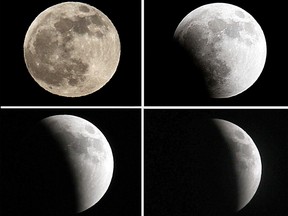
A total lunar eclipse will be visible from Montreal in the early hours of March 3, 2024. Although conditions may not be ideal, the event offers a rare opportunity to witness the moon fully enveloped in the Earth’s shadow. The totality phase, when the moon appears red, will commence at approximately 6:04 a.m., coinciding with the moon’s setting and the sun’s rising.
Despite the timing, stargazers are encouraged to awaken early, as this will be the last total lunar eclipse visible from Montreal for three years. Gary Boyle, known as The Backyard Astronomer, emphasizes the unique experience of observing the eclipse firsthand. “You can look at a picture… but until you’ve actually seen the moon turn orange in the sky, it’s not the same,” he stated.
The moon takes on an orange-red hue during a lunar eclipse due to sunlight being filtered through the Earth’s atmosphere and into the planet’s shadow. Unlike solar eclipses, which are visible only in specific locations, lunar eclipses can be observed by anyone on the night side of the Earth. This accessibility occurs when the sun, Earth, and moon align, a phenomenon that happens about two to three times a year, resulting in two to six total or partial eclipses annually.
As Olivier Hernandez, an astrophysicist and director of the Montreal Planetarium, explains, total lunar eclipses are less frequent than partial ones, as they require the moon to pass entirely into the Earth’s central shadow. The next total lunar eclipse in Montreal is scheduled for the overnight hours between June 25 and June 26, 2029.
On March 3, the partial eclipse will initiate at 4:50 a.m., with totality lasting until around 7:02 a.m.. However, for viewers in Montreal, the moon will dip below the horizon by 6:30 a.m., making it crucial to find an unobstructed view of the western skyline. Hernandez recommends the Outremont Summit of Mount Royal as an ideal location for optimal viewing. “The western horizon is very clear there,” he noted.
For those outside the city, elevated locations such as Mont St-Hilaire, Mont St-Bruno, and Mont St-Grégoire are also excellent choices. “As soon as you can elevate yourself slightly and have a clear horizon, that’s where it’s most interesting,” Hernandez advised.
Unlike solar eclipses, which necessitate protective eyewear, lunar eclipses can be viewed safely with the naked eye. This accessibility adds to the appeal of the event, allowing everyone to engage with this spectacular celestial phenomenon.
Overall, the total lunar eclipse on March 3 promises to be a captivating experience for both amateur and seasoned astronomers alike, marking a significant event in the skies above Montreal.

Meta Plans Major Layoffs as AI Costs Surge

Alberta’s Referendum Could Pave Way for U.S. Statehood

Minooka District 201 Plans Enhanced Bilingual Support for Students

Canmore Approves Multiple Development Permits for New Projects

Remembering Bradly Castillo Shearsmith: A Life of Friendship and Joy

BIS Urges Watchdogs to Integrate Synthetic Risk Transfers in Stress Tests

Teva Transforms: Shifting Focus from Generics to Branded Success

Apple Launches AirPods Max 2 with Enhanced Audio Features

Ontario Ends Funding for Seven Supervised Injection Sites

Toyoake City Proposes Daily Two-Hour Smartphone Use Limit

Pedestrian Fatally Injured in Esquimalt Collision on August 14

B.C. Review Reveals Urgent Need for Rare-Disease Drug Reforms

Dark Adventure Game “Bye Sweet Carole” Set for October Release

Konami Revives Iconic Metal Gear Solid Delta Ahead of Release

Victoria’s Pop-Up Shop Shines Light on B.C.’s Wolf Cull

Jimmy Lai’s Defense Challenges Charges Under National Security Law

Snapmaker U1 Color 3D Printer Redefines Speed and Sustainability

Apple Expands Self-Service Repair Program to Canada
-
 Science12 months ago
Toyoake City Proposes Daily Two-Hour Smartphone Use Limit
-
 Top Stories12 months ago
Pedestrian Fatally Injured in Esquimalt Collision on August 14
-
 Health12 months ago
B.C. Review Reveals Urgent Need for Rare-Disease Drug Reforms
-
 Technology11 months ago
Dark Adventure Game “Bye Sweet Carole” Set for October Release
-
 Technology12 months ago
Konami Revives Iconic Metal Gear Solid Delta Ahead of Release
-
 Lifestyle12 months ago
Victoria’s Pop-Up Shop Shines Light on B.C.’s Wolf Cull
-
 World12 months ago
Jimmy Lai’s Defense Challenges Charges Under National Security Law
-
 Technology12 months ago
Snapmaker U1 Color 3D Printer Redefines Speed and Sustainability
-
 Technology12 months ago
Apple Expands Self-Service Repair Program to Canada
-

 Technology12 months ago
AION Folding Knife: Redefining EDC Design with Premium Materials
-

 Technology12 months ago
Solve Today’s Wordle Challenge: Hints and Answer for August 19
-

 Business12 months ago
Gordon Murray Automotive Unveils S1 LM and Le Mans GTR at Monterey