
Business
UK Households Hoard Cash as Christmas Spending Fears Rise

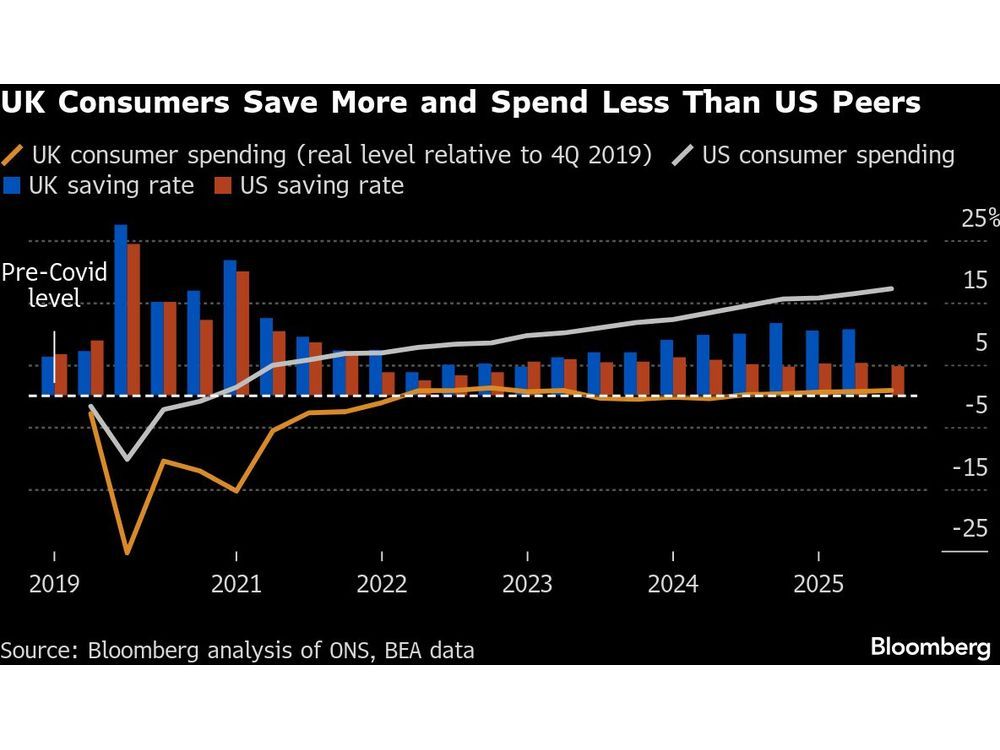
As the festive season approaches, UK households are increasingly reluctant to spend, according to a recent analysis by former Bank of England rate-setter Michael Saunders. A growing sense of financial insecurity, stemming from economic shocks over the past five years, has led many to prioritize saving over spending. This trend poses significant challenges for retailers during a critical trading period.
In his analysis published by Oxford Economics, Saunders noted a sharp rise in saving rates since the onset of the pandemic. Many Britons have opted to stash away a larger proportion of their income, driven by fears of insufficient savings for emergencies. Compounding this reluctance is the current climate of higher interest rates, which makes saving more attractive.
The implications for the economy are concerning. Recent official figures indicate that the UK’s GDP contracted for a second consecutive month in October, raising fears of the first quarterly downturn in two years. Retail sales have declined, reflecting consumers’ hesitance to spend.
Consumer spending plays a vital role in driving economic growth, accounting for approximately 60% of national output. However, it has stagnated over the past three years, contrasting sharply with the US, where consumer spending has fueled strong economic performance among Group of Seven economies.
A revival in household spending is crucial for achieving the tax revenues that Chancellor of the Exchequer Rachel Reeves needs to maintain her budget commitments. Saunders attributes the current caution in consumer behavior to lasting effects from the pandemic and the subsequent cost-of-living crisis, which saw inflation peak at over 11% in late 2022 and significantly increased mortgage rates.
Despite an increase in average household savings compared to pre-pandemic levels, a growing number of families report feeling unprepared for emergencies. “Even though the median level of liquid assets is higher now than the pre-pandemic period, the share of households who say they don’t have enough savings for emergencies has risen markedly,” Saunders explained.
The saving rate currently sits over 10%, approximately 2.5 percentage points above the long-term average. This cautious behavior is most pronounced among individuals aged 25 to 55, renters, and those with fewer savings. The Bank of England anticipates only a gradual decline in the saving rate in the coming years, with Governor Andrew Bailey acknowledging a “high level of caution” among consumers in these uncertain times.
Financial markets expect a quarter-point cut in interest rates on December 18, reducing the rate to 3.75%. Saunders predicts that while rates may decrease further over the next couple of years, they will remain elevated compared to pre-pandemic levels. This situation will likely lead to “sluggish growth” and could prompt the Bank of England to lower rates more than anticipated.
Using data from the Bank of England’s annual NMG survey of approximately 6,000 households since 2010, Saunders examined the causes behind the UK’s cautious consumption. Interestingly, pensioners appear to be the only demographic unaffected by these economic shocks. “Financial insecurity has fallen among the over 65s, probably because the triple lock has protected pension income and with higher levels of assets they have benefited from higher interest rates,” he noted.
The triple lock ensures that state pensions increase by the highest of either earnings growth, inflation, or 2.5%. According to Saunders, historical patterns show that periods of extreme economic volatility often lead to heightened precautionary saving. He referenced similar behavior following the US Great Depression in the 1930s and the inflation surge in the UK during the 1970s.
A separate survey conducted by consulting firm RSM revealed that if given a one-off windfall of £5,000 (approximately $6,673.50), nearly 57% of respondents would choose to save it or pay down debt, while only 8% indicated they would spend it on Christmas gifts.
As the festive season approaches, the reluctance to spend among UK households poses challenges for retailers and the broader economy. With consumer confidence low, the future of holiday spending remains uncertain.

Meta Plans Major Layoffs as AI Costs Surge

Alberta’s Referendum Could Pave Way for U.S. Statehood

Minooka District 201 Plans Enhanced Bilingual Support for Students

Canmore Approves Multiple Development Permits for New Projects

Remembering Bradly Castillo Shearsmith: A Life of Friendship and Joy

BIS Urges Watchdogs to Integrate Synthetic Risk Transfers in Stress Tests

Teva Transforms: Shifting Focus from Generics to Branded Success

Apple Launches AirPods Max 2 with Enhanced Audio Features

Ontario Ends Funding for Seven Supervised Injection Sites

Toyoake City Proposes Daily Two-Hour Smartphone Use Limit

Pedestrian Fatally Injured in Esquimalt Collision on August 14

B.C. Review Reveals Urgent Need for Rare-Disease Drug Reforms

Dark Adventure Game “Bye Sweet Carole” Set for October Release

Konami Revives Iconic Metal Gear Solid Delta Ahead of Release

Victoria’s Pop-Up Shop Shines Light on B.C.’s Wolf Cull

Jimmy Lai’s Defense Challenges Charges Under National Security Law

Snapmaker U1 Color 3D Printer Redefines Speed and Sustainability

Apple Expands Self-Service Repair Program to Canada
-
 Science12 months ago
Toyoake City Proposes Daily Two-Hour Smartphone Use Limit
-
 Top Stories12 months ago
Pedestrian Fatally Injured in Esquimalt Collision on August 14
-
 Health12 months ago
B.C. Review Reveals Urgent Need for Rare-Disease Drug Reforms
-
 Technology12 months ago
Dark Adventure Game “Bye Sweet Carole” Set for October Release
-
 Technology12 months ago
Konami Revives Iconic Metal Gear Solid Delta Ahead of Release
-
 Lifestyle12 months ago
Victoria’s Pop-Up Shop Shines Light on B.C.’s Wolf Cull
-
 World12 months ago
Jimmy Lai’s Defense Challenges Charges Under National Security Law
-
 Technology12 months ago
Snapmaker U1 Color 3D Printer Redefines Speed and Sustainability
-
 Technology12 months ago
Apple Expands Self-Service Repair Program to Canada
-

 Technology12 months ago
AION Folding Knife: Redefining EDC Design with Premium Materials
-

 Technology12 months ago
Solve Today’s Wordle Challenge: Hints and Answer for August 19
-

 Business12 months ago
Gordon Murray Automotive Unveils S1 LM and Le Mans GTR at Monterey