
Business
UK Wind Power Output Soars to Four-Year High, Driving Prices Down

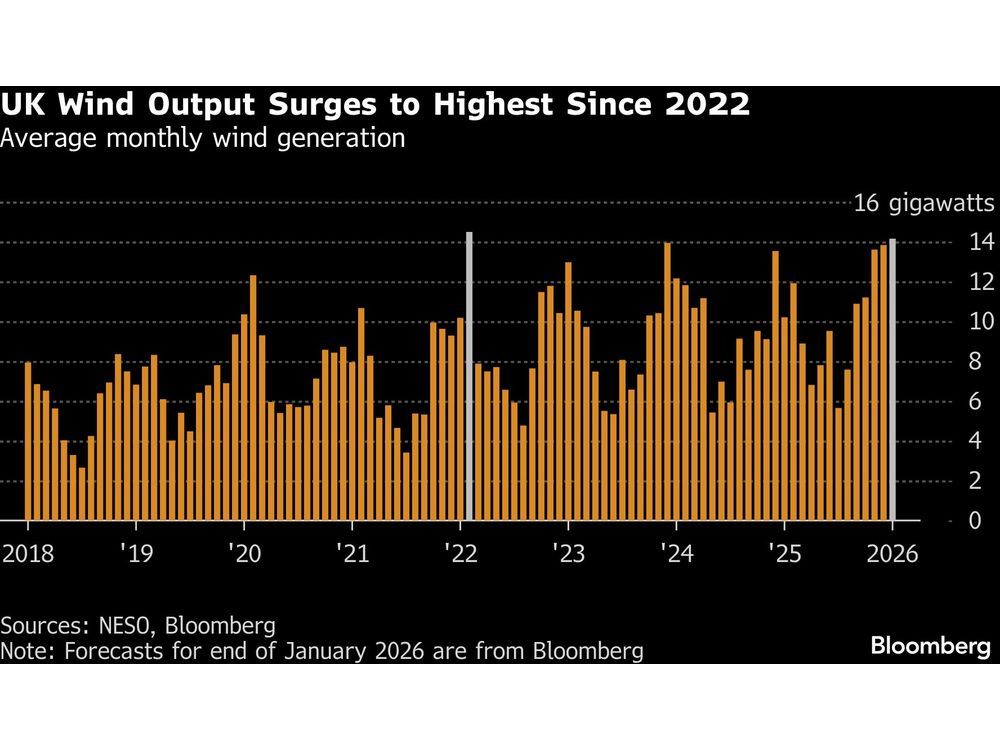
UK wind farms are set to deliver their highest power output in almost four years this January, driven by increased turbine installations and favorable weather conditions. Data from the National Energy System Operator and forecasts from Bloomberg indicate that wind generation is on track to average over 14 gigawatts this month. This surge in renewable energy has helped stabilize electricity prices even as wholesale natural gas costs rise due to diminishing inventories.
The acceleration of renewable energy initiatives follows a concerted effort by European governments to reduce dependence on gas for power generation, particularly in response to geopolitical tensions stemming from Russia’s invasion of Ukraine. Earlier this month, the UK secured record amounts of new offshore wind capacity through a government auction, demonstrating its commitment to lowering energy costs for consumers.
Comparative Power Prices Across Europe
UK day-ahead power prices have averaged around €109 per megawatt-hour on the Nord Pool exchange in January, which is approximately €7 higher than the equivalent French contract. This marks a significant reduction in the price differential, which averaged €33 during the same period last year. France has been somewhat insulated from rising electricity prices due to its extensive nuclear fleet, leaving it with lower costs compared to many other European countries.
Wind conditions are not uniform across Europe. For instance, while the UK has benefited from stormy weather conducive to wind energy generation, Germany has experienced calmer conditions that have hindered its renewable output. According to Jess Hicks from BloombergNEF, the weather pattern has brought increased wind speeds to the UK, whereas Germany has seen a decline in onshore wind generation, projected to drop to its lowest levels since 2021.
Future Energy Outlook
The Fraunhofer Institute for Solar Energy Systems reports that Germany’s onshore wind generation will likely decline despite the country adding over 10 gigawatts of installed capacity. This deficit forces a reliance on more expensive fossil fuels, particularly since the closure of Germany’s last nuclear reactors in 2023.
Looking ahead, a negative North Atlantic Oscillation weather pattern may adversely affect wind generation in February. The European Centre for Medium-Range Weather Forecasts anticipates these conditions could emerge early in the month, potentially leaving Germany outside the main storm track. This shift could lead to increased costs on the spot electricity market, with Matthias Apel, an analyst at Ispex AG, indicating that the first half of February is likely to be particularly expensive for consumers in Germany.
In contrast, Spain is poised for record wind generation in January, as reported by the European Network of Transmission System Operators for Electricity. The differing conditions across these countries highlight the variability and challenges inherent in transitioning to renewable energy sources. As the landscape of European energy continues to evolve, the impact on prices and generation capabilities will remain a critical area of focus for both policymakers and consumers alike.

Meta Plans Major Layoffs as AI Costs Surge

Alberta’s Referendum Could Pave Way for U.S. Statehood

Minooka District 201 Plans Enhanced Bilingual Support for Students

Canmore Approves Multiple Development Permits for New Projects

Remembering Bradly Castillo Shearsmith: A Life of Friendship and Joy

BIS Urges Watchdogs to Integrate Synthetic Risk Transfers in Stress Tests

Teva Transforms: Shifting Focus from Generics to Branded Success

Apple Launches AirPods Max 2 with Enhanced Audio Features

Ontario Ends Funding for Seven Supervised Injection Sites

Toyoake City Proposes Daily Two-Hour Smartphone Use Limit

Pedestrian Fatally Injured in Esquimalt Collision on August 14

B.C. Review Reveals Urgent Need for Rare-Disease Drug Reforms

Dark Adventure Game “Bye Sweet Carole” Set for October Release

Konami Revives Iconic Metal Gear Solid Delta Ahead of Release

Victoria’s Pop-Up Shop Shines Light on B.C.’s Wolf Cull

Jimmy Lai’s Defense Challenges Charges Under National Security Law

Snapmaker U1 Color 3D Printer Redefines Speed and Sustainability

Apple Expands Self-Service Repair Program to Canada
-
 Science12 months ago
Toyoake City Proposes Daily Two-Hour Smartphone Use Limit
-
 Top Stories12 months ago
Pedestrian Fatally Injured in Esquimalt Collision on August 14
-
 Health12 months ago
B.C. Review Reveals Urgent Need for Rare-Disease Drug Reforms
-
 Technology12 months ago
Dark Adventure Game “Bye Sweet Carole” Set for October Release
-
 Technology12 months ago
Konami Revives Iconic Metal Gear Solid Delta Ahead of Release
-
 Lifestyle12 months ago
Victoria’s Pop-Up Shop Shines Light on B.C.’s Wolf Cull
-
 World12 months ago
Jimmy Lai’s Defense Challenges Charges Under National Security Law
-
 Technology12 months ago
Snapmaker U1 Color 3D Printer Redefines Speed and Sustainability
-
 Technology12 months ago
Apple Expands Self-Service Repair Program to Canada
-

 Technology12 months ago
AION Folding Knife: Redefining EDC Design with Premium Materials
-

 Technology12 months ago
Solve Today’s Wordle Challenge: Hints and Answer for August 19
-

 Business12 months ago
Gordon Murray Automotive Unveils S1 LM and Le Mans GTR at Monterey