
Education
Peter Stoicheff Reflects on Tenure as University of Saskatchewan President

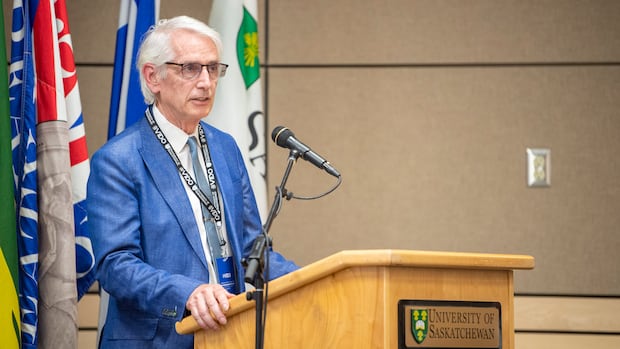
Peter Stoicheff’s decade-long leadership at the University of Saskatchewan (U of S) is nearing its conclusion. As president and vice-chancellor, Stoicheff navigated significant challenges, including the COVID-19 pandemic and advancements in artificial intelligence. He will officially hand over the role to Vince Bruni-Bossio on January 1, 2024.
In a recent conversation with Saskatoon Morning host Stephanie Massicotte, Stoicheff reflected on his time leading the university. He emphasized the institution’s evolution into an “outward-facing” entity, committed to serving not just the local community but also the broader province and beyond.
Challenges and Achievements
Stoicheff acknowledged that his ten-year tenure is long by academic leadership standards, where the average presidency lasts around 4.1 years. He described the experience as a “huge privilege” and pointed to the pandemic as one of the most significant challenges faced during his time. “The pandemic… you can’t ignore that,” he stated, highlighting the need for universities to adapt quickly to unprecedented conditions. He credited the collaborative efforts of faculty, students, and staff for the university’s effective response.
One of Stoicheff’s major accomplishments was the establishment of a campus in Prince Albert. He expressed pride in making higher education more accessible, particularly for those from remote northern communities. “Having a campus in P.A. means that a university education is accessible to all sorts of people,” he said, noting the geographical and financial barriers many face.
Another highlight of Stoicheff’s presidency was the successful replacement of the Rutherford Arena with Merlis Belsher Place, a project that many had deemed impossible. His leadership allowed the university to achieve significant infrastructural goals during his tenure.
A Legacy of Pride and Ambition
When asked about his desired legacy, Stoicheff reflected on the university’s rich history and its vital role in Saskatchewan, particularly for the agricultural community. He noted the institution’s longstanding commitment to serve the needs of the province, recalling initiatives that date back over a century, including the farm train that provided expertise to farmers during the Great Depression.
Stoicheff hopes that his legacy will inspire pride in the University of Saskatchewan, not just locally but nationally, particularly in areas such as vaccine research, food security, water security, and crop development.
As he prepares to step down, Stoicheff offered a key piece of advice for his successor and the future of U of S: “Think big.” He praised the modesty inherent in Saskatchewan’s culture but urged that achieving significant accomplishments should be a priority.
His reflections serve as both a conclusion to a notable presidency and a call to action for the university’s future leadership.

Meta Plans Major Layoffs as AI Costs Surge

Alberta’s Referendum Could Pave Way for U.S. Statehood

Minooka District 201 Plans Enhanced Bilingual Support for Students

Canmore Approves Multiple Development Permits for New Projects

Remembering Bradly Castillo Shearsmith: A Life of Friendship and Joy

BIS Urges Watchdogs to Integrate Synthetic Risk Transfers in Stress Tests

Teva Transforms: Shifting Focus from Generics to Branded Success

Apple Launches AirPods Max 2 with Enhanced Audio Features

Ontario Ends Funding for Seven Supervised Injection Sites

Toyoake City Proposes Daily Two-Hour Smartphone Use Limit

Pedestrian Fatally Injured in Esquimalt Collision on August 14

B.C. Review Reveals Urgent Need for Rare-Disease Drug Reforms

Dark Adventure Game “Bye Sweet Carole” Set for October Release

Konami Revives Iconic Metal Gear Solid Delta Ahead of Release

Victoria’s Pop-Up Shop Shines Light on B.C.’s Wolf Cull

Jimmy Lai’s Defense Challenges Charges Under National Security Law

Snapmaker U1 Color 3D Printer Redefines Speed and Sustainability

Apple Expands Self-Service Repair Program to Canada
-
 Science1 year ago
Toyoake City Proposes Daily Two-Hour Smartphone Use Limit
-
 Top Stories1 year ago
Pedestrian Fatally Injured in Esquimalt Collision on August 14
-
 Health1 year ago
B.C. Review Reveals Urgent Need for Rare-Disease Drug Reforms
-
 Technology1 year ago
Dark Adventure Game “Bye Sweet Carole” Set for October Release
-
 Technology1 year ago
Konami Revives Iconic Metal Gear Solid Delta Ahead of Release
-
 Lifestyle1 year ago
Victoria’s Pop-Up Shop Shines Light on B.C.’s Wolf Cull
-
 World1 year ago
Jimmy Lai’s Defense Challenges Charges Under National Security Law
-
 Technology1 year ago
Snapmaker U1 Color 3D Printer Redefines Speed and Sustainability
-
 Technology1 year ago
Apple Expands Self-Service Repair Program to Canada
-

 Technology1 year ago
AION Folding Knife: Redefining EDC Design with Premium Materials
-

 Technology1 year ago
Solve Today’s Wordle Challenge: Hints and Answer for August 19
-

 Business1 year ago
Gordon Murray Automotive Unveils S1 LM and Le Mans GTR at Monterey