
Health
Surgeons Use Remote-Controlled Robots to Save Lives in Rural Canada

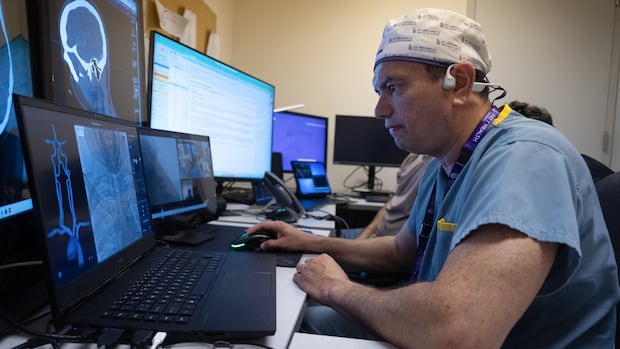
Advancements in medical technology are enabling doctors to perform robotic surgeries from a distance, significantly impacting patients in rural Canada. At St. Michael’s Hospital in Toronto, a team led by Dr. Vitor Mendes Pereira has successfully conducted ten brain angiograms using a remote-controlled robot, showcasing the potential of this innovative approach to healthcare.
The remote-controlled surgeries utilize a fibre-optic internet connection, allowing Pereira to operate a robotic catheter to obtain detailed images of patients’ brain blood vessels. “Every minute counts,” Pereira stated during an interview on The Current. “If I can deploy the robot and treat closest to where the patient is, that can save hours. And that is really the ultimate goal of this type of treatment.”
Remote Surgery: A Lifesaving Innovation
The team at St. Michael’s Hospital is not stopping at angiograms. They aim to expand their services to include remote endovascular thrombectomies, a critical procedure to remove blood clots, for patients located approximately 500 kilometres away in Sault Ste. Marie. If approved by Health Canada, this would mark the first instance of such a surgery being performed remotely anywhere in the world.
This innovation could dramatically benefit stroke patients in rural regions, where timely access to specialized care is often limited. Currently, patients needing urgent surgeries are frequently transported by air to larger hospitals, resulting in increased morbidity due to delays.
From his control room, Pereira is able to interact with a clinical team in the operating room, ensuring effective communication throughout the procedure. Initially, he performed surgeries from just 12 metres away, but during the most recent operation in August 2023, he worked from six kilometres away at another facility within Unity Health Toronto.
Concerns about maintaining a stable internet connection during these surgeries have been addressed through rigorous testing and safety protocols, as explained by Nicole Cancelliere, program manager at St. Michael’s Hospital. “We would be able to adapt in a scenario if that was to happen,” she assured.
Making Healthcare Accessible
The implications of this remote surgery technology extend beyond the operating room. For Cancelliere, the advancement holds personal significance, having lost her grandfather to a stroke. “Knowing that it can help patients like my grandfather and families and save lives is just something that I’m truly passionate about,” she said.
Dr. Michael Kutryk, chief of cardiology at Sault Area Hospital, highlighted that the local hospital lacks the necessary surgical team to perform these operations. Currently, patients are transported to Sudbury for treatment, which can take significant time and lead to poorer outcomes. Kutryk estimates that there are between 12 and 17 strokes annually in Sault Ste. Marie requiring this surgery, a figure insufficient to justify a full-time specialist in the area.
With the introduction of robotic surgery, patients could receive treatment on-site, significantly reducing the time to intervention. “I think it’s going to be a game-changer for the whole world,” Kutryk expressed.
The costs associated with this technology, however, pose challenges. The surgical robot itself ranges from $1 million to $3 million, and each procedure requires one-time use equipment, adding to the financial burden for rural hospitals. Dr. Sarah Giles, president-elect of the Society of Royal Physicians of Canada, remarked that while the technology could provide rapid and life-saving care, the expenses may deter rural facilities from adopting it.
To be sustainable, Giles emphasized that hospitals would need to perform multiple procedures each year. Yet, Pereira and Kutryk argue that the potential for cost savings in other areas, such as reducing long-term care needs for stroke victims, makes the investment worthwhile.
Pereira is currently conducting a cost-effectiveness study on the technology. He believes that a single robot in a hospital could save up to $2 million for the healthcare system each year if it enables the performance of 20 procedures. “Time is one of the most challenging factors for us to deal with in medicine overall,” Pereira stated. “Having a solution that we can buy time, I think that it will convince any health authority that needs to approve a technology like that.”
As the field of remote robotic surgery evolves, it holds the promise of bringing essential medical care to underserved populations, potentially transforming healthcare accessibility across Canada and beyond.

Meta Plans Major Layoffs as AI Costs Surge

Alberta’s Referendum Could Pave Way for U.S. Statehood

Minooka District 201 Plans Enhanced Bilingual Support for Students

Canmore Approves Multiple Development Permits for New Projects

Remembering Bradly Castillo Shearsmith: A Life of Friendship and Joy

BIS Urges Watchdogs to Integrate Synthetic Risk Transfers in Stress Tests

Teva Transforms: Shifting Focus from Generics to Branded Success

Apple Launches AirPods Max 2 with Enhanced Audio Features

Ontario Ends Funding for Seven Supervised Injection Sites

Toyoake City Proposes Daily Two-Hour Smartphone Use Limit

Pedestrian Fatally Injured in Esquimalt Collision on August 14

B.C. Review Reveals Urgent Need for Rare-Disease Drug Reforms

Dark Adventure Game “Bye Sweet Carole” Set for October Release

Konami Revives Iconic Metal Gear Solid Delta Ahead of Release

Victoria’s Pop-Up Shop Shines Light on B.C.’s Wolf Cull

Jimmy Lai’s Defense Challenges Charges Under National Security Law

Snapmaker U1 Color 3D Printer Redefines Speed and Sustainability

Apple Expands Self-Service Repair Program to Canada
-
 Science11 months ago
Toyoake City Proposes Daily Two-Hour Smartphone Use Limit
-
 Top Stories11 months ago
Pedestrian Fatally Injured in Esquimalt Collision on August 14
-
 Health11 months ago
B.C. Review Reveals Urgent Need for Rare-Disease Drug Reforms
-
 Technology11 months ago
Dark Adventure Game “Bye Sweet Carole” Set for October Release
-
 Technology11 months ago
Konami Revives Iconic Metal Gear Solid Delta Ahead of Release
-
 Lifestyle11 months ago
Victoria’s Pop-Up Shop Shines Light on B.C.’s Wolf Cull
-
 World11 months ago
Jimmy Lai’s Defense Challenges Charges Under National Security Law
-
 Technology11 months ago
Snapmaker U1 Color 3D Printer Redefines Speed and Sustainability
-
 Technology11 months ago
Apple Expands Self-Service Repair Program to Canada
-

 Technology11 months ago
AION Folding Knife: Redefining EDC Design with Premium Materials
-

 Technology11 months ago
Solve Today’s Wordle Challenge: Hints and Answer for August 19
-

 Business11 months ago
Gordon Murray Automotive Unveils S1 LM and Le Mans GTR at Monterey