
Science
Chinese Families Choose Homeschooling Amid Education Concerns

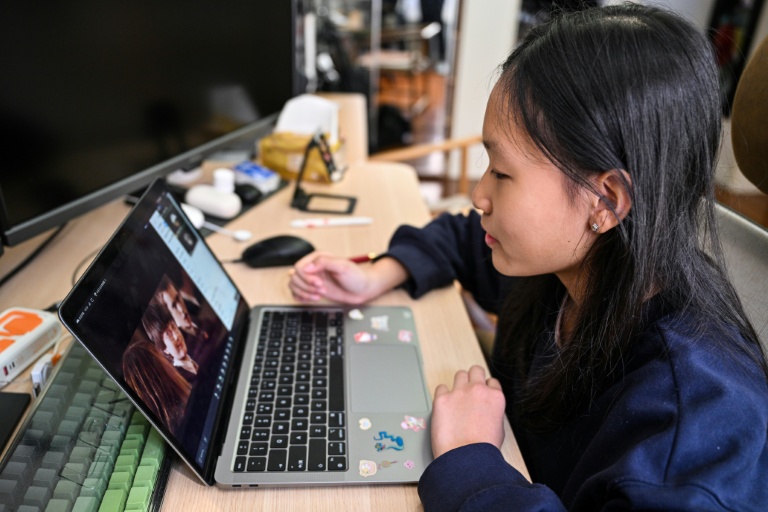
In a notable shift within China’s educational landscape, some families are turning to homeschooling as a response to the pressures of the traditional school system. Fourteen-year-old Estella, for instance, has traded the rigors of public school for a more personalized learning experience, studying subjects such as Spanish and acupuncture at home. Her parents withdrew her from a Shanghai school three years ago, fearing that the demanding curriculum would not keep pace with changes brought about by artificial intelligence (AI).
Estella’s mother, Xu Zoe, expressed her concerns about the current education system, which often subjects students to grueling school days lasting up to ten hours, followed by extensive homework and tutoring. “In the future, education models and jobs will face huge changes due to AI,” she told AFP. “We wanted to get used to the uncertainty early.”
Though technically illegal, homeschooling remains a rare but growing trend in China. According to the non-profit 21st Century Education Research Institute, only 6,000 children were homeschooled in 2017, in a country with approximately 145 million primary and middle school students. However, this number has increased annually by around 30 percent since 2013, reflecting a shift in parental attitudes towards education.
Rethinking Education in a Competitive Market
Supporters of homeschooling argue that a flexible schedule promotes creativity and practical learning experiences that the national curriculum often stifles. Estella’s daily routine allows her to engage in activities she genuinely enjoys, such as climbing and exploring her interests without the burden of preparing for high-stakes exams. “Instead of just doing a stressful exam in school, I will do the things I was interested in,” she noted.
The broader context reveals a growing skepticism regarding the value of elite university degrees in an oversaturated job market. In 2023, fewer than one in five graduates from Fudan University, one of China’s most prestigious institutions, secured jobs immediately after graduation. The unemployment rate for young individuals aged 16 to 24 reached a two-year high of 18.9 percent in August, according to the National Bureau of Statistics. “(China) has out-produced. Too many PhDs, too many Masters, too many undergraduates. The jobs they are trying to get are disappearing,” said education expert Yong Zhao in an interview with AFP.
In response to this competitive landscape, Chinese authorities have attempted to counteract the pressure of academic competition by cracking down on tutoring centers. Despite this, demand for supplemental education remains high, with many families seeking private tutoring options outside the formal educational framework.
Individual Stories of Homeschooling
One mother from Zhejiang Province, who chose to remain anonymous, reported leveraging an AI chatbot to create lesson plans for her nine-year-old son, focusing on practical projects such as recycling. “The development of AI has allowed me to say that what you learn in a classroom, you don’t need anymore,” she explained. Her son continues to study core subjects like Chinese and mathematics but enjoys afternoons filled with hands-on activities.
Another individual, Gong Yimei, shared her experience of being homeschooled after her father withdrew her from school at age eight. She found that the freedom from traditional schooling allowed her to reflect on her passions and aspirations, ultimately leading her to consider launching an education startup. “It helped me more quickly find myself,” she remarked.
Estella’s future remains uncertain, as her family plans to travel to Europe or South America to enhance her language skills. Xu Zoe remains optimistic about the potential for homeschooling to become a more accepted practice in China. “You don’t need to be afraid,” she encouraged other parents contemplating similar choices.
As the landscape of education continues to evolve, the experiences of families like Estella’s may signal a shift towards more personalized learning approaches in response to a rapidly changing world.

Meta Plans Major Layoffs as AI Costs Surge

Alberta’s Referendum Could Pave Way for U.S. Statehood

Minooka District 201 Plans Enhanced Bilingual Support for Students

Canmore Approves Multiple Development Permits for New Projects

Remembering Bradly Castillo Shearsmith: A Life of Friendship and Joy

BIS Urges Watchdogs to Integrate Synthetic Risk Transfers in Stress Tests

Teva Transforms: Shifting Focus from Generics to Branded Success

Apple Launches AirPods Max 2 with Enhanced Audio Features

Ontario Ends Funding for Seven Supervised Injection Sites

Toyoake City Proposes Daily Two-Hour Smartphone Use Limit

Pedestrian Fatally Injured in Esquimalt Collision on August 14

B.C. Review Reveals Urgent Need for Rare-Disease Drug Reforms

Dark Adventure Game “Bye Sweet Carole” Set for October Release

Konami Revives Iconic Metal Gear Solid Delta Ahead of Release

Victoria’s Pop-Up Shop Shines Light on B.C.’s Wolf Cull

Jimmy Lai’s Defense Challenges Charges Under National Security Law

Snapmaker U1 Color 3D Printer Redefines Speed and Sustainability

Apple Expands Self-Service Repair Program to Canada
-
 Science11 months ago
Toyoake City Proposes Daily Two-Hour Smartphone Use Limit
-
 Top Stories11 months ago
Pedestrian Fatally Injured in Esquimalt Collision on August 14
-
 Health11 months ago
B.C. Review Reveals Urgent Need for Rare-Disease Drug Reforms
-
 Technology11 months ago
Dark Adventure Game “Bye Sweet Carole” Set for October Release
-
 Technology11 months ago
Konami Revives Iconic Metal Gear Solid Delta Ahead of Release
-
 Lifestyle11 months ago
Victoria’s Pop-Up Shop Shines Light on B.C.’s Wolf Cull
-
 World11 months ago
Jimmy Lai’s Defense Challenges Charges Under National Security Law
-
 Technology11 months ago
Snapmaker U1 Color 3D Printer Redefines Speed and Sustainability
-
 Technology11 months ago
Apple Expands Self-Service Repair Program to Canada
-

 Technology11 months ago
AION Folding Knife: Redefining EDC Design with Premium Materials
-

 Technology11 months ago
Solve Today’s Wordle Challenge: Hints and Answer for August 19
-

 Business11 months ago
Gordon Murray Automotive Unveils S1 LM and Le Mans GTR at Monterey