
Science
Deep Banding Technique Promises Cost Savings for Farmers

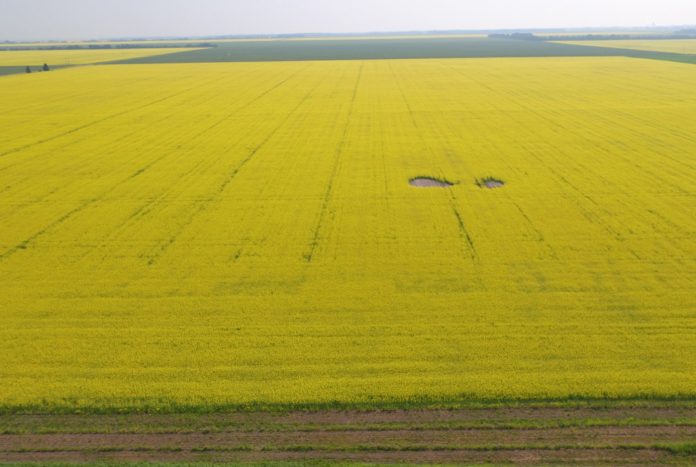
Agricultural producers in the Peace region are exploring a new technique called deep banding, which could significantly reduce costs and labor associated with fertilization. This method injects nutrients such as phosphorus and potassium four to six inches below the soil’s surface, making them more readily available to plant roots. Conducted by SARDA Ag Research, the trial aims to determine the long-term benefits of this approach for canola and other crops.
Deep banding occurs every three years and is particularly beneficial for no-till or reduced-tillage farming practices. According to grain farmer Norm Boulet, this method streamlines the seeding process by allowing farmers to apply fewer products at planting time. Boulet, who is participating in the trial, explains, “Deep banding the nutrient speeds up seeding by reducing the amount of products we have to deal with through the drill at seeding.”
In the trial, Boulet’s farm applied 200 lbs per acre of 11-52 phosphorus fertilizer, a significant increase from the typical application of 50 lbs per acre. The goal was to ensure that the nutrients would last for four years, thereby minimizing the need for additional fertilizer applications.
Benefits of Deep Banding for Farmers
The primary advantage of deep banding lies in its potential to lower input costs. Farmers can purchase fertilizers like monoammonium phosphate (MAP) at lower prices in the fall and inject them into the soil for future use. Boulet noted that if deep banding proves effective, it would alleviate the burden of handling multiple products during the busy spring planting season. “If we didn’t have to place the phosphorus at seeding time, it would allow us to carry more seed or other types of fertilizer,” he remarked.
The trial also aims to assess whether deep banding affects crop yields. Boulet highlighted that during the initial years of the trial, there was no observed yield loss. “No yield loss had been experienced,” he stated, emphasizing the importance of maintaining productivity while exploring new agricultural practices.
Boulet’s family farm conducted a 50-acre trial, deep banding phosphorus fertilizer in the fall of 2021. With a typical four-year crop rotation, they aimed to understand how this method could impact all crops involved. The results showed that yields remained consistent even after four years, with no significant changes in grain quality.
Future Considerations for Deep Banding
The research indicates that deep banding could also be beneficial in optimizing soil moisture. By seeding crops more quickly, farmers can better utilize available moisture and potentially improve yield outcomes. Boulet noted that early seeding typically correlates with higher yields, as crops can establish before weeds compete for resources.
While the trial results are promising, challenges remain. Boulet mentioned that fertilizer prices surged significantly after the trial began, complicating the economic feasibility of the practice. “Adopting it didn’t seem to make economic sense for us,” he explained.
Despite these challenges, Boulet believes that deep banding could be particularly advantageous for farmers facing time constraints during the spring. Those using smaller equipment, which limits the amount of product they can carry, may find this method especially appealing. “If I were to be offered a very good price on MAP in the fall and had the time to deep band the product, I would certainly consider it,” he stated.
The collaboration between SARDA Ag Research and local farmers has yielded valuable insights into the efficacy of deep banding. As the agricultural community continues to adapt to changing economic conditions and environmental challenges, this technique may offer a viable solution for optimizing fertilization practices.
For more information about deep banding practices, interested parties can contact the SARDA Ag Research office at (780) 837-2900.

Meta Plans Major Layoffs as AI Costs Surge

Alberta’s Referendum Could Pave Way for U.S. Statehood

Minooka District 201 Plans Enhanced Bilingual Support for Students

Canmore Approves Multiple Development Permits for New Projects

Remembering Bradly Castillo Shearsmith: A Life of Friendship and Joy

BIS Urges Watchdogs to Integrate Synthetic Risk Transfers in Stress Tests

Teva Transforms: Shifting Focus from Generics to Branded Success

Apple Launches AirPods Max 2 with Enhanced Audio Features

Ontario Ends Funding for Seven Supervised Injection Sites

Toyoake City Proposes Daily Two-Hour Smartphone Use Limit

Pedestrian Fatally Injured in Esquimalt Collision on August 14

Dark Adventure Game “Bye Sweet Carole” Set for October Release

B.C. Review Reveals Urgent Need for Rare-Disease Drug Reforms

Konami Revives Iconic Metal Gear Solid Delta Ahead of Release

Jimmy Lai’s Defense Challenges Charges Under National Security Law

Victoria’s Pop-Up Shop Shines Light on B.C.’s Wolf Cull

Snapmaker U1 Color 3D Printer Redefines Speed and Sustainability

Apple Expands Self-Service Repair Program to Canada
-
 Science9 months ago
Toyoake City Proposes Daily Two-Hour Smartphone Use Limit
-
 Top Stories9 months ago
Pedestrian Fatally Injured in Esquimalt Collision on August 14
-
 Technology9 months ago
Dark Adventure Game “Bye Sweet Carole” Set for October Release
-
 Health9 months ago
B.C. Review Reveals Urgent Need for Rare-Disease Drug Reforms
-
 Technology9 months ago
Konami Revives Iconic Metal Gear Solid Delta Ahead of Release
-
 World9 months ago
Jimmy Lai’s Defense Challenges Charges Under National Security Law
-
 Lifestyle9 months ago
Victoria’s Pop-Up Shop Shines Light on B.C.’s Wolf Cull
-
 Technology9 months ago
Snapmaker U1 Color 3D Printer Redefines Speed and Sustainability
-
 Technology9 months ago
Apple Expands Self-Service Repair Program to Canada
-

 Technology9 months ago
AION Folding Knife: Redefining EDC Design with Premium Materials
-

 Technology9 months ago
Solve Today’s Wordle Challenge: Hints and Answer for August 19
-

 Business9 months ago
Gordon Murray Automotive Unveils S1 LM and Le Mans GTR at Monterey