
Science
First Nation Professor Revitalizes Salish Sky Stories Through Research

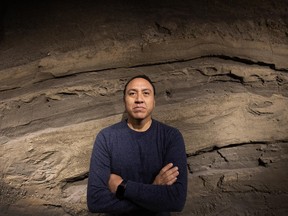
A professor at the University of British Columbia is working to revitalize traditional Salish astronomical knowledge, connecting ancient stories to modern understandings of the night sky. Shandin Pete, who belongs to the Bitterroot Band of Salish in Montana, is dedicated to recovering the celestial narratives that link his ancestors to the cosmos. His journey began with a childhood wonder about the Milky Way, a curiosity he shared with his grandfather, who struggled to recall the Salish name for this prominent feature.
The impact of colonialism led to a significant loss of Indigenous knowledge, particularly regarding how the Salish people understood the stars. “Our creation stories are still told today, but what was lost was the connection to places that were not terrestrial,” Pete explained. He emphasizes that understanding the sky requires a shift in perspective, one that aligns with Indigenous views of the cosmos.
Pete’s research includes interviews with elders, archival studies, and anthropology field notes. He aims to piece together the stories associated with various celestial formations, particularly asterisms—smaller patterns within the 88 recognized constellations. These patterns have largely been overlooked by Western astronomy, which has not incorporated Indigenous perspectives.
“What we see when we look up away from earth is another reality that mirrors what is happening on earth,” Pete said. In the Salish worldview, the stars are seen as reflections of earthly events, often marking critical moments in stories. For instance, one of the first connections he made was with the constellation Orion. In Salish tradition, Orion’s belt symbolizes the centre of a canoe, with the other stars representing its ends. “Once you start understanding the story, you lose the form of Orion and see the canoe so clearly,” he noted.
A pivotal moment in Pete’s research came when he discovered a passage in an anthropologist’s notes that referenced three stars rising in a consistent location. After consulting with trained astronomers, he managed to connect this observation with Salish stories about the canoe, revealing insights into lunar cycles and solstices. “This knowledge is documented in many seagoing cultures, but it is a testament to the knowledge of my ancestors that they also understood it,” he remarked.
The significance of restoring Indigenous astronomical knowledge extends beyond academic interest. Pete believes it is crucial for young people within his community to recognize the intelligence and functionality of their ancestors. “It’s important for my community to demonstrate how well they functioned before the advent of technology,” he said.
On December 13, Pete will share these celestial stories at the H.R. MacMillan Space Centre in Vancouver. The event, titled “Salish Skies: Indigenous Sky Stories,” aims to highlight the rich cultural heritage associated with the stars. Doors open at 14:30, with Pete’s presentation starting at 15:00. Tickets are available for $26.20 via Eventbrite.
Through his work, Pete not only honors his ancestors but also enriches the understanding of Indigenous perspectives in the broader context of astronomy. By bridging ancient knowledge with contemporary science, he fosters a renewed appreciation for the Salish connection to the cosmos.

Meta Plans Major Layoffs as AI Costs Surge

Alberta’s Referendum Could Pave Way for U.S. Statehood

Minooka District 201 Plans Enhanced Bilingual Support for Students

Canmore Approves Multiple Development Permits for New Projects

Remembering Bradly Castillo Shearsmith: A Life of Friendship and Joy

BIS Urges Watchdogs to Integrate Synthetic Risk Transfers in Stress Tests

Teva Transforms: Shifting Focus from Generics to Branded Success

Apple Launches AirPods Max 2 with Enhanced Audio Features

Ontario Ends Funding for Seven Supervised Injection Sites

Toyoake City Proposes Daily Two-Hour Smartphone Use Limit

Pedestrian Fatally Injured in Esquimalt Collision on August 14

B.C. Review Reveals Urgent Need for Rare-Disease Drug Reforms

Dark Adventure Game “Bye Sweet Carole” Set for October Release

Konami Revives Iconic Metal Gear Solid Delta Ahead of Release

Victoria’s Pop-Up Shop Shines Light on B.C.’s Wolf Cull

Jimmy Lai’s Defense Challenges Charges Under National Security Law

Snapmaker U1 Color 3D Printer Redefines Speed and Sustainability

Apple Expands Self-Service Repair Program to Canada
-
 Science12 months ago
Toyoake City Proposes Daily Two-Hour Smartphone Use Limit
-
 Top Stories12 months ago
Pedestrian Fatally Injured in Esquimalt Collision on August 14
-
 Health12 months ago
B.C. Review Reveals Urgent Need for Rare-Disease Drug Reforms
-
 Technology12 months ago
Dark Adventure Game “Bye Sweet Carole” Set for October Release
-
 Technology12 months ago
Konami Revives Iconic Metal Gear Solid Delta Ahead of Release
-
 Lifestyle12 months ago
Victoria’s Pop-Up Shop Shines Light on B.C.’s Wolf Cull
-
 World12 months ago
Jimmy Lai’s Defense Challenges Charges Under National Security Law
-
 Technology12 months ago
Snapmaker U1 Color 3D Printer Redefines Speed and Sustainability
-
 Technology12 months ago
Apple Expands Self-Service Repair Program to Canada
-

 Technology12 months ago
AION Folding Knife: Redefining EDC Design with Premium Materials
-

 Technology12 months ago
Solve Today’s Wordle Challenge: Hints and Answer for August 19
-

 Business12 months ago
Gordon Murray Automotive Unveils S1 LM and Le Mans GTR at Monterey