
Science
Researchers Explore Robot Empathy with Interactive Technology

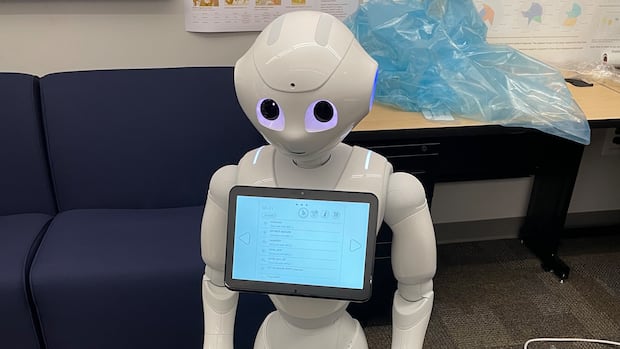
A team of researchers at Simon Fraser University is investigating whether robots can be taught to understand and respond to human emotions. Led by Angelica Lim, an associate professor of computing science, the project focuses on developing robots that can interpret non-verbal cues, enhancing their interactions with people.
During a demonstration, Lim showcased a robot named Pepper, which attempts to tell jokes while gauging its audience’s reactions. When Pepper quipped, “What’s the deal with bananas? Where’s the banana juice?” it looked to Lim for feedback, interpreting her neutral expression as a signal that its joke did not resonate. This capability of reading human emotions is central to Lim’s research, which aims to create robots that can engage with humans on a more personal level.
Understanding Human Interaction
Lim’s fascination with robotics began in childhood, inspired by the Disney characters brought to life through animatronics. She recalls her aspiration to become a Disney imagineer, a dream she is now pursuing through her work in robotics. Her past experiences include creating a musical robot during her graduate studies in Japan, which sparked her interest in whether robots could possess emotions.
As Lim’s research evolved, she recognized the ethical dilemmas surrounding the creation of robots that could feel pain or emotion. Instead, her focus shifted toward teaching robots like Pepper to respond appropriately to human body language and facial expressions. Lim explained, “There are unwritten social rules that humans instinctively know, and we want robots to understand these rules as well.”
Her team is developing algorithms that rely on data from facial expressions and body language. This involves navigating challenges related to bias and privacy while ensuring the robots can effectively interpret human emotions.
Applications Beyond Entertainment
The potential applications of this technology extend beyond entertainment. AJung Moon, a computer scientist at McGill University, emphasizes the significance of robots recognizing non-verbal cues in various contexts. Moon’s lab is currently working on a robotic shopping assistant designed to aid customers with specific needs.
In a hypothetical scenario, a customer with a visual impairment and dietary restrictions might rely on a robot to navigate a grocery store. Moon highlighted the importance of the robot picking up on cues indicating the customer’s desire for efficiency in their shopping experience. “This technology has the potential to be life-changing for individuals who require assistance,” she noted.
As researchers like Lim and Moon explore the boundaries of robotic interaction, they are also mindful of the ethical considerations that accompany advancements in this field. Moon advocates for establishing guidelines around how robots simulate human emotions, ensuring that their capabilities align with their intended purposes.
Lim’s lab at Simon Fraser University houses a fleet of ten Pepper robots, which have been utilized in various educational contexts. These robots have helped teach coding to high school students and introduced Indigenous studies students to the Blackfoot language, Niitsíʼpowahsin.
Looking ahead, Lim continues to envision a future where robotics can evoke joy and wonder, similar to the experiences she cherished in her youth. As she reflects on her journey, she remains committed to advancing the field of robotics while ensuring that ethical considerations remain at the forefront of her research.

Meta Plans Major Layoffs as AI Costs Surge

Alberta’s Referendum Could Pave Way for U.S. Statehood

Minooka District 201 Plans Enhanced Bilingual Support for Students

Canmore Approves Multiple Development Permits for New Projects

Remembering Bradly Castillo Shearsmith: A Life of Friendship and Joy

BIS Urges Watchdogs to Integrate Synthetic Risk Transfers in Stress Tests

Teva Transforms: Shifting Focus from Generics to Branded Success

Apple Launches AirPods Max 2 with Enhanced Audio Features

Ontario Ends Funding for Seven Supervised Injection Sites

Toyoake City Proposes Daily Two-Hour Smartphone Use Limit

Pedestrian Fatally Injured in Esquimalt Collision on August 14

B.C. Review Reveals Urgent Need for Rare-Disease Drug Reforms

Dark Adventure Game “Bye Sweet Carole” Set for October Release

Konami Revives Iconic Metal Gear Solid Delta Ahead of Release

Victoria’s Pop-Up Shop Shines Light on B.C.’s Wolf Cull

Jimmy Lai’s Defense Challenges Charges Under National Security Law

Snapmaker U1 Color 3D Printer Redefines Speed and Sustainability

Apple Expands Self-Service Repair Program to Canada
-
 Science11 months ago
Toyoake City Proposes Daily Two-Hour Smartphone Use Limit
-
 Top Stories11 months ago
Pedestrian Fatally Injured in Esquimalt Collision on August 14
-
 Health11 months ago
B.C. Review Reveals Urgent Need for Rare-Disease Drug Reforms
-
 Technology11 months ago
Dark Adventure Game “Bye Sweet Carole” Set for October Release
-
 Technology11 months ago
Konami Revives Iconic Metal Gear Solid Delta Ahead of Release
-
 Lifestyle11 months ago
Victoria’s Pop-Up Shop Shines Light on B.C.’s Wolf Cull
-
 World11 months ago
Jimmy Lai’s Defense Challenges Charges Under National Security Law
-
 Technology11 months ago
Snapmaker U1 Color 3D Printer Redefines Speed and Sustainability
-
 Technology11 months ago
Apple Expands Self-Service Repair Program to Canada
-

 Technology11 months ago
AION Folding Knife: Redefining EDC Design with Premium Materials
-

 Technology11 months ago
Solve Today’s Wordle Challenge: Hints and Answer for August 19
-

 Business11 months ago
Gordon Murray Automotive Unveils S1 LM and Le Mans GTR at Monterey