
Science
SpaceX Removes Crew Access Arm to Enhance Starship Launches

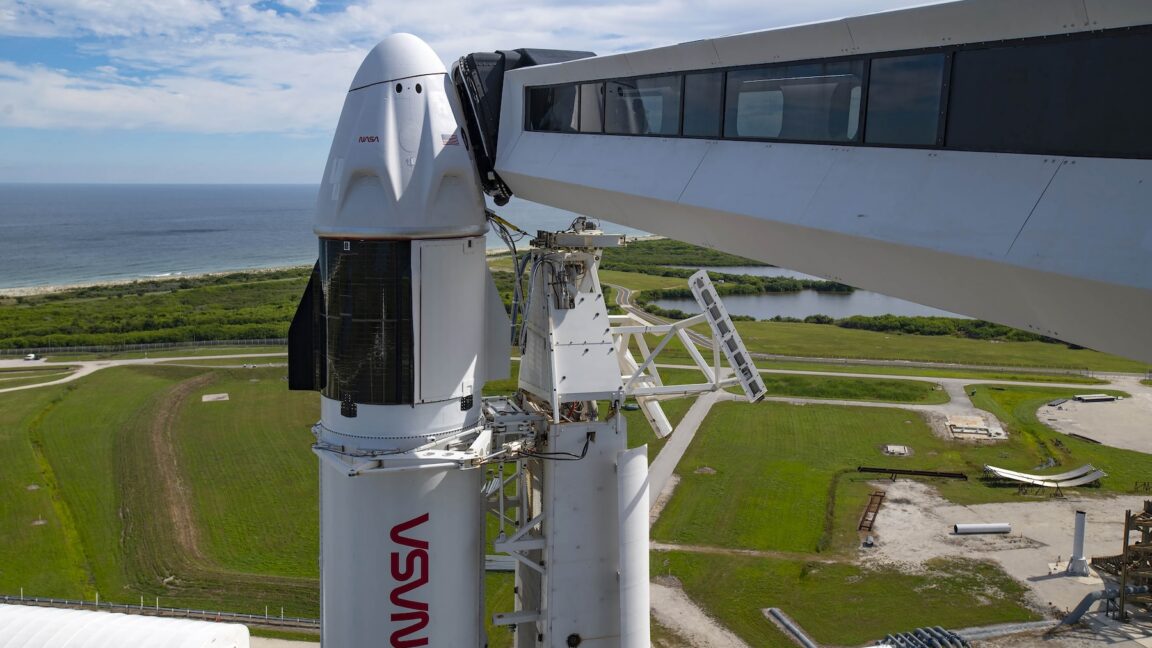
SpaceX has removed the Crew Access Arm from Pad 39A at NASA’s Kennedy Space Center in Florida as part of preparations for the upcoming launches of its Starship rocket. This change marks another evolution for the historic launch site, which has seen significant transformations since its inception over 60 years ago.
Launch Complex 39A has a storied history, originally developed for the Saturn V rockets that took astronauts to the Moon. The pad was later adapted for the Space Shuttle program, with the last shuttle flight departing from here in 2011. In 2017, NASA leased the site to SpaceX, which has since utilized it for Falcon 9 and Falcon Heavy launches. A new Crew Access Arm was installed in 2018 to facilitate crew access for SpaceX’s Crew Dragon spacecraft, first used for manned flights in 2020.
Transition to Starship
With the impending arrival of the Starship rocket, SpaceX is shifting its focus. A new launch tower is currently under construction about 1,000 feet east of Pad 39A. The company aims to conduct its first Starship launch from Kennedy Space Center later this year, following initial flights from its Starbase test site in South Texas. Consequently, Falcon 9 flights will be temporarily suspended from Pad 39A, as SpaceX redirects operations to nearby Pad 40 at Cape Canaveral Space Force Station.
Kiko Dontchev, SpaceX’s vice president of launch, noted on X in December that this move would enable teams to concentrate on “ramping Starship from the Cape” while continuing Falcon Heavy operations from Pad 39A. The next Falcon Heavy launch is scheduled for no earlier than April, with a limited number of flights planned for the remainder of the decade.
Pad 40 will now serve as the primary launch site for Crew Dragon missions, with the first of these flights scheduled for later this week. Lee Echerd, a senior mission manager for human spaceflight at SpaceX, emphasized the advantages of operating from two launch pads, stating, “For our manifest going forward, we’re planning to launch most of our Falcon 9 launches off of Space Launch Complex 40.”
Maintenance and Future Plans
While the removal of the Crew Access Arm is a significant alteration, it is also necessary for maintenance. Bill Gerstenmaier, SpaceX’s vice president of build and flight reliability, explained that the bearings connecting the arm to the launch pad’s tower require repairs. “To physically get access to those, the arm needs to be removed,” he stated. This maintenance work will take place at Kennedy Space Center, ensuring the arm can be reinstalled when needed for future missions.
Despite the ongoing construction and changes, Falcon 9 and Falcon Heavy launches continue from Pad 39A without interruptions. Gerstenmaier reassured that operations remain unaffected for the time being, though future Starship testing could necessitate more extensive closures of the pad.
As SpaceX transitions towards an ambitious future with Starship, the company is also aware of its operational needs for Falcon 9 and Falcon Heavy. The enhanced capabilities and focused efforts at both Pad 39A and Pad 40 reflect SpaceX’s commitment to maintaining a robust launch schedule while preparing for the next generation of space exploration.

Meta Plans Major Layoffs as AI Costs Surge

Alberta’s Referendum Could Pave Way for U.S. Statehood

Minooka District 201 Plans Enhanced Bilingual Support for Students

Canmore Approves Multiple Development Permits for New Projects

Remembering Bradly Castillo Shearsmith: A Life of Friendship and Joy

BIS Urges Watchdogs to Integrate Synthetic Risk Transfers in Stress Tests

Teva Transforms: Shifting Focus from Generics to Branded Success

Apple Launches AirPods Max 2 with Enhanced Audio Features

Ontario Ends Funding for Seven Supervised Injection Sites

Toyoake City Proposes Daily Two-Hour Smartphone Use Limit

Pedestrian Fatally Injured in Esquimalt Collision on August 14

B.C. Review Reveals Urgent Need for Rare-Disease Drug Reforms

Dark Adventure Game “Bye Sweet Carole” Set for October Release

Konami Revives Iconic Metal Gear Solid Delta Ahead of Release

Victoria’s Pop-Up Shop Shines Light on B.C.’s Wolf Cull

Jimmy Lai’s Defense Challenges Charges Under National Security Law

Snapmaker U1 Color 3D Printer Redefines Speed and Sustainability

Apple Expands Self-Service Repair Program to Canada
-
 Science11 months ago
Toyoake City Proposes Daily Two-Hour Smartphone Use Limit
-
 Top Stories11 months ago
Pedestrian Fatally Injured in Esquimalt Collision on August 14
-
 Health11 months ago
B.C. Review Reveals Urgent Need for Rare-Disease Drug Reforms
-
 Technology11 months ago
Dark Adventure Game “Bye Sweet Carole” Set for October Release
-
 Technology11 months ago
Konami Revives Iconic Metal Gear Solid Delta Ahead of Release
-
 Lifestyle11 months ago
Victoria’s Pop-Up Shop Shines Light on B.C.’s Wolf Cull
-
 World11 months ago
Jimmy Lai’s Defense Challenges Charges Under National Security Law
-
 Technology11 months ago
Snapmaker U1 Color 3D Printer Redefines Speed and Sustainability
-
 Technology11 months ago
Apple Expands Self-Service Repair Program to Canada
-

 Technology11 months ago
AION Folding Knife: Redefining EDC Design with Premium Materials
-

 Technology11 months ago
Solve Today’s Wordle Challenge: Hints and Answer for August 19
-

 Business11 months ago
Gordon Murray Automotive Unveils S1 LM and Le Mans GTR at Monterey