
Technology
Comparing the 2026 Honda CR-V Hybrid and Hyundai Tucson Hybrid

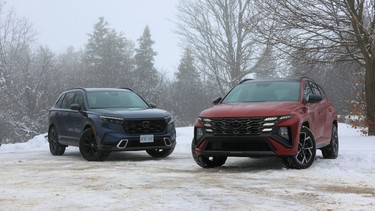
Minimizing fuel costs is increasingly important for drivers, and hybrid vehicles offer an appealing alternative to traditional gasoline engines. The release of the 2026 models has brought renewed attention to two standout options in the hybrid crossover segment: the 2026 Honda CR-V Hybrid and the 2026 Hyundai Tucson Hybrid. This article aims to evaluate their affordability, efficiency, and practicality.
Pricing and Trims
The 2026 Honda CR-V Hybrid, manufactured in Canada, continues to be a popular choice among consumers. Among its seven trims, four offer hybrid options. The most affordable variant, the CR-V Sport Hybrid, starts at $49,041, while the more advanced Touring Hybrid model, which we tested, retails for $54,341.
In contrast, the 2026 Hyundai Tucson Hybrid presents a different pricing structure. It includes only two hybrid trims: the entry-level N-Line, priced at $43,799, and the top-tier Ultimate trim at $47,799. Notably, the Tucson Ultimate can also be upgraded to a plug-in hybrid variant for an additional $5,500.
Reliability and Warranty Comparison
When considering reliability, both manufacturers have established their reputations over the years. According to J.D. Power and Consumer Reports, Honda is recognized as a more reliable automaker compared to Hyundai. However, Hyundai offers a more extensive warranty. The Tucson comes with a five-year, 100,000-kilometre limited warranty, supplemented by an eight-year, 160,000-kilometre hybrid warranty. Honda provides similar coverage for five years and 100,000 kilometres for the powertrain, but only three years or 60,000 kilometres of comprehensive coverage.
Features and Comfort
The average cost of a new car in Canada is around $65,000, positioning both the CR-V and Tucson as relatively affordable options in the hybrid market. To justify their price, both vehicles offer an array of features. The CR-V’s entry-level model includes stylish 18-inch wheels, while the Tucson N-Line boasts larger 19-inch wheels, along with features like rain-sensing wipers, a panoramic sunroof, and a remote starter.
Inside, the Tucson provides a more generous assortment of technology and comfort options. It features two 12.3-inch screens, heated front and rear seats, a heated steering wheel, dual-zone climate control, and a wireless phone charger. The Ultimate trim enhances the Tucson’s appeal with premium seating, built-in navigation, and ventilated seats. Conversely, the CR-V Sport Hybrid, despite being priced higher, lacks some of these features, such as rear seat heaters and premium upholstery, with a smaller nine-inch infotainment screen.
Interior Space and Practicality
When it comes to interior space, the Tucson offers more passenger room than the CR-V. With 3,055 litres of passenger capacity, it surpasses the CR-V’s 2,931 litres. Additionally, the Tucson also leads in cargo capacity, providing 1,097 litres behind the rear seats and 2,108 litres with the seats folded down, compared to the CR-V’s 1,028 litres and 2,030 litres, respectively.
Although the Tucson excels in space, the lower LATCH points for securing child seats can be cumbersome, making it less user-friendly than the CR-V in this aspect.
Performance and Efficiency
In terms of performance, the 2026 Honda CR-V Hybrid is equipped with a 2.0-litre four-cylinder engine, paired with electric motors to produce a total of 204 horsepower and 247 lb-ft of torque. This engine configuration promises fuel efficiency, with Natural Resources Canada estimating consumption rates of 6 L/100 km in city driving, 6.9 L/100 km on the highway, and 6.4 L/100 km combined.
On the other hand, the Hyundai Tucson Hybrid utilizes a 1.6-litre turbocharged four-cylinder engine, combined with an electric motor and a six-speed automatic transmission, delivering 231 horsepower and 271 lb-ft of torque. The Tucson’s efficiency ratings are slightly less impressive at 6.7 L/100 km for both city and highway driving, leading to a combined consumption of 6.7 L/100 km.
During real-world testing in winter conditions, both vehicles struggled to meet their efficiency ratings, averaging between 7.5 and 8 L/100 km.
Driving Experience
In terms of driving dynamics, the CR-V showcases confidence on the road, although the continuously variable transmission (CVT) can sometimes produce an unappealing noise when more power is needed. The available drive modes, including Normal, Sport, Econ, Snow, and a customizable Individual mode, offer some flexibility, though significant differences were not always perceptible.
The Tucson, while being more responsive, also had a slightly mushy brake feel. Despite this, its additional power made passing maneuvers more straightforward. Similar to the CR-V, the Tucson features various drive modes, including settings for snow and mud conditions.
Both models offer advanced safety features, including adaptive cruise control, lane-keeping assist, and blind-spot monitoring. However, neither vehicle has yet received the IIHS Top Safety Pick+ rating, potentially due to the lack of testing for the 2026 models.
Conclusion
The 2026 Honda CR-V Hybrid presents itself as a reliable and efficient option for hybrid crossover seekers. Nevertheless, the 2026 Hyundai Tucson Hybrid stands out with its superior power, spacious interior, and extensive features, making it a compelling choice. Even without strict budget considerations, the Tucson’s advantages justify its selection as the preferred option in this comparison.

Meta Plans Major Layoffs as AI Costs Surge

Alberta’s Referendum Could Pave Way for U.S. Statehood

Minooka District 201 Plans Enhanced Bilingual Support for Students

Canmore Approves Multiple Development Permits for New Projects

Remembering Bradly Castillo Shearsmith: A Life of Friendship and Joy

BIS Urges Watchdogs to Integrate Synthetic Risk Transfers in Stress Tests

Teva Transforms: Shifting Focus from Generics to Branded Success

Apple Launches AirPods Max 2 with Enhanced Audio Features

Ontario Ends Funding for Seven Supervised Injection Sites

Toyoake City Proposes Daily Two-Hour Smartphone Use Limit

Pedestrian Fatally Injured in Esquimalt Collision on August 14

B.C. Review Reveals Urgent Need for Rare-Disease Drug Reforms

Dark Adventure Game “Bye Sweet Carole” Set for October Release

Konami Revives Iconic Metal Gear Solid Delta Ahead of Release

Victoria’s Pop-Up Shop Shines Light on B.C.’s Wolf Cull

Jimmy Lai’s Defense Challenges Charges Under National Security Law

Snapmaker U1 Color 3D Printer Redefines Speed and Sustainability

Apple Expands Self-Service Repair Program to Canada
-
 Science1 year ago
Toyoake City Proposes Daily Two-Hour Smartphone Use Limit
-
 Top Stories1 year ago
Pedestrian Fatally Injured in Esquimalt Collision on August 14
-
 Health1 year ago
B.C. Review Reveals Urgent Need for Rare-Disease Drug Reforms
-
 Technology1 year ago
Dark Adventure Game “Bye Sweet Carole” Set for October Release
-
 Technology1 year ago
Konami Revives Iconic Metal Gear Solid Delta Ahead of Release
-
 Lifestyle1 year ago
Victoria’s Pop-Up Shop Shines Light on B.C.’s Wolf Cull
-
 World1 year ago
Jimmy Lai’s Defense Challenges Charges Under National Security Law
-
 Technology1 year ago
Snapmaker U1 Color 3D Printer Redefines Speed and Sustainability
-
 Technology1 year ago
Apple Expands Self-Service Repair Program to Canada
-

 Technology1 year ago
AION Folding Knife: Redefining EDC Design with Premium Materials
-

 Technology1 year ago
Solve Today’s Wordle Challenge: Hints and Answer for August 19
-

 Business1 year ago
Gordon Murray Automotive Unveils S1 LM and Le Mans GTR at Monterey