
Top Stories
Iran Faces Uncertain Future as Succession Process Begins After Khamenei’s Death

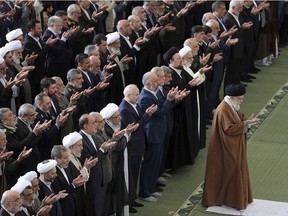
The death of Supreme Leader Ayatollah Ali Khamenei on June 18, 2025, after nearly 37 years in power, has initiated a critical succession process in Iran. His passing, reportedly resulting from an airstrike campaign conducted by the United States and Israel, has raised significant questions about the future direction of the country.
In response to this development, Iran’s constitution mandates the formation of a temporary leadership council. This council, established immediately following Khamenei’s death, consists of the sitting president, Masoud Pezeshkian, the head of the judiciary, Gholamhossein Mohseni Ejei, and a member selected from the Guardian Council. This council will assume leadership duties until a new supreme leader is appointed.
The Assembly of Experts, an 88-member body comprised entirely of Shiite clerics, is responsible for selecting the next supreme leader as outlined by Iranian law. The members of this panel are elected every eight years and their candidacies must be approved by the Guardian Council, the constitutional watchdog known for disqualifying candidates. Most recently, former President Hassan Rouhani was barred from running for the Assembly in March 2024.
While this leadership council will govern temporarily, the deliberations surrounding the selection of Khamenei’s successor are expected to remain largely behind closed doors. The process is intricate and may involve various factions within Iran’s political landscape. Initially, hard-line President Ebrahim Raisi was seen as a potential successor; however, he died in a helicopter crash on May 20, 2024, significantly altering the succession landscape.
Now, Khamenei’s son, Mojtaba Khamenei, emerges as a potential candidate despite lacking formal government experience. His ascension could provoke backlash, particularly from critics of clerical rule, who may view a father-to-son transfer as an un-Islamic attempt to establish a new religious dynasty reminiscent of the pre-1979 era under Shah Mohammad Reza Pahlavi.
The transfer of power in Iran is rare, with only one prior instance occurring in 1989 when Grand Ayatollah Ruhollah Khomeini passed away. As the architect of the 1979 Islamic Revolution, Khomeini’s leadership was pivotal during the subsequent eight-year war with Iraq. The current transition unfolds against the backdrop of ongoing tensions, particularly following a 12-day military conflict initiated by Israel against Iran in June 2025.
The supreme leader wields substantial authority within Iran’s complex power structure, overseeing all state matters as well as serving as the commander-in-chief of the military and the influential Revolutionary Guard. This paramilitary force has been designated a terrorist organization by the United States since 2019 and has played a crucial role in Iran’s foreign policy, particularly in countering U.S. and Israeli influence in the region.
As Iran navigates this unprecedented moment, the global community watches closely, awaiting clarity on the potential direction of leadership and policy in a country that has long been a focal point of geopolitical tensions. The next steps in the succession process will likely shape Iran’s internal and external relations for years to come.

Meta Plans Major Layoffs as AI Costs Surge

Alberta’s Referendum Could Pave Way for U.S. Statehood

Minooka District 201 Plans Enhanced Bilingual Support for Students

Canmore Approves Multiple Development Permits for New Projects

Remembering Bradly Castillo Shearsmith: A Life of Friendship and Joy

BIS Urges Watchdogs to Integrate Synthetic Risk Transfers in Stress Tests

Teva Transforms: Shifting Focus from Generics to Branded Success

Apple Launches AirPods Max 2 with Enhanced Audio Features

Ontario Ends Funding for Seven Supervised Injection Sites

Toyoake City Proposes Daily Two-Hour Smartphone Use Limit

Pedestrian Fatally Injured in Esquimalt Collision on August 14

B.C. Review Reveals Urgent Need for Rare-Disease Drug Reforms

Dark Adventure Game “Bye Sweet Carole” Set for October Release

Konami Revives Iconic Metal Gear Solid Delta Ahead of Release

Victoria’s Pop-Up Shop Shines Light on B.C.’s Wolf Cull

Jimmy Lai’s Defense Challenges Charges Under National Security Law

Snapmaker U1 Color 3D Printer Redefines Speed and Sustainability

Apple Expands Self-Service Repair Program to Canada
-
 Science12 months ago
Toyoake City Proposes Daily Two-Hour Smartphone Use Limit
-
 Top Stories12 months ago
Pedestrian Fatally Injured in Esquimalt Collision on August 14
-
 Health12 months ago
B.C. Review Reveals Urgent Need for Rare-Disease Drug Reforms
-
 Technology12 months ago
Dark Adventure Game “Bye Sweet Carole” Set for October Release
-
 Technology12 months ago
Konami Revives Iconic Metal Gear Solid Delta Ahead of Release
-
 Lifestyle12 months ago
Victoria’s Pop-Up Shop Shines Light on B.C.’s Wolf Cull
-
 World12 months ago
Jimmy Lai’s Defense Challenges Charges Under National Security Law
-
 Technology12 months ago
Snapmaker U1 Color 3D Printer Redefines Speed and Sustainability
-
 Technology12 months ago
Apple Expands Self-Service Repair Program to Canada
-

 Technology12 months ago
AION Folding Knife: Redefining EDC Design with Premium Materials
-

 Technology12 months ago
Solve Today’s Wordle Challenge: Hints and Answer for August 19
-

 Business12 months ago
Gordon Murray Automotive Unveils S1 LM and Le Mans GTR at Monterey