
World
AI Distorts Narrative Surrounding Maduro’s Capture in US Court

The recent capture of Venezuelan leader Nicolas Maduro on January 3, 2024, has ignited a complex narrative, heavily influenced by artificial intelligence-generated content. Following his arrest in Caracas alongside his wife, Cilia Flores, a barrage of memes and dramatic recreations have flooded social media, blurring the lines between reality and fiction. These portrayals include comedic scenarios, such as an AI-generated courtroom where Maduro declares himself a “prisoner of war,” and absurd escape attempts that pit him against Donald Trump in surreal settings.
Maduro and Flores were apprehended during U.S. military operations in the Venezuelan capital and are now facing drug trafficking charges in a New York prison. While some view Maduro’s ouster as a positive development, the “Chavismo” movement, which he leads, is actively working to redefine the implications of his downfall for Venezuela’s future.
AI Content Flooding Social Media
According to Leon Hernandez, a researcher at Andres Bello Catholic University, the rapid proliferation of AI-generated content has given rise to what he describes as “disinformation labs.” These entities generate a mix of real and fabricated information that creates confusion among the public. “There were things that circulated that were not real during the capture, and things that circulated which were real that generated doubt,” Hernandez told AFP.
He emphasized the strategy behind this phenomenon is to overwhelm audiences with content, making it increasingly difficult for individuals to discern truth from fiction. Even traditional media outlets, such as the Venezuelan state broadcaster VTV, have participated by airing AI-created videos, including animations narrated by children that recount Maduro’s capture.
AI as a Tool for Political Manipulation
The use of AI in shaping political narratives is not unique to Venezuela. Elena Block, a professor of political communication and strategy at the University of Queensland, stated, “AI has become the new instrument of power for autocrats to confuse, combat, and silence dissent.” She noted that cartoons and animations have been utilized as propaganda tools in both authoritarian and democratic contexts.
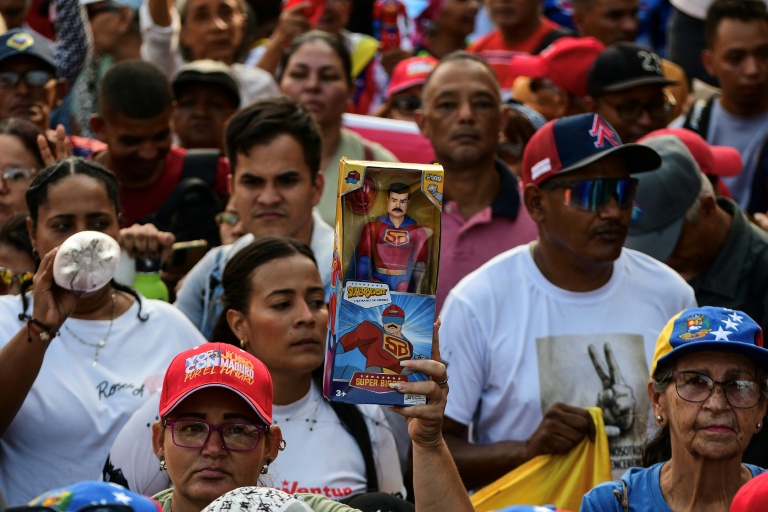
Long before his arrest, Maduro was often depicted as “Super Bigote” or “Super Mustache,” a superhero figure combating perceived threats. The popularity of this character has translated into merchandise and support at rallies advocating for his return. Block highlighted that as traditional media faces censorship and decline, social media has emerged as a vital space for information dissemination.
Maduro’s approach to media control mirrors that of other leaders, including Trump, who has also leveraged AI-generated visuals to amplify his political messaging. Block remarked, “These digital and AI tools end up trivializing politics: you don’t explain it, you diminish it.” She concluded by asserting that AI poses a significant challenge to democratic discourse, characterizing it as “the greatest threat to democracy.”
The evolving dynamics of media and political narratives underscore the intricate relationship between technology and governance. As events unfold in Venezuela, the impact of AI on public perception remains a pivotal factor in the ongoing discourse surrounding Maduro’s future and that of his government. As the landscape continues to change, the question of how to navigate the complexities of information in an AI-driven era becomes increasingly relevant.

Meta Plans Major Layoffs as AI Costs Surge

Alberta’s Referendum Could Pave Way for U.S. Statehood

Minooka District 201 Plans Enhanced Bilingual Support for Students

Canmore Approves Multiple Development Permits for New Projects

Remembering Bradly Castillo Shearsmith: A Life of Friendship and Joy

BIS Urges Watchdogs to Integrate Synthetic Risk Transfers in Stress Tests

Teva Transforms: Shifting Focus from Generics to Branded Success

Apple Launches AirPods Max 2 with Enhanced Audio Features

Ontario Ends Funding for Seven Supervised Injection Sites

Toyoake City Proposes Daily Two-Hour Smartphone Use Limit

Pedestrian Fatally Injured in Esquimalt Collision on August 14

B.C. Review Reveals Urgent Need for Rare-Disease Drug Reforms

Dark Adventure Game “Bye Sweet Carole” Set for October Release

Konami Revives Iconic Metal Gear Solid Delta Ahead of Release

Victoria’s Pop-Up Shop Shines Light on B.C.’s Wolf Cull

Jimmy Lai’s Defense Challenges Charges Under National Security Law

Snapmaker U1 Color 3D Printer Redefines Speed and Sustainability

Apple Expands Self-Service Repair Program to Canada
-
 Science1 year ago
Toyoake City Proposes Daily Two-Hour Smartphone Use Limit
-
 Top Stories1 year ago
Pedestrian Fatally Injured in Esquimalt Collision on August 14
-
 Health1 year ago
B.C. Review Reveals Urgent Need for Rare-Disease Drug Reforms
-
 Technology12 months ago
Dark Adventure Game “Bye Sweet Carole” Set for October Release
-
 Technology1 year ago
Konami Revives Iconic Metal Gear Solid Delta Ahead of Release
-
 Lifestyle1 year ago
Victoria’s Pop-Up Shop Shines Light on B.C.’s Wolf Cull
-
 World1 year ago
Jimmy Lai’s Defense Challenges Charges Under National Security Law
-
 Technology1 year ago
Snapmaker U1 Color 3D Printer Redefines Speed and Sustainability
-
 Technology1 year ago
Apple Expands Self-Service Repair Program to Canada
-

 Technology1 year ago
AION Folding Knife: Redefining EDC Design with Premium Materials
-

 Technology1 year ago
Solve Today’s Wordle Challenge: Hints and Answer for August 19
-

 Business1 year ago
Gordon Murray Automotive Unveils S1 LM and Le Mans GTR at Monterey