
World
Gold Prices Plunge as U.S. Dollar Strengthens Amid Iran Conflict

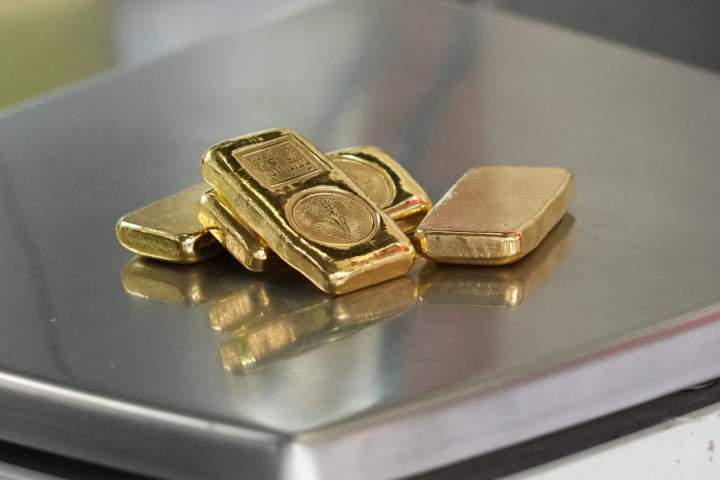
The ongoing conflict in Iran has led to a significant downturn in gold prices, which have historically been viewed as a safe haven during crises. On March 12, 2024, gold prices fell approximately four percent to around $5,124 per ounce. Analysts attribute this decline primarily to the strengthened position of the U.S. dollar in the wake of escalating tensions in the Middle East.
According to independent analyst Ross Norman, “The dollar is absolutely roaring away, as are U.S. Treasuries, and that’s providing a strong headwind to gold and particularly silver.” He explained that commodities like gold are typically priced in U.S. dollars, meaning that a stronger dollar generally diminishes the cost of these assets.
The recent airstrikes by the U.S. and Israel on Iranian targets have heightened instability in the region. In response, Iran has launched counterstrikes against U.S. military infrastructure, raising concerns over the potential for prolonged conflict. This situation has shifted investor confidence towards the U.S. dollar. Colin White, CEO of Verecan Capital Management, highlighted that “the whole world trades based on confidence.” He noted that, in times of uncertainty, the U.S. dollar tends to be seen as a more reliable asset than gold.
Market Reactions and Economic Implications
As the conflict continues, stock markets, including Wall Street, experienced a sell-off at the beginning of trading on March 12. Iran’s threats to close the Strait of Hormuz, a crucial shipping route for global oil, have further complicated the situation. This area sees approximately a fifth of the world’s oil supply, and disruptions here could drive prices up significantly. Currently, a barrel of crude oil is priced at around $74, marking a nearly 20 percent increase from less than $64 just days before.
The potential for rising oil prices is also contributing to inflation concerns. Higher energy costs typically lead to increased prices for goods and services, impacting consumers directly. Patrick De Haan, a petroleum analyst with GasBuddy, stated, “It is certainly impactful to what you’re going to be paying at the grocery store, when you go to the mall, the retail outlets.” He emphasized that rising diesel prices could trigger broader inflationary pressures across various sectors of the economy.
The expectation of increased inflation could prompt the U.S. Federal Reserve to raise interest rates. This scenario would likely strengthen the U.S. dollar further, as higher borrowing costs tend to attract foreign investment. As a result, gold prices may continue to face downward pressure.
Investor Sentiment and Future Outlook
Market analysts express caution regarding the future of gold prices in this volatile environment. Colin White further noted, “People are trying to find a direction and there’s a lot of uncertainty, and markets hate uncertainty.” As sentiments fluctuate, the perception of gold as a reliable investment may be challenged by the dynamics of currency strength and inflation risks.
The unfolding situation in Iran serves as a reminder of the interconnectedness of global markets. As geopolitical tensions rise, the response from investors will likely shape market trends in the coming weeks. The interplay between the U.S. dollar and commodities like gold will continue to be closely monitored as traders navigate this complex landscape.

Meta Plans Major Layoffs as AI Costs Surge

Alberta’s Referendum Could Pave Way for U.S. Statehood

Minooka District 201 Plans Enhanced Bilingual Support for Students

Canmore Approves Multiple Development Permits for New Projects

Remembering Bradly Castillo Shearsmith: A Life of Friendship and Joy

BIS Urges Watchdogs to Integrate Synthetic Risk Transfers in Stress Tests

Teva Transforms: Shifting Focus from Generics to Branded Success

Apple Launches AirPods Max 2 with Enhanced Audio Features

Ontario Ends Funding for Seven Supervised Injection Sites

Toyoake City Proposes Daily Two-Hour Smartphone Use Limit

Pedestrian Fatally Injured in Esquimalt Collision on August 14

B.C. Review Reveals Urgent Need for Rare-Disease Drug Reforms

Dark Adventure Game “Bye Sweet Carole” Set for October Release

Konami Revives Iconic Metal Gear Solid Delta Ahead of Release

Victoria’s Pop-Up Shop Shines Light on B.C.’s Wolf Cull

Jimmy Lai’s Defense Challenges Charges Under National Security Law

Snapmaker U1 Color 3D Printer Redefines Speed and Sustainability

Apple Expands Self-Service Repair Program to Canada
-
 Science12 months ago
Toyoake City Proposes Daily Two-Hour Smartphone Use Limit
-
 Top Stories12 months ago
Pedestrian Fatally Injured in Esquimalt Collision on August 14
-
 Health12 months ago
B.C. Review Reveals Urgent Need for Rare-Disease Drug Reforms
-
 Technology12 months ago
Dark Adventure Game “Bye Sweet Carole” Set for October Release
-
 Technology12 months ago
Konami Revives Iconic Metal Gear Solid Delta Ahead of Release
-
 Lifestyle12 months ago
Victoria’s Pop-Up Shop Shines Light on B.C.’s Wolf Cull
-
 World12 months ago
Jimmy Lai’s Defense Challenges Charges Under National Security Law
-
 Technology12 months ago
Snapmaker U1 Color 3D Printer Redefines Speed and Sustainability
-
 Technology12 months ago
Apple Expands Self-Service Repair Program to Canada
-

 Technology12 months ago
AION Folding Knife: Redefining EDC Design with Premium Materials
-

 Technology12 months ago
Solve Today’s Wordle Challenge: Hints and Answer for August 19
-

 Business12 months ago
Gordon Murray Automotive Unveils S1 LM and Le Mans GTR at Monterey