
World
Russian Prosthetics Workshops Support Soldiers Returning from War

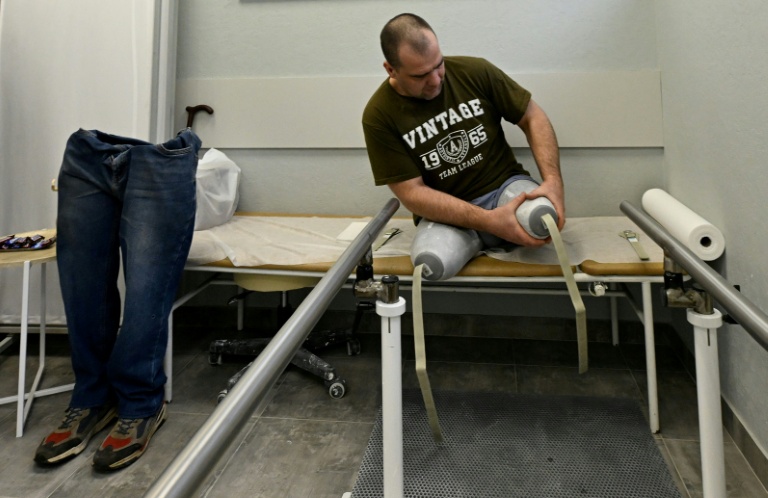
After suffering severe injuries in the ongoing conflict in Ukraine, many soldiers are finding support and rehabilitation through Russia’s growing network of prosthetics workshops. One such workshop, located in Vsevolozhsk near Saint Petersburg, is accommodating an increasing number of clients, including Dmitry, a former fighter with the Wagner Group. Dmitry, who lost his right leg on the battlefield, is now able to walk again thanks to a new prosthetic limb.
With the conflict escalating since Russia’s full-scale offensive began in February 2022, estimates suggest that hundreds of thousands of Russian soldiers have returned home wounded. Dmitry, 54, reflected on his injury with a faint smile, recounting how his unit was bombed while trying to cross the Dnipro River. He described the moment when he realized his leg was gone: “It was my first injury. I was surprised that I fought so long and was constantly lucky.”
His experience in the war has been traumatic. After being injured, he spent eight months in the hospital and another year in a wheelchair. Now, at the prosthetics workshop, he noted, “The atmosphere is friendly here, almost soothing,” as technicians worked on artificial limbs around him.
Surge in Demand for Prosthetic Limbs
The Russian government has not disclosed the exact number of soldiers killed or injured in Ukraine. However, independent reports and Western intelligence suggest the number may reach several hundreds of thousands. In a significant indication of the toll the conflict has taken, official data reveals that Russia issued 60,000 more prosthetic limbs in 2024 compared to 2021, marking a 65-percent increase.
Mikhail Moskovtsev, head of the workshop, emphasized that the type of injuries they see often indicates military service. He noted, “These are specific wounds, for example from mine blasts,” which are distinct from those suffered in civilian accidents. Moskovtsev operates his workshop with a philosophy of equality, stating, “I don’t ask the person where it’s from or the reasons behind it. If they want, they talk on their own.”
The advanced prosthetic limbs produced in these workshops can cost up to 5 million rubles (approximately $65,000). Veterans have the option to choose between public and private facilities and are offered various rehabilitation programs and financial assistance based on their injuries. Dmitry received 3 million rubles as compensation, which he used to purchase a new vehicle.
Changing Perspectives on Veteran Support
Dmitry expressed his satisfaction with the support offered to wounded veterans in Russia, contrasting it sharply with the treatment veterans received after the Soviet Union’s conflicts in Afghanistan and Chechnya. He recalled the bureaucratic indifference faced by veterans in the past: “I remember very well the return of the veterans of Afghanistan and the famous phrase from the bureaucrats: ‘I’m not the one who sent you there.’”
As the Russian government continues to adapt its economy and societal structures to support the military effort in Ukraine, it is clear that veterans are being positioned to take on significant roles. President Vladimir Putin has emphasized the importance of veterans in shaping the future of the nation, aiming to cultivate a “new elite” from those returning from the front lines.
Another ex-soldier, also named Dmitry and known by the call sign “Torg,” shared his own experience of being wounded in a drone strike while fighting in the Ukrainian city of Bakhmut in 2024. He, too, expressed no regrets about his decision to fight, echoing the Kremlin’s narrative about defending Russia. “My main motivation was to make sure that what was happening there stayed there,” he said, affirming his commitment to the cause.
The influx of wounded veterans poses potential social challenges, as many return home with life-altering injuries. Yet, the workshops continue to serve as a crucial lifeline, providing not only physical rehabilitation but also a sense of community and support during a time of national strife. As Russia navigates this complex landscape, the resilience of its veterans remains a focal point in the ongoing narrative of the conflict.

Meta Plans Major Layoffs as AI Costs Surge

Alberta’s Referendum Could Pave Way for U.S. Statehood

Minooka District 201 Plans Enhanced Bilingual Support for Students

Canmore Approves Multiple Development Permits for New Projects

Remembering Bradly Castillo Shearsmith: A Life of Friendship and Joy

BIS Urges Watchdogs to Integrate Synthetic Risk Transfers in Stress Tests

Teva Transforms: Shifting Focus from Generics to Branded Success

Apple Launches AirPods Max 2 with Enhanced Audio Features

Ontario Ends Funding for Seven Supervised Injection Sites

Toyoake City Proposes Daily Two-Hour Smartphone Use Limit

Pedestrian Fatally Injured in Esquimalt Collision on August 14

B.C. Review Reveals Urgent Need for Rare-Disease Drug Reforms

Dark Adventure Game “Bye Sweet Carole” Set for October Release

Konami Revives Iconic Metal Gear Solid Delta Ahead of Release

Jimmy Lai’s Defense Challenges Charges Under National Security Law

Victoria’s Pop-Up Shop Shines Light on B.C.’s Wolf Cull

Snapmaker U1 Color 3D Printer Redefines Speed and Sustainability

Apple Expands Self-Service Repair Program to Canada
-
 Science11 months ago
Toyoake City Proposes Daily Two-Hour Smartphone Use Limit
-
 Top Stories11 months ago
Pedestrian Fatally Injured in Esquimalt Collision on August 14
-
 Health11 months ago
B.C. Review Reveals Urgent Need for Rare-Disease Drug Reforms
-
 Technology11 months ago
Dark Adventure Game “Bye Sweet Carole” Set for October Release
-
 Technology11 months ago
Konami Revives Iconic Metal Gear Solid Delta Ahead of Release
-
 World11 months ago
Jimmy Lai’s Defense Challenges Charges Under National Security Law
-
 Lifestyle11 months ago
Victoria’s Pop-Up Shop Shines Light on B.C.’s Wolf Cull
-
 Technology11 months ago
Snapmaker U1 Color 3D Printer Redefines Speed and Sustainability
-
 Technology11 months ago
Apple Expands Self-Service Repair Program to Canada
-

 Technology11 months ago
AION Folding Knife: Redefining EDC Design with Premium Materials
-

 Technology11 months ago
Solve Today’s Wordle Challenge: Hints and Answer for August 19
-

 Business11 months ago
Gordon Murray Automotive Unveils S1 LM and Le Mans GTR at Monterey