
Science
Fermilab’s MicroBooNE Confirms No Existence of Sterile Neutrinos

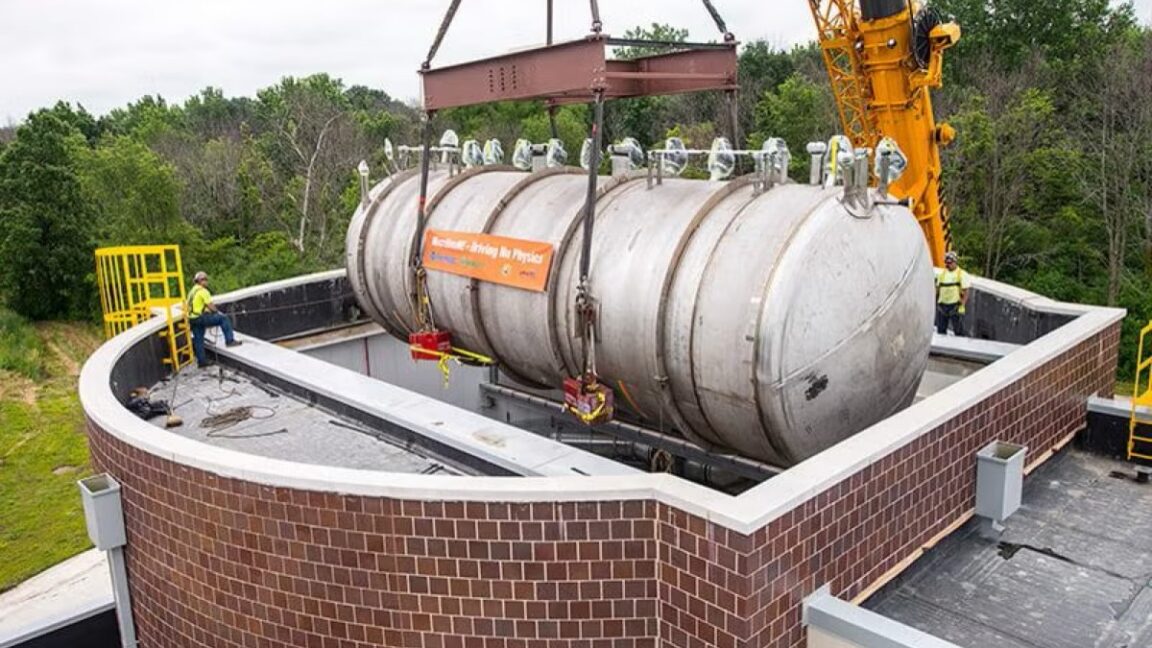
Physicists at Fermilab have declared that the mysterious existence of sterile neutrinos has been effectively ruled out. This conclusion follows the latest findings from the MiniBooNE experiment, detailed in a paper published in the journal Nature. Despite decades of speculation regarding a potential fourth type of neutrino, the evidence has proven elusive until now.
The journey toward understanding neutrinos began in 1966 when scientists first detected solar neutrinos from the Sun. However, they encountered a significant puzzle: fewer neutrinos were detected than theoretical models predicted. This discrepancy became known as the solar neutrino problem. The discovery of the muon neutrino in 1962 and the tau neutrino in 2000 led physicists to hypothesize that neutrinos might oscillate between different flavors, which would imply they possess a tiny mass.
In 2002, researchers at the Sudbury Neutrino Observatory confirmed this hypothesis, explaining that the missing solar electron neutrinos had converted into other flavors during their journey to Earth. This revelation opened up new inquiries into the nature of neutrinos, particularly regarding the existence of the sterile neutrino. Unlike the known flavors, the sterile neutrino does not interact via the electroweak force, leading physicists to speculate it could be related to dark matter.
Previous experiments, including the Los Alamos LSND and Fermilab’s MiniBooNE, indicated potential evidence for sterile neutrinos by observing muon neutrinos oscillating into electron neutrinos. This unexpected behavior suggested the possibility of a fourth neutrino flavor.
To further investigate, Fermilab constructed the MicroBooNE experiment, which utilized two beams to direct neutrinos into a liquid-argon time projection chamber. This setup allows for precise measurements of neutrino interactions. The initial results, released earlier this year, covered data collected from 2015 to 2021, leading to the conclusion that sterile neutrinos could not account for the anomalies observed in earlier experiments.
The recent paper confirms these earlier findings, asserting that the data is consistent with no oscillations into any sterile neutrino. This effectively rules out the existence of this exotic particle.
As researchers shift focus, alternative explanations for past anomalies are being explored. Upcoming experiments, including Fermilab’s Short-Baseline Neutrino (SBN) program and the Deep Underground Neutrino Experiment (DUNE), are set to play significant roles in advancing neutrino research. The SBN program features both near and far detectors, which have begun data collection, while DUNE is currently under construction in South Dakota, designed to capture high-energy neutron beams over a distance of 800 miles.
David Caratelli, co-author and physicist at the University of California, Santa Barbara, emphasized the significance of MicroBooNE’s findings, stating, “MicroBooNE is big—it’s the size of a school bus. But DUNE is football field-scale. One of the key things that MicroBooNE did was give us all confidence and teach us how to use this technology to measure neutrinos with high precision.”
The results from MicroBooNE not only deepen our understanding of neutrinos but also set the groundwork for future experiments that will continue to unravel the complexities of these fundamental particles.

Meta Plans Major Layoffs as AI Costs Surge

Alberta’s Referendum Could Pave Way for U.S. Statehood

Minooka District 201 Plans Enhanced Bilingual Support for Students

Canmore Approves Multiple Development Permits for New Projects

Remembering Bradly Castillo Shearsmith: A Life of Friendship and Joy

BIS Urges Watchdogs to Integrate Synthetic Risk Transfers in Stress Tests

Teva Transforms: Shifting Focus from Generics to Branded Success

Apple Launches AirPods Max 2 with Enhanced Audio Features

Ontario Ends Funding for Seven Supervised Injection Sites

Toyoake City Proposes Daily Two-Hour Smartphone Use Limit

Pedestrian Fatally Injured in Esquimalt Collision on August 14

B.C. Review Reveals Urgent Need for Rare-Disease Drug Reforms

Dark Adventure Game “Bye Sweet Carole” Set for October Release

Konami Revives Iconic Metal Gear Solid Delta Ahead of Release

Victoria’s Pop-Up Shop Shines Light on B.C.’s Wolf Cull

Jimmy Lai’s Defense Challenges Charges Under National Security Law

Snapmaker U1 Color 3D Printer Redefines Speed and Sustainability

Apple Expands Self-Service Repair Program to Canada
-
 Science12 months ago
Toyoake City Proposes Daily Two-Hour Smartphone Use Limit
-
 Top Stories12 months ago
Pedestrian Fatally Injured in Esquimalt Collision on August 14
-
 Health12 months ago
B.C. Review Reveals Urgent Need for Rare-Disease Drug Reforms
-
 Technology12 months ago
Dark Adventure Game “Bye Sweet Carole” Set for October Release
-
 Technology12 months ago
Konami Revives Iconic Metal Gear Solid Delta Ahead of Release
-
 Lifestyle12 months ago
Victoria’s Pop-Up Shop Shines Light on B.C.’s Wolf Cull
-
 World12 months ago
Jimmy Lai’s Defense Challenges Charges Under National Security Law
-
 Technology12 months ago
Snapmaker U1 Color 3D Printer Redefines Speed and Sustainability
-
 Technology12 months ago
Apple Expands Self-Service Repair Program to Canada
-

 Technology12 months ago
AION Folding Knife: Redefining EDC Design with Premium Materials
-

 Technology12 months ago
Solve Today’s Wordle Challenge: Hints and Answer for August 19
-

 Business12 months ago
Gordon Murray Automotive Unveils S1 LM and Le Mans GTR at Monterey