
Technology
Ottawa Senators Seek Government Funds for New Arena: A Controversy

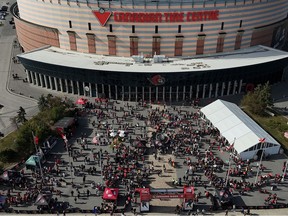
The Ottawa Senators are exploring a move from their current home at the Canadian Tire Centre and have engaged lobbyists to seek government funding for a new arena. This initiative has sparked a significant debate about whether taxpayers should contribute to the costs associated with professional sports venues.
The Senators, currently valued at approximately $1.4 billion, are not the first Canadian sports franchise to consider a new arena. While sports teams often pursue new venues, the necessity for public funding remains contentious. Historically, franchises like the Montreal Canadiens and the NBA’s Toronto Raptors financed their arenas without taxpayer support, raising questions about the Senators’ approach.
The organization’s decision to hire lobbyists suggests a desire for financial assistance from both the federal and Ontario governments. Critics argue that if the Senators can afford to seek government aid, they should instead invest their own resources into constructing a new facility. Given their substantial valuation, the franchise should be capable of financing the arena independently.
Recent examples from other Canadian cities highlight the potential pitfalls of public funding for sports complexes. In Calgary, the Flames secured $867 million from the city and province for their new arena, a move that placed a financial burden on taxpayers. Similarly, Edmonton taxpayers contributed over $300 million towards the construction of Rogers Place for the Oilers, leading to increased property taxes for local residents.
Opponents of public funding often cite economic studies that challenge the notion that sports arenas yield significant economic benefits. For instance, in Baltimore, taxpayers invested over $200 million in Oriole Park at Camden Yards, which ultimately generated only $3 million annually in new jobs and tax revenue. Such examples raise concerns about the efficacy of using taxpayer money for sports facilities.
The financial landscape for governments in Canada is critical, with federal debt projected to reach $1.35 trillion, Ontario’s debt nearing $459 billion, and Ottawa’s own debt at $3.5 billion. With fiscal responsibilities weighing heavily on taxpayers, the prospect of subsidizing a billion-dollar franchise’s arena appears increasingly untenable.
Noah Jarvis, the Ontario Director for the Canadian Taxpayers Federation, emphasizes the importance of keeping taxpayer money out of professional sports funding. He argues that the Senators should explore revenue options such as ticket sales rather than relying on public coffers.
As the Senators contemplate their future, the expectation remains that they will demonstrate financial responsibility and independence. Taxpayers should not be tasked with financing the ambitions of a wealthy sports franchise, especially in a time of significant governmental debt. The call to action for leaders like Prime Minister Mark Carney and Ontario Premier Doug Ford is clear: refuse to subsidize a new arena for the Senators and prioritize the financial well-being of citizens.

Meta Plans Major Layoffs as AI Costs Surge

Alberta’s Referendum Could Pave Way for U.S. Statehood

Minooka District 201 Plans Enhanced Bilingual Support for Students

Canmore Approves Multiple Development Permits for New Projects

Remembering Bradly Castillo Shearsmith: A Life of Friendship and Joy

BIS Urges Watchdogs to Integrate Synthetic Risk Transfers in Stress Tests

Teva Transforms: Shifting Focus from Generics to Branded Success

Apple Launches AirPods Max 2 with Enhanced Audio Features

Ontario Ends Funding for Seven Supervised Injection Sites

Toyoake City Proposes Daily Two-Hour Smartphone Use Limit

Pedestrian Fatally Injured in Esquimalt Collision on August 14

B.C. Review Reveals Urgent Need for Rare-Disease Drug Reforms

Dark Adventure Game “Bye Sweet Carole” Set for October Release

Konami Revives Iconic Metal Gear Solid Delta Ahead of Release

Victoria’s Pop-Up Shop Shines Light on B.C.’s Wolf Cull

Jimmy Lai’s Defense Challenges Charges Under National Security Law

Snapmaker U1 Color 3D Printer Redefines Speed and Sustainability

Apple Expands Self-Service Repair Program to Canada
-
 Science11 months ago
Toyoake City Proposes Daily Two-Hour Smartphone Use Limit
-
 Top Stories11 months ago
Pedestrian Fatally Injured in Esquimalt Collision on August 14
-
 Health11 months ago
B.C. Review Reveals Urgent Need for Rare-Disease Drug Reforms
-
 Technology11 months ago
Dark Adventure Game “Bye Sweet Carole” Set for October Release
-
 Technology11 months ago
Konami Revives Iconic Metal Gear Solid Delta Ahead of Release
-
 Lifestyle11 months ago
Victoria’s Pop-Up Shop Shines Light on B.C.’s Wolf Cull
-
 World11 months ago
Jimmy Lai’s Defense Challenges Charges Under National Security Law
-
 Technology11 months ago
Snapmaker U1 Color 3D Printer Redefines Speed and Sustainability
-
 Technology11 months ago
Apple Expands Self-Service Repair Program to Canada
-

 Technology11 months ago
AION Folding Knife: Redefining EDC Design with Premium Materials
-

 Technology11 months ago
Solve Today’s Wordle Challenge: Hints and Answer for August 19
-

 Business11 months ago
Gordon Murray Automotive Unveils S1 LM and Le Mans GTR at Monterey