
World
Kate Barr Challenges GOP in NC as a Self-Described ‘Fake Republican’

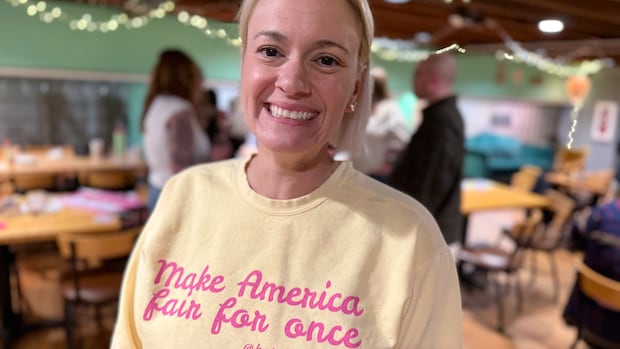
Kate Barr, a candidate for Congress in North Carolina’s 14th district, is making headlines by running as a self-described “fake Republican.” Barr, who has a history of voting Democrat and has previously campaigned for the party, is challenging incumbent Republican Congressman Tim Moore, who has received endorsements from prominent figures, including Donald Trump. Her campaign, which she acknowledges is a long shot, aims to highlight issues such as gerrymandering and the need for more inclusive political representation.
Upon entering her campaign headquarters in Davidson, North Carolina, visitors are greeted by a neon sign that reads “LOSER.” This emblematic nod to a previous campaign reflects Barr’s willingness to take risks for what she believes in. “I need to be fighting as hard as I possibly can to get to a place where I can be proud of this country, and this democracy,” she stated, emphasizing her commitment to making a statement rather than merely seeking political office.
Barr’s campaign has been characterized as an “experiment,” as she believes that running as a Republican will allow her to reach voters who might not otherwise consider a progressive message. She intends to connect with Republicans and Independents dissatisfied with Trump’s presidency, while also advocating for policies such as reducing income taxes to appeal to traditional conservative values.
March 3, 2024, marks the primary election date for Barr’s campaign, and her efforts come at a time when history shows it is particularly challenging to unseat an incumbent. According to Eric Heberlig, a political science professor at the University of North Carolina at Charlotte, “Her probability of winning is low, but it’s a way of increasing public attention to the politics behind the election.”
The campaign has sparked a divided response, eliciting both support and backlash. Local Republicans have expressed outrage, with some accusing Barr of election fraud and alleging that her campaign is an attempt to undermine the party. Kyle Kirby, chair of the Mecklenburg County Republican Party, suggested that her actions could set a concerning precedent for future elections. “I think that it could very well count as election fraud,” he said, while also asserting that he is not worried about Moore losing.
Barr, for her part, insists she is transparent about her political identity and has adhered to all legal requirements to run as a Republican. “I’m being honest about who I am and what I stand for,” she stated, defending her decision to switch parties.
Among progressive voters, opinions on Barr’s strategy are mixed. Some support her innovative approach to challenging the status quo, feeling that it might inspire change within the political system. “We gotta get smarter,” said Rebecca Miyares, a 55-year-old activist, who plans to vote in the Republican primary to support Barr. Others, however, worry that her campaign could detract from Democratic candidates. Shawn Copeland, a lawyer and friend of Barr, expressed concern that her efforts might undermine broader Democratic goals.
Central to Barr’s campaign is her opposition to gerrymandering, a practice where political boundaries are drawn to favor one party over another. This manipulation of district lines, she argues, deprives voters of fair representation. “Politicians draw voting districts to ensure that they will keep their power,” she remarked, criticizing a system that allows politicians to select their voters.
As the primary approaches, Barr is facing threats and harassment, which she attributes to her unconventional bid. Following a feature on Fox News, she reported receiving death threats, prompting her to enhance her home security. Barr’s family has taken safety precautions, with her children temporarily sleeping on the floor of their bedroom.
Despite the challenges, Barr believes her campaign can illuminate important issues surrounding political representation and voter engagement. She plans to analyze the impact of her run, including financial expenditures and voter turnout, regardless of the election’s outcome. “We’ll look at voter turnout to see if more voters turned out in the primary — those are the kinds of things that will inform whether this is a strategy that makes sense going forward,” she explained.
Barr’s candidacy is a provocative reflection of the changing political landscape in North Carolina, where increasing numbers of voters identify as independents. Her unique approach to campaigning may not lead her to Congress this time, but it is intended to challenge existing norms and provoke necessary discussions about the future of politics in the state.

Meta Plans Major Layoffs as AI Costs Surge

Alberta’s Referendum Could Pave Way for U.S. Statehood

Minooka District 201 Plans Enhanced Bilingual Support for Students

Canmore Approves Multiple Development Permits for New Projects

Remembering Bradly Castillo Shearsmith: A Life of Friendship and Joy

BIS Urges Watchdogs to Integrate Synthetic Risk Transfers in Stress Tests

Teva Transforms: Shifting Focus from Generics to Branded Success

Apple Launches AirPods Max 2 with Enhanced Audio Features

Ontario Ends Funding for Seven Supervised Injection Sites

Toyoake City Proposes Daily Two-Hour Smartphone Use Limit

Pedestrian Fatally Injured in Esquimalt Collision on August 14

B.C. Review Reveals Urgent Need for Rare-Disease Drug Reforms

Dark Adventure Game “Bye Sweet Carole” Set for October Release

Konami Revives Iconic Metal Gear Solid Delta Ahead of Release

Jimmy Lai’s Defense Challenges Charges Under National Security Law

Victoria’s Pop-Up Shop Shines Light on B.C.’s Wolf Cull

Snapmaker U1 Color 3D Printer Redefines Speed and Sustainability

Apple Expands Self-Service Repair Program to Canada
-
 Science11 months ago
Toyoake City Proposes Daily Two-Hour Smartphone Use Limit
-
 Top Stories11 months ago
Pedestrian Fatally Injured in Esquimalt Collision on August 14
-
 Health11 months ago
B.C. Review Reveals Urgent Need for Rare-Disease Drug Reforms
-
 Technology11 months ago
Dark Adventure Game “Bye Sweet Carole” Set for October Release
-
 Technology11 months ago
Konami Revives Iconic Metal Gear Solid Delta Ahead of Release
-
 World11 months ago
Jimmy Lai’s Defense Challenges Charges Under National Security Law
-
 Lifestyle11 months ago
Victoria’s Pop-Up Shop Shines Light on B.C.’s Wolf Cull
-
 Technology11 months ago
Snapmaker U1 Color 3D Printer Redefines Speed and Sustainability
-
 Technology11 months ago
Apple Expands Self-Service Repair Program to Canada
-

 Technology11 months ago
AION Folding Knife: Redefining EDC Design with Premium Materials
-

 Technology11 months ago
Solve Today’s Wordle Challenge: Hints and Answer for August 19
-

 Business11 months ago
Gordon Murray Automotive Unveils S1 LM and Le Mans GTR at Monterey