
Top Stories
Middle East Conflict Disrupts Global Air Travel for Thousands

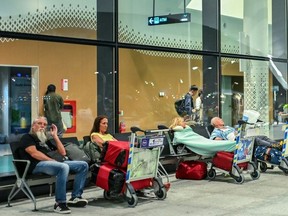
Thousands of passengers found themselves stranded at airports worldwide as a significant disruption to global air travel unfolded due to ongoing conflict in the Middle East. For the second consecutive day on March 3, 2024, airlines faced massive flight cancellations and rerouting as tensions escalated following Iranian retaliatory strikes against U.S. and Israeli targets. Major Gulf hubs, including Dubai and Doha, shut down operations, affecting air traffic in an unprecedented manner not seen since the COVID-19 pandemic.
Iran’s military launched attacks on both Dubai International Airport, the world’s busiest for international traffic, and Kuwait International Airport, prompting several nations, including Iraq, Israel, Syria, and the United Arab Emirates, to announce partial closures of their airspace. “There haven’t been any other crises of this magnitude since COVID,” stated Didier Brechemier, an expert at business consultancy Roland Berger, in an interview with AFP. He noted that previous conflicts, including Russia’s invasion of Ukraine, had not disrupted major air hubs in the same way.
According to aviation analytics firm Cirium, over 1,500 flights to the Middle East were cancelled on March 3, equating to more than 40 percent of scheduled traffic. Global flight tracking website FlightAware reported that more than 2,700 flights were cancelled worldwide, with an additional 12,300 delayed. The financial impact of this disruption is already substantial, with losses in the air transport sector estimated to be in the hundreds of millions of euros, according to Didier Arino, CEO of the consulting firm Protourisme.
Passengers stranded by the cancellations described experiences that extended beyond mere inconvenience. Italian rapper BigMama, for example, found herself on a flight from Male in the Maldives that was abruptly rerouted to a remote location near Dubai, where she reported hearing missile activity overhead. In a tearful video posted on Instagram, she expressed her fear and uncertainty, stating, “We keep hearing missiles over our heads. I’m terrified.”
Many travelers voiced concerns about the rising costs of alternative flights and the lack of available accommodation. One passenger stuck at Johannesburg’s main international airport, whose Emirates flight to London was cancelled, remarked on the increasing prices of tickets from other airlines. “I don’t know where I am sleeping tonight,” said another traveler, identified only as Farhad, who was attempting to return to Germany.
Countries such as France and Thailand have initiated plans to evacuate their citizens from the Middle East. Patrice Caradec, president of the French Association of Tour Operators, highlighted efforts to establish air bridges through alternative hubs like Istanbul to facilitate these evacuations.
The ongoing conflict has also had repercussions on the regional image of the Gulf monarchies. “Tehran’s attacks and the impact on air travel dealt a blow to the ‘soft power’ of the Gulf monarchies,” Brechemier explained. He noted that the perception of safety and stability that places like Dubai once enjoyed is now tarnished.
As the situation continues to unfold, reports of explosions and missile strikes have emerged from various locations in the UAE, including the iconic Palm Jumeirah and the Burj Al Arab hotel. One tourist, Claudine Schwartz, recounted a harrowing experience as she witnessed explosions and plumes of smoke while staying at the Royal Atlantis on The Palm. She described the panic that ensued and the precautionary measures taken by hotel staff to ensure guest safety.
With the conflict showing no immediate signs of resolution, thousands of passengers remain in a state of uncertainty, awaiting updates on their travel plans and hoping for a swift return to normalcy. The global air transport industry now faces not only immediate logistical challenges but also long-term implications stemming from the continuing tensions in the Middle East.

Meta Plans Major Layoffs as AI Costs Surge

Alberta’s Referendum Could Pave Way for U.S. Statehood

Minooka District 201 Plans Enhanced Bilingual Support for Students

Canmore Approves Multiple Development Permits for New Projects

Remembering Bradly Castillo Shearsmith: A Life of Friendship and Joy

BIS Urges Watchdogs to Integrate Synthetic Risk Transfers in Stress Tests

Teva Transforms: Shifting Focus from Generics to Branded Success

Apple Launches AirPods Max 2 with Enhanced Audio Features

Ontario Ends Funding for Seven Supervised Injection Sites

Toyoake City Proposes Daily Two-Hour Smartphone Use Limit

Pedestrian Fatally Injured in Esquimalt Collision on August 14

B.C. Review Reveals Urgent Need for Rare-Disease Drug Reforms

Dark Adventure Game “Bye Sweet Carole” Set for October Release

Konami Revives Iconic Metal Gear Solid Delta Ahead of Release

Jimmy Lai’s Defense Challenges Charges Under National Security Law

Victoria’s Pop-Up Shop Shines Light on B.C.’s Wolf Cull

Snapmaker U1 Color 3D Printer Redefines Speed and Sustainability

Apple Expands Self-Service Repair Program to Canada
-
 Science11 months ago
Toyoake City Proposes Daily Two-Hour Smartphone Use Limit
-
 Top Stories11 months ago
Pedestrian Fatally Injured in Esquimalt Collision on August 14
-
 Health11 months ago
B.C. Review Reveals Urgent Need for Rare-Disease Drug Reforms
-
 Technology11 months ago
Dark Adventure Game “Bye Sweet Carole” Set for October Release
-
 Technology11 months ago
Konami Revives Iconic Metal Gear Solid Delta Ahead of Release
-
 World11 months ago
Jimmy Lai’s Defense Challenges Charges Under National Security Law
-
 Lifestyle11 months ago
Victoria’s Pop-Up Shop Shines Light on B.C.’s Wolf Cull
-
 Technology11 months ago
Snapmaker U1 Color 3D Printer Redefines Speed and Sustainability
-
 Technology11 months ago
Apple Expands Self-Service Repair Program to Canada
-

 Technology11 months ago
AION Folding Knife: Redefining EDC Design with Premium Materials
-

 Technology11 months ago
Solve Today’s Wordle Challenge: Hints and Answer for August 19
-

 Business11 months ago
Gordon Murray Automotive Unveils S1 LM and Le Mans GTR at Monterey