
Business
European Bonds Decline as Traders React to Energy Price Surge

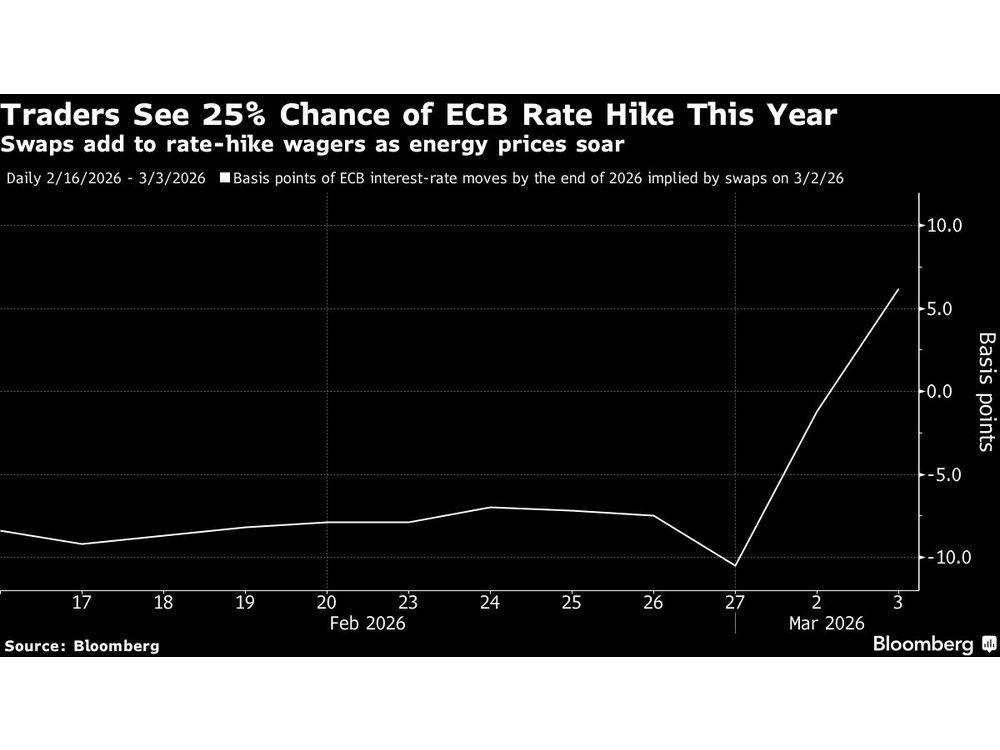
European bonds experienced extended losses as traders assessed the implications of rising energy prices and the potential for a prolonged conflict in the Middle East. The chief economist of the European Central Bank (ECB), Philip Lane, cautioned that such a scenario would be stagflationary for the region. Yields on shorter-dated German bonds, which are more sensitive to changes in monetary policy, increased by as much as eight basis points to reach 2.17%. Money markets now indicate a one-in-three likelihood that the ECB may raise interest rates before the end of the year.
The euro-area debt market has notably underperformed compared to U.S. Treasuries, where yields rose approximately four basis points. Europe’s vulnerability to an escalation in the conflict is heightened, as the region relies heavily on imports for almost all its oil and most of its natural gas. In contrast, the United States stands as a net energy exporter.
Natural gas prices in Europe surged by more than 60% since the close of trading on Friday, reflecting volatility not witnessed since the energy crisis of 2022. This spike followed the suspension of shipments from Qatar, the world’s largest LNG export facility. According to Salman Ahmed, global head of macro and strategic asset allocation at Fidelity International, “European bonds have now woken up,” following recent fluctuations in LNG prices. He advised clients to consider gold as a protective investment rather than sovereign debt in the current climate, stating, “This is not a war where bonds will be your stabilizers.”
Investor sentiment has shifted globally, with many selling government bonds due to renewed inflation concerns as oil prices rise. In the United States, President Donald Trump has expressed his intention to take decisive action regarding Iran, hinting at the possibility of extending military involvement beyond his previous four to five-week estimation.
In the United Kingdom, traders have significantly reduced expectations for interest rate cuts from the Bank of England, fully pricing out the prospect of a second quarter-point reduction this year. Yields on two-year UK debt climbed as much as twelve basis points to reach 3.76%. The financial markets continue to react to these dynamic shifts, reflecting the broader implications of geopolitical tensions and energy market fluctuations on economic stability.

Meta Plans Major Layoffs as AI Costs Surge

Alberta’s Referendum Could Pave Way for U.S. Statehood

Minooka District 201 Plans Enhanced Bilingual Support for Students

Canmore Approves Multiple Development Permits for New Projects

Remembering Bradly Castillo Shearsmith: A Life of Friendship and Joy

BIS Urges Watchdogs to Integrate Synthetic Risk Transfers in Stress Tests

Teva Transforms: Shifting Focus from Generics to Branded Success

Apple Launches AirPods Max 2 with Enhanced Audio Features

Ontario Ends Funding for Seven Supervised Injection Sites

Toyoake City Proposes Daily Two-Hour Smartphone Use Limit

Pedestrian Fatally Injured in Esquimalt Collision on August 14

B.C. Review Reveals Urgent Need for Rare-Disease Drug Reforms

Dark Adventure Game “Bye Sweet Carole” Set for October Release

Konami Revives Iconic Metal Gear Solid Delta Ahead of Release

Victoria’s Pop-Up Shop Shines Light on B.C.’s Wolf Cull

Jimmy Lai’s Defense Challenges Charges Under National Security Law

Snapmaker U1 Color 3D Printer Redefines Speed and Sustainability

Apple Expands Self-Service Repair Program to Canada
-
 Science12 months ago
Toyoake City Proposes Daily Two-Hour Smartphone Use Limit
-
 Top Stories12 months ago
Pedestrian Fatally Injured in Esquimalt Collision on August 14
-
 Health12 months ago
B.C. Review Reveals Urgent Need for Rare-Disease Drug Reforms
-
 Technology12 months ago
Dark Adventure Game “Bye Sweet Carole” Set for October Release
-
 Technology12 months ago
Konami Revives Iconic Metal Gear Solid Delta Ahead of Release
-
 Lifestyle12 months ago
Victoria’s Pop-Up Shop Shines Light on B.C.’s Wolf Cull
-
 World12 months ago
Jimmy Lai’s Defense Challenges Charges Under National Security Law
-
 Technology12 months ago
Snapmaker U1 Color 3D Printer Redefines Speed and Sustainability
-
 Technology12 months ago
Apple Expands Self-Service Repair Program to Canada
-

 Technology12 months ago
AION Folding Knife: Redefining EDC Design with Premium Materials
-

 Technology12 months ago
Solve Today’s Wordle Challenge: Hints and Answer for August 19
-

 Business12 months ago
Gordon Murray Automotive Unveils S1 LM and Le Mans GTR at Monterey