
Science
Astronomers Explore Kuiper Belt’s Secrets with New Technology

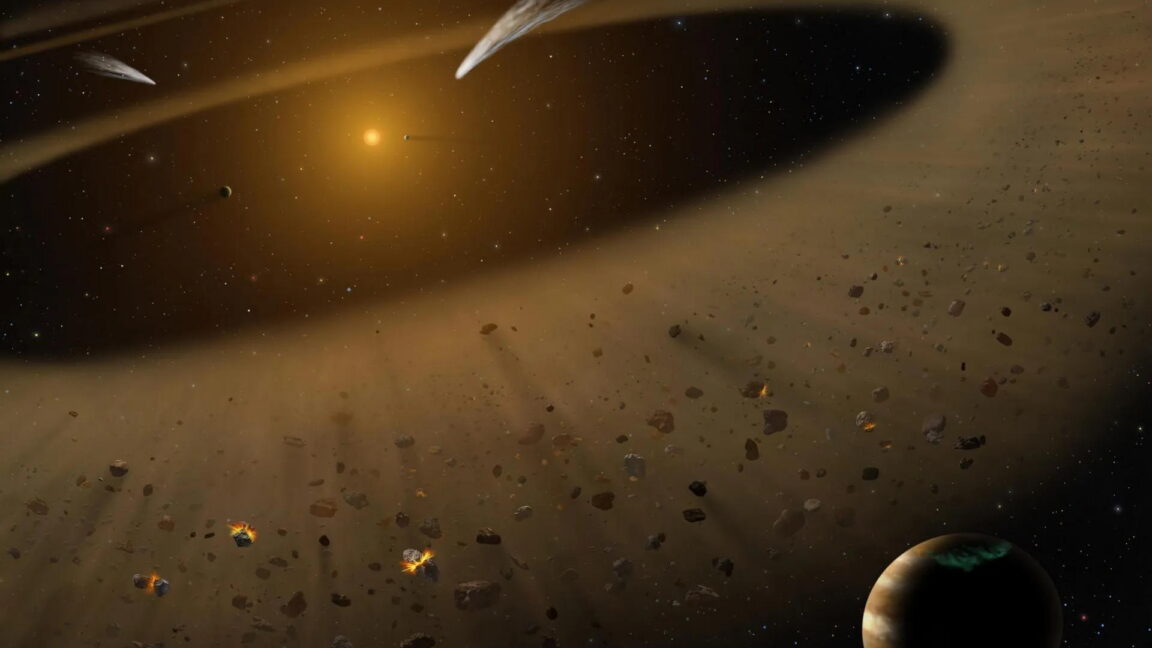
Astronomers are set to significantly expand our understanding of the Kuiper Belt, a mysterious region located beyond the orbit of Neptune. This belt, which contains ancient remnants from the early solar system, is expected to yield a wealth of new discoveries thanks to advanced observational technologies. The Vera C. Rubin Observatory in Chile has begun its flagship project, the Legacy Survey of Space and Time (LSST), aiming to document thousands of new Kuiper Belt objects (KBOs) in the coming years.
Since the discovery of the Kuiper Belt in the 1990s, astronomers have cataloged around 4,000 KBOs, including several dwarf planets such as Pluto and Eris. However, experts predict that this number could increase tenfold as more sensitive telescopes, including the James Webb Space Telescope (JWST), come online. According to Renu Malhotra, a professor at the University of Arizona, the LSST will fill critical gaps in our knowledge of the solar system’s contents, enhancing our census of celestial objects.
As astronomers prepare for an influx of new data, they seek to answer significant questions about the Kuiper Belt. These include the potential existence of undiscovered planets, the extent of the belt itself, and evidence of past dynamic interactions between celestial bodies. Amir Siraj, a graduate student at Princeton University, anticipates that the LSST will ignite a surge of interest in this field, leading to groundbreaking discoveries.
The Kuiper Belt serves as a time capsule from the solar system’s formation over 4.6 billion years ago. It contains various structures that suggest historical interactions among planets, including a cluster known as a “kernel.” This kernel, located at about 44 astronomical units (AU), may have formed as a result of Neptune’s migration through the solar system. Wes Fraser, an astronomer at the Dominion Astrophysical Observatory in Canada, likens this process to a snowplow leaving a clump of snow behind as it moves along a road.
Recent research by Siraj and his team has revealed hints of an additional structure, termed an “inner kernel,” located at approximately 43 AU. This finding, while still under investigation, raises intriguing possibilities about the formation processes that shaped the Kuiper Belt. As more KBOs are identified, the nature of these structures may become clearer, offering insights into the turbulent origins of our solar system.
Astronomers are also on the lookout for hypothetical planets within the Kuiper Belt. Notably, the existence of a potential giant planet, often referred to as Planet Nine, was proposed in 2016. Some researchers believe that the gravitational effects of this elusive planet could explain the unusual orbits of certain KBOs. Additionally, there are speculations about a smaller world, dubbed Planet Y, which may reside closer to the belt, between 80 and 200 AU.
The LSST’s capabilities could help in detecting these possible celestial bodies, although predicting their characteristics remains challenging. Fraser states, “We know nothing about the atmospheres and surfaces of gas giant or ice giant type planets at this distance.” If such planets exist, they may display features far removed from those of planets in the inner solar system.
Even if the LSST and JWST fail to discover new planets, the findings could still provide valuable insights. Malhotra notes, “If we don’t find any, that would tell us something as well,” indicating that understanding the absence of certain bodies could refine our models of planet formation.
A major question surrounding the Kuiper Belt is its boundary, known as the Kuiper cliff, which occurs around 50 AU. This sharp delineation raises questions about why our solar system has a comparatively small debris belt compared to other stellar systems, which often feature much larger debris disks. Recent hints of a potential population of objects at around 100 AU could challenge existing notions about the solar system’s structure.
As astronomers gear up for this transformative phase of exploration, the Kuiper Belt remains a tantalizing frontier. Malhotra encapsulates the prevailing curiosity: “What are we missing?” With advanced telescopes poised to illuminate this distant region, the potential for remarkable discoveries looms large, possibly revealing hidden planets and new insights into our solar system’s formation.

Meta Plans Major Layoffs as AI Costs Surge

Alberta’s Referendum Could Pave Way for U.S. Statehood

Minooka District 201 Plans Enhanced Bilingual Support for Students

Canmore Approves Multiple Development Permits for New Projects

Remembering Bradly Castillo Shearsmith: A Life of Friendship and Joy

BIS Urges Watchdogs to Integrate Synthetic Risk Transfers in Stress Tests

Teva Transforms: Shifting Focus from Generics to Branded Success

Apple Launches AirPods Max 2 with Enhanced Audio Features

Ontario Ends Funding for Seven Supervised Injection Sites

Toyoake City Proposes Daily Two-Hour Smartphone Use Limit

Pedestrian Fatally Injured in Esquimalt Collision on August 14

B.C. Review Reveals Urgent Need for Rare-Disease Drug Reforms

Dark Adventure Game “Bye Sweet Carole” Set for October Release

Konami Revives Iconic Metal Gear Solid Delta Ahead of Release

Victoria’s Pop-Up Shop Shines Light on B.C.’s Wolf Cull

Jimmy Lai’s Defense Challenges Charges Under National Security Law

Snapmaker U1 Color 3D Printer Redefines Speed and Sustainability

Apple Expands Self-Service Repair Program to Canada
-
 Science11 months ago
Toyoake City Proposes Daily Two-Hour Smartphone Use Limit
-
 Top Stories11 months ago
Pedestrian Fatally Injured in Esquimalt Collision on August 14
-
 Health11 months ago
B.C. Review Reveals Urgent Need for Rare-Disease Drug Reforms
-
 Technology11 months ago
Dark Adventure Game “Bye Sweet Carole” Set for October Release
-
 Technology11 months ago
Konami Revives Iconic Metal Gear Solid Delta Ahead of Release
-
 Lifestyle11 months ago
Victoria’s Pop-Up Shop Shines Light on B.C.’s Wolf Cull
-
 World11 months ago
Jimmy Lai’s Defense Challenges Charges Under National Security Law
-
 Technology11 months ago
Snapmaker U1 Color 3D Printer Redefines Speed and Sustainability
-
 Technology11 months ago
Apple Expands Self-Service Repair Program to Canada
-

 Technology11 months ago
AION Folding Knife: Redefining EDC Design with Premium Materials
-

 Technology11 months ago
Solve Today’s Wordle Challenge: Hints and Answer for August 19
-

 Business11 months ago
Gordon Murray Automotive Unveils S1 LM and Le Mans GTR at Monterey