
Science
Astronomers Unveil “Cloud-9”: A Breakthrough in Dark Matter Research

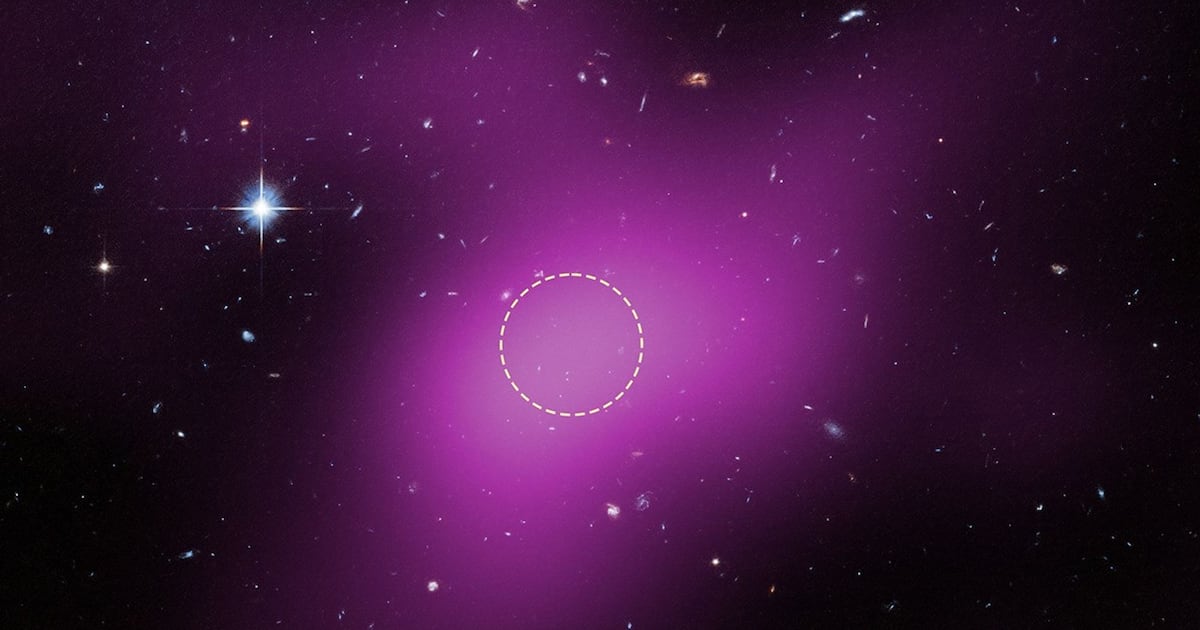
Astronomers have identified a previously unknown celestial object, informally named “Cloud-9,” which holds significant implications for understanding dark matter. Dark matter, an elusive substance believed to constitute approximately 85 percent of the universe’s total matter, has long perplexed scientists due to its failure to emit light, making it challenging to observe directly. The discovery was detailed in research published on October 23, 2023, in The Astrophysical Journal Letters.
According to study coauthor Andrew Fox, an astronomer at the Space Telescope Science Institute in Baltimore, “This cloud is a window into the dark Universe.” He emphasized that while theoretical models suggest most of the universe’s mass is dark matter, its detection remains a formidable challenge. Cloud-9 is theorized to be a dark matter cloud, potentially a remnant from the early universe, specifically from the formation of galaxies.
The origins of dark matter are believed to trace back to the Big Bang, which occurred approximately 13.8 billion years ago. This mysterious material is thought to form cosmic clouds that did not accumulate sufficient gas to develop into stars. Observations from the Hubble Space Telescope confirmed Cloud-9 is devoid of stars, giving rise to the characterization of this phenomenon as a “failed galaxy.” Study coauthor Alejandro Benitez-Llambay, an astrophysicist and assistant professor at the University of Milano-Bicocca in Milan, noted, “In science, we usually learn more from the failures than from the successes. In this case, seeing no stars is what proves the theory right.”
The search for such elusive objects has not been easy. Unlike bright stars or star-filled galaxies, failed galaxies like Cloud-9 are dark and difficult to identify. Initially, it may have been mistaken for a faint dwarf galaxy, which typically contains anywhere from 1,000 to several billion stars. Cloud-9 was first detected three years ago during a hydrogen gas survey near the spiral galaxy Messier 94 by the Five-hundred-meter Aperture Spherical Telescope (FAST) located in China’s Guizhou province.
Follow-up observations were conducted using the Green Bank Telescope and the Very Large Array observatory, confirming the starless nature of the cloud. Fox explained, “Theories of galaxy formation predicted there is a minimum threshold of dark matter required to ignite star formation and turn a dark cloud into a luminous galaxy. With Cloud-9, we have an example of an object just below this threshold, containing no stars.”
Cloud-9 stands out due to its size and structure. This compact, spherical cloud spans approximately 4,900 light-years in diameter, composed primarily of neutral hydrogen with a mass around 1 million times that of the Sun. Astronomers estimate that the dark matter component accounts for about 5 billion solar masses. Dr. Rachel Beaton, an assistant astronomer at the Space Telescope Science Institute, remarked, “There must be a massive amount of ‘invisible’ gravity holding it together.”
The research team highlighted the precarious balance of Cloud-9. It possesses just enough mass to retain its gas, but insufficient to trigger star formation. Beaton pointed out that this rarity could explain why few such objects exist in the local universe. “Most halos either lose their gas entirely or become full-fledged galaxies,” she stated.
The potential future of Cloud-9 remains uncertain. If it gathers additional mass, the gas may condense and lead to star formation, transforming it into a late-blooming galaxy. Conversely, if the cloud moves closer to Messier 94, it could lose mass, potentially causing it to dissipate entirely. Fox noted, “Future high-resolution observations could provide a clearer look at Cloud-9’s core, a ‘holy grail’ to reveal how much dark matter is contained in the object’s center.”
While Cloud-9 is a captivating discovery, it is not the first object linked to the concept of “dark galaxies.” Dr. Jacco van Loon, an associate professor of astrophysics at Keele University in England, cautioned against hastily labeling Cloud-9 as a definitive dark matter cloud without stronger evidence. He cited another hydrogen cloud, identified as FAST J0139+4328, which was recently confirmed to be a very faint galaxy.
In the meantime, researchers continue to search for similar objects to ascertain whether Cloud-9 is an anomaly or part of a larger category of relics. Dr. Kristine Spekkens, a professor of astronomy and astrophysics at Queen’s University in Kingston, Ontario, emphasized the significance of ongoing studies of this starless gas. She stated, “Whatever its nature, Cloud-9 is a fantastic example of the bright future of this field of study in helping researchers unlock the mysteries of the universe.”
As astronomers delve deeper into the cosmos, discoveries like Cloud-9 promise to enhance our understanding of dark matter and the universe’s intricate structure.

Meta Plans Major Layoffs as AI Costs Surge

Alberta’s Referendum Could Pave Way for U.S. Statehood

Minooka District 201 Plans Enhanced Bilingual Support for Students

Canmore Approves Multiple Development Permits for New Projects

Remembering Bradly Castillo Shearsmith: A Life of Friendship and Joy

BIS Urges Watchdogs to Integrate Synthetic Risk Transfers in Stress Tests

Teva Transforms: Shifting Focus from Generics to Branded Success

Apple Launches AirPods Max 2 with Enhanced Audio Features

Ontario Ends Funding for Seven Supervised Injection Sites

Toyoake City Proposes Daily Two-Hour Smartphone Use Limit

Pedestrian Fatally Injured in Esquimalt Collision on August 14

B.C. Review Reveals Urgent Need for Rare-Disease Drug Reforms

Dark Adventure Game “Bye Sweet Carole” Set for October Release

Konami Revives Iconic Metal Gear Solid Delta Ahead of Release

Victoria’s Pop-Up Shop Shines Light on B.C.’s Wolf Cull

Jimmy Lai’s Defense Challenges Charges Under National Security Law

Snapmaker U1 Color 3D Printer Redefines Speed and Sustainability

Apple Expands Self-Service Repair Program to Canada
-
 Science1 year ago
Toyoake City Proposes Daily Two-Hour Smartphone Use Limit
-
 Top Stories1 year ago
Pedestrian Fatally Injured in Esquimalt Collision on August 14
-
 Health1 year ago
B.C. Review Reveals Urgent Need for Rare-Disease Drug Reforms
-
 Technology1 year ago
Dark Adventure Game “Bye Sweet Carole” Set for October Release
-
 Technology1 year ago
Konami Revives Iconic Metal Gear Solid Delta Ahead of Release
-
 Lifestyle1 year ago
Victoria’s Pop-Up Shop Shines Light on B.C.’s Wolf Cull
-
 World1 year ago
Jimmy Lai’s Defense Challenges Charges Under National Security Law
-
 Technology1 year ago
Snapmaker U1 Color 3D Printer Redefines Speed and Sustainability
-
 Technology1 year ago
Apple Expands Self-Service Repair Program to Canada
-

 Technology1 year ago
AION Folding Knife: Redefining EDC Design with Premium Materials
-

 Technology1 year ago
Solve Today’s Wordle Challenge: Hints and Answer for August 19
-

 Business1 year ago
Gordon Murray Automotive Unveils S1 LM and Le Mans GTR at Monterey