
Science
Canadian Researchers Discover Nearly Invisible ‘Ghost Galaxy’

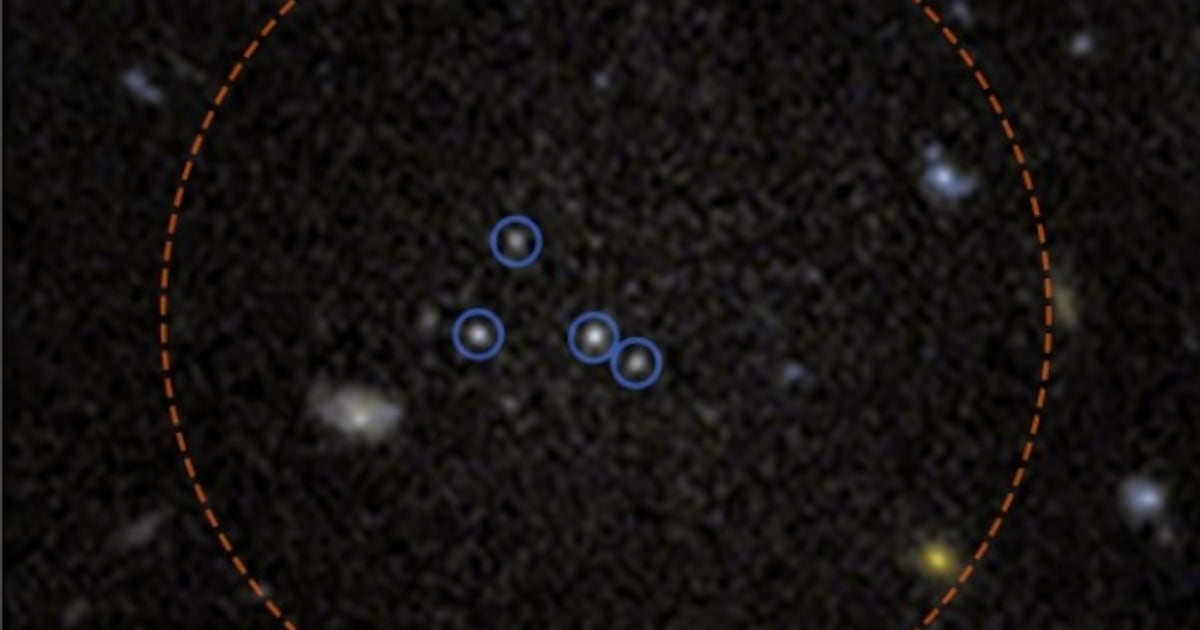
A team of Canadian researchers has made a groundbreaking discovery, identifying a nearly invisible galaxy located approximately 250 million light-years away. This elusive formation, dubbed a “dark galaxy,” is primarily composed of dark matter, which emits little to no light. The discovery highlights the ongoing mysteries of the universe and the significant gaps in our understanding of cosmic structures.
The galaxy, referred to as CDG-2 (Candidate Dark Galaxy-2), presents a faint smudge in the night sky, with only a few stars detectable. David Li, a post-doctoral fellow at the University of Toronto, expressed excitement about the find. “Yeah, it’s pretty much invisible,” he stated, emphasizing the uniqueness of dark galaxies. The term “ghost galaxy” reflects its elusive nature and the challenges astronomers face in locating such formations.
NASA has actively supported this research, utilizing the Hubble Space Telescope to aid in the discovery. Li described the galaxy as being composed of roughly 99.9 percent dark matter. This high proportion of dark matter complicates visibility, necessitating innovative techniques for detection. Instead of directly observing the galaxy, the research team focused on identifying globular clusters—dense groups of ancient stars that orbit galaxies.
While exploring a seemingly empty region of space, the researchers found four globular clusters that hinted at the presence of a hidden, massive object. This invisible entity is believed to be CDG-2. Collaborating with institutions including McMaster University and the University of Waterloo, Li’s team combined data from three powerful astronomical instruments: NASA’s Hubble Space Telescope, the European Space Agency’s Euclid space telescope, and the ground-based Subaru Telescope in Hawaii. They detected a faint glow and diffuse structure surrounding the clusters, providing evidence of the hidden galaxy.
Li noted that CDG-2 has a brightness comparable to only 5 million stars, a stark contrast to the 100 to 400 billion stars found in the Milky Way. “They’re very different from what we know about normal galaxies,” he remarked. The researchers hypothesize that interactions with larger neighboring galaxies may have stripped CDG-2 of the material necessary to form new stars, leaving it predominantly dark and resembling a mere skeleton of its former self.
This research falls under the field of astrostatistics, which applies statistical methods to analyze the vast datasets generated by modern telescopes. The mystery of dark matter has intrigued scientists since it was first proposed in 1933. NASA describes it as the “invisible glue” holding the universe together, comprising an estimated 80 percent of all matter in existence. Dark matter does not reflect, emit, or absorb light, but its presence is inferred from its gravitational effects on visible matter.
In addition to this discovery, Canadian astronomers have been actively exploring various cosmic phenomena this year. Earlier in October 2023, researchers from the University of Waterloo observed the most distant “jellyfish galaxy,” which exhibits long tails of gas resembling jellyfish tentacles. Additionally, in January, a team from Dalhousie University and the University of British Columbia identified a cluster of galaxies containing scorching hot gas that existed merely 1.4 billion years after the Big Bang.
Li expressed surprise at the global attention his team’s discovery has garnered. “It’s been a little bit crazy,” he said, expressing gratitude that the public is engaged with science and astronomy. He hopes to uncover more dark galaxies in the future, believing they could provide crucial insights into the nature of dark matter. “Maybe thousands, or tens of thousands of them, could show up in the future,” he suggested, pointing towards a promising avenue for further exploration in astrophysics.

Meta Plans Major Layoffs as AI Costs Surge

Alberta’s Referendum Could Pave Way for U.S. Statehood

Minooka District 201 Plans Enhanced Bilingual Support for Students

Canmore Approves Multiple Development Permits for New Projects

Remembering Bradly Castillo Shearsmith: A Life of Friendship and Joy

BIS Urges Watchdogs to Integrate Synthetic Risk Transfers in Stress Tests

Teva Transforms: Shifting Focus from Generics to Branded Success

Apple Launches AirPods Max 2 with Enhanced Audio Features

Ontario Ends Funding for Seven Supervised Injection Sites

Toyoake City Proposes Daily Two-Hour Smartphone Use Limit

Pedestrian Fatally Injured in Esquimalt Collision on August 14

B.C. Review Reveals Urgent Need for Rare-Disease Drug Reforms

Dark Adventure Game “Bye Sweet Carole” Set for October Release

Konami Revives Iconic Metal Gear Solid Delta Ahead of Release

Victoria’s Pop-Up Shop Shines Light on B.C.’s Wolf Cull

Jimmy Lai’s Defense Challenges Charges Under National Security Law

Snapmaker U1 Color 3D Printer Redefines Speed and Sustainability

Apple Expands Self-Service Repair Program to Canada
-
 Science11 months ago
Toyoake City Proposes Daily Two-Hour Smartphone Use Limit
-
 Top Stories11 months ago
Pedestrian Fatally Injured in Esquimalt Collision on August 14
-
 Health11 months ago
B.C. Review Reveals Urgent Need for Rare-Disease Drug Reforms
-
 Technology11 months ago
Dark Adventure Game “Bye Sweet Carole” Set for October Release
-
 Technology11 months ago
Konami Revives Iconic Metal Gear Solid Delta Ahead of Release
-
 Lifestyle11 months ago
Victoria’s Pop-Up Shop Shines Light on B.C.’s Wolf Cull
-
 World11 months ago
Jimmy Lai’s Defense Challenges Charges Under National Security Law
-
 Technology11 months ago
Snapmaker U1 Color 3D Printer Redefines Speed and Sustainability
-
 Technology11 months ago
Apple Expands Self-Service Repair Program to Canada
-

 Technology11 months ago
AION Folding Knife: Redefining EDC Design with Premium Materials
-

 Technology11 months ago
Solve Today’s Wordle Challenge: Hints and Answer for August 19
-

 Business11 months ago
Gordon Murray Automotive Unveils S1 LM and Le Mans GTR at Monterey