
Science
Ontario Artist Sparks Debate with Imaginary Canada-US Annexation

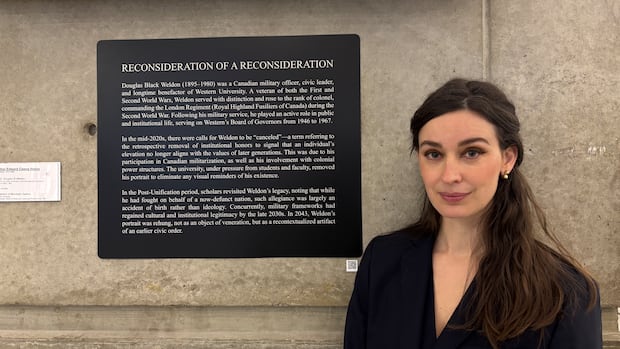
A thought-provoking art installation by Ontario artist Dara Vandor invites viewers to consider a future where Canada has been annexed by the United States. The project, titled *Pax Americana*, features a series of 20 fictional historical plaques displayed throughout Western University’s Weldon Library, encouraging discussions about national identity and historical narratives.
Vandor’s exhibit was inspired by comments made in 2025 when former President Donald Trump suggested the possibility of annexing Canada. The plaques, crafted from durable material known as dura black, present an imagined reality in which Canada has already been incorporated into the U.S. They challenge viewers to think critically about how history is recorded and who gets to define it.
“I wanted people to feel it,” Vandor explained. “I wanted them to think about the actual reality, not just the strawberries.” She noted that initial reactions from Canadians were often dismissive, focusing on trivial concerns such as sourcing strawberries from California or accessing Disney World, rather than considering the broader implications of losing national identity.
The idea began with a single plaque in Vandor’s Toronto neighborhood. “I was just going to do one,” she recalled. “And then one became two, and the ideas just started to spiral.” Each plaque is designed to evoke a sense of permanence, as if the annexation had already occurred, provoking emotional and intellectual responses from viewers.
Vandor’s project garnered attention from Frank Schumacher, a professor of history at Western University. He recognized the blend of “eerie realism and playful imagination” in the installation. Schumacher invited Vandor to showcase her work at the university, believing it provides a unique opportunity for students to engage with complex questions about politics and power.
“Speculative art is free to speculate,” he remarked. “It can tackle questions that a scholar might not even consider.” The plaques serve not merely as predictions, but as reflections on how nations perceive themselves in uncertain times. Schumacher emphasized the importance of stepping back to reconsider current crises through the lens of art.
The plaques have elicited diverse reactions, from inquiries about permits to accusations of hidden political agendas. Vandor expressed satisfaction with the range of responses, stating, “If it provokes an emotion, I’m happy.” She views the plaques as invitations for reflection rather than definitive statements about the future.
In Vandor’s perspective, even discomfort can be a catalyst for productive dialogue. She noted, “The ease at which Canada exists in the world should not be taken for granted.” By instilling a sense of unease, she aims to provoke constructive conversations about Canada’s relationship with its neighbor.
Schumacher concurs, highlighting that the plaques allow viewers to draw their own conclusions. “They can see it, agree with it, or reject it,” he noted. “It can inspire them to think differently about the world.” Through this bold artistic endeavor, Vandor not only challenges viewers to reflect on their national identity but also encourages a broader discourse on the implications of territorial and cultural sovereignty in a changing global landscape.

Meta Plans Major Layoffs as AI Costs Surge

Alberta’s Referendum Could Pave Way for U.S. Statehood

Minooka District 201 Plans Enhanced Bilingual Support for Students

Canmore Approves Multiple Development Permits for New Projects

Remembering Bradly Castillo Shearsmith: A Life of Friendship and Joy

BIS Urges Watchdogs to Integrate Synthetic Risk Transfers in Stress Tests

Teva Transforms: Shifting Focus from Generics to Branded Success

Apple Launches AirPods Max 2 with Enhanced Audio Features

Ontario Ends Funding for Seven Supervised Injection Sites

Toyoake City Proposes Daily Two-Hour Smartphone Use Limit

Pedestrian Fatally Injured in Esquimalt Collision on August 14

B.C. Review Reveals Urgent Need for Rare-Disease Drug Reforms

Dark Adventure Game “Bye Sweet Carole” Set for October Release

Konami Revives Iconic Metal Gear Solid Delta Ahead of Release

Victoria’s Pop-Up Shop Shines Light on B.C.’s Wolf Cull

Jimmy Lai’s Defense Challenges Charges Under National Security Law

Snapmaker U1 Color 3D Printer Redefines Speed and Sustainability

Apple Expands Self-Service Repair Program to Canada
-
 Science11 months ago
Toyoake City Proposes Daily Two-Hour Smartphone Use Limit
-
 Top Stories12 months ago
Pedestrian Fatally Injured in Esquimalt Collision on August 14
-
 Health12 months ago
B.C. Review Reveals Urgent Need for Rare-Disease Drug Reforms
-
 Technology11 months ago
Dark Adventure Game “Bye Sweet Carole” Set for October Release
-
 Technology11 months ago
Konami Revives Iconic Metal Gear Solid Delta Ahead of Release
-
 Lifestyle11 months ago
Victoria’s Pop-Up Shop Shines Light on B.C.’s Wolf Cull
-
 World11 months ago
Jimmy Lai’s Defense Challenges Charges Under National Security Law
-
 Technology11 months ago
Snapmaker U1 Color 3D Printer Redefines Speed and Sustainability
-
 Technology11 months ago
Apple Expands Self-Service Repair Program to Canada
-

 Technology11 months ago
AION Folding Knife: Redefining EDC Design with Premium Materials
-

 Technology11 months ago
Solve Today’s Wordle Challenge: Hints and Answer for August 19
-

 Business11 months ago
Gordon Murray Automotive Unveils S1 LM and Le Mans GTR at Monterey