
World
Canada Strikes Trade Deal with China Amid Security Concerns

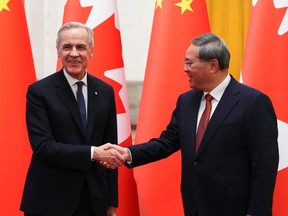
Prime Minister Mark Carney has announced a new trade agreement with China that will allow a limited number of electric vehicles into Canada in exchange for reduced tariffs on canola and other Canadian products. This deal emerges against a backdrop of strained relations with the United States, where President Donald Trump has indicated that American markets no longer require many Canadian goods. Carney’s strategy aims to thaw relations with Canada’s second-largest trading partner, but it raises significant concerns about national security.
In the past, Carney has referred to China as Canada’s greatest security threat. His recent statements emphasize the government’s commitment to safeguarding Canadians against foreign interference, a concern highlighted by the recent foreign interference inquiry, which identified China as “the most persistent and sophisticated foreign interference threat” to Canada. The inquiry revealed alarming instances of China-controlled police stations operating in Canada and targeted campaigns against Canadian politicians.
Critics have pointed out that the government’s history with China has been fraught with challenges, including instances of political donations and dealings that some argue compromise Canada’s national security. Carney’s new agreement has been characterized by some as largely symbolic, raising doubts about its long-term effectiveness.
While Carney insists that he will implement “guardrails” around cooperation with China—specifically excluding areas such as artificial intelligence, critical minerals, and defense—there is skepticism regarding the government’s ability to effectively manage these risks. Although the government has discussed establishing a foreign lobbyists’ registry for the past five years, it has yet to take significant action in this regard.
The necessity of diversifying Canada’s trade partnerships is evident, especially as Carney describes a “new world order” that involves strengthening ties with China while also reducing dependence on the U.S. Nevertheless, the prime minister’s primary responsibility remains clear: to ensure the safety and security of Canadians.
As the situation develops, the implications of this trade agreement will likely resonate across the political spectrum, with various leaders, including Doug Ford, voicing their opinions. Ford has criticized the deal, calling it “lopsided,” indicating a potential divide in how different political factions view economic relations with China.
As Canada navigates this complex landscape, the balance between economic growth and national security will be critical. The success of this agreement remains to be seen, and it will be essential for Carney’s government to address the underlying security concerns while pursuing new economic opportunities.

Meta Plans Major Layoffs as AI Costs Surge

Alberta’s Referendum Could Pave Way for U.S. Statehood

Minooka District 201 Plans Enhanced Bilingual Support for Students

Canmore Approves Multiple Development Permits for New Projects

Remembering Bradly Castillo Shearsmith: A Life of Friendship and Joy

BIS Urges Watchdogs to Integrate Synthetic Risk Transfers in Stress Tests

Teva Transforms: Shifting Focus from Generics to Branded Success

Apple Launches AirPods Max 2 with Enhanced Audio Features

Ontario Ends Funding for Seven Supervised Injection Sites

Toyoake City Proposes Daily Two-Hour Smartphone Use Limit

Pedestrian Fatally Injured in Esquimalt Collision on August 14

B.C. Review Reveals Urgent Need for Rare-Disease Drug Reforms

Dark Adventure Game “Bye Sweet Carole” Set for October Release

Konami Revives Iconic Metal Gear Solid Delta Ahead of Release

Victoria’s Pop-Up Shop Shines Light on B.C.’s Wolf Cull

Jimmy Lai’s Defense Challenges Charges Under National Security Law

Snapmaker U1 Color 3D Printer Redefines Speed and Sustainability

Apple Expands Self-Service Repair Program to Canada
-
 Science12 months ago
Toyoake City Proposes Daily Two-Hour Smartphone Use Limit
-
 Top Stories12 months ago
Pedestrian Fatally Injured in Esquimalt Collision on August 14
-
 Health12 months ago
B.C. Review Reveals Urgent Need for Rare-Disease Drug Reforms
-
 Technology12 months ago
Dark Adventure Game “Bye Sweet Carole” Set for October Release
-
 Technology12 months ago
Konami Revives Iconic Metal Gear Solid Delta Ahead of Release
-
 Lifestyle12 months ago
Victoria’s Pop-Up Shop Shines Light on B.C.’s Wolf Cull
-
 World12 months ago
Jimmy Lai’s Defense Challenges Charges Under National Security Law
-
 Technology12 months ago
Snapmaker U1 Color 3D Printer Redefines Speed and Sustainability
-
 Technology12 months ago
Apple Expands Self-Service Repair Program to Canada
-

 Technology12 months ago
AION Folding Knife: Redefining EDC Design with Premium Materials
-

 Technology12 months ago
Solve Today’s Wordle Challenge: Hints and Answer for August 19
-

 Business12 months ago
Gordon Murray Automotive Unveils S1 LM and Le Mans GTR at Monterey