
World
Magnetic North Pole Drifts Toward Russia, Geomagnetic Pole Lands in Canada

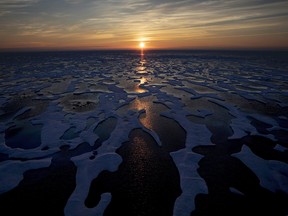
Recent observations reveal that the magnetic north pole is continuing its drift away from Canada and toward Russia, a phenomenon that has significant implications for navigation systems. According to the latest updates from the World Magnetic Model, released in 2022 by British and American scientific organizations, the magnetic north pole is moving more slowly than in previous years but remains on a trajectory that takes it across the Arctic Ocean and into Russian territory.
Understanding the difference between the magnetic north pole and the geographic North Pole is crucial. The geographic North Pole, located at the point where all lines of longitude meet, is fixed. In contrast, the magnetic north pole is influenced by the dynamic processes occurring within the Earth’s outer core, where convection currents generate the planet’s magnetic field. This field causes compass needles to align, pointing towards magnetic north.
The magnetic north pole’s drift has been documented since the early 19th century. It has moved from Canadian territories such as Victoria Island and King William Island to its current position, which has notably passed the geographic North Pole and is now heading southward. At its peak, the pole was drifting at several kilometers per year, but that pace has recently slowed. While this drift presents navigational challenges, the story is not merely about the magnetic pole’s movement.
Exploring the Geomagnetic North Pole
A lesser-known aspect of this story is the recent arrival of the geomagnetic north pole on Canada’s Ellesmere Island. Unlike the magnetic north pole, which has immediate implications for navigation, the geomagnetic north pole serves a different purpose. It represents a theoretical point that averages out local variations in the Earth’s magnetic field. This perspective is crucial for space science and understanding the interaction between solar radiation and the Earth’s magnetic field.
The geomagnetic north pole is less mobile than its magnetic counterpart. Until five years ago, it was located off the northwest coast of Greenland but has since moved to Ellesmere Island, near Hans Island. This shift is significant as it gives Canada a unique claim to a new “north pole,” underscoring the dynamic nature of Earth’s magnetic properties.
The geomagnetic north pole impacts phenomena such as the auroras, which occur when charged particles from the solar wind interact with gases in the Earth’s atmosphere. These spectacular light displays are shaped by the planet’s magnetic field and occur in oval bands around the poles, unaffected by the local movements of the magnetic north pole.
The Impact on Navigation and Future Implications
As the magnetic north pole continues to drift, implications for navigation systems are becoming evident. The changes could disrupt the courses of boats and planes, leading to adjustments in navigational charts and practices. Reports suggest that this drift may also hint at larger geological processes, including a potential future reversal of the Earth’s magnetic field, a phenomenon that occurs over thousands of years and leaves traces in geological formations.
While the magnetic north pole receives considerable media attention, the geomagnetic pole’s movement also warrants recognition. As Canada gains a new geomagnetic reference point, it reflects the ongoing changes in our planet’s magnetic environment. The implications of these shifts extend beyond mere navigation; they contribute to our understanding of Earth’s complex systems and the interplay between its magnetic field and solar radiation.
In conclusion, as the magnetic north pole drifts toward Russia, Canada finds itself in a unique position with the emergence of the geomagnetic north pole on Ellesmere Island. This evolving narrative about our planet’s magnetic dynamics underscores the importance of continuous scientific observation and adaptation in navigating both the physical and theoretical aspects of Earth’s magnetic field.

Meta Plans Major Layoffs as AI Costs Surge

Alberta’s Referendum Could Pave Way for U.S. Statehood

Minooka District 201 Plans Enhanced Bilingual Support for Students

Canmore Approves Multiple Development Permits for New Projects

Remembering Bradly Castillo Shearsmith: A Life of Friendship and Joy

BIS Urges Watchdogs to Integrate Synthetic Risk Transfers in Stress Tests

Teva Transforms: Shifting Focus from Generics to Branded Success

Apple Launches AirPods Max 2 with Enhanced Audio Features

Ontario Ends Funding for Seven Supervised Injection Sites

Toyoake City Proposes Daily Two-Hour Smartphone Use Limit

Pedestrian Fatally Injured in Esquimalt Collision on August 14

B.C. Review Reveals Urgent Need for Rare-Disease Drug Reforms

Dark Adventure Game “Bye Sweet Carole” Set for October Release

Konami Revives Iconic Metal Gear Solid Delta Ahead of Release

Victoria’s Pop-Up Shop Shines Light on B.C.’s Wolf Cull

Jimmy Lai’s Defense Challenges Charges Under National Security Law

Snapmaker U1 Color 3D Printer Redefines Speed and Sustainability

Apple Expands Self-Service Repair Program to Canada
-
 Science12 months ago
Toyoake City Proposes Daily Two-Hour Smartphone Use Limit
-
 Top Stories12 months ago
Pedestrian Fatally Injured in Esquimalt Collision on August 14
-
 Health12 months ago
B.C. Review Reveals Urgent Need for Rare-Disease Drug Reforms
-
 Technology12 months ago
Dark Adventure Game “Bye Sweet Carole” Set for October Release
-
 Technology12 months ago
Konami Revives Iconic Metal Gear Solid Delta Ahead of Release
-
 Lifestyle12 months ago
Victoria’s Pop-Up Shop Shines Light on B.C.’s Wolf Cull
-
 World12 months ago
Jimmy Lai’s Defense Challenges Charges Under National Security Law
-
 Technology12 months ago
Snapmaker U1 Color 3D Printer Redefines Speed and Sustainability
-
 Technology12 months ago
Apple Expands Self-Service Repair Program to Canada
-

 Technology12 months ago
AION Folding Knife: Redefining EDC Design with Premium Materials
-

 Technology12 months ago
Solve Today’s Wordle Challenge: Hints and Answer for August 19
-

 Business12 months ago
Gordon Murray Automotive Unveils S1 LM and Le Mans GTR at Monterey