
World
Robots Transform Service Industry: Caffeo’s Automated Coffee Experience

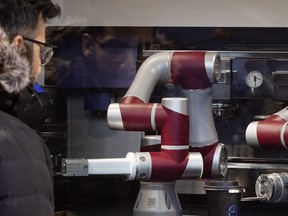
In downtown Toronto, a new café called Caffeo is redefining the coffee experience with the help of robotics. Customers, like Vandhana Mohanraj and her partner Faisal Fakhani, can now enjoy a vanilla latte prepared by a robotic barista, which efficiently brews coffee without the risk of burning it. This innovative approach marks a significant shift in the service industry, showcasing how technology can enhance customer satisfaction while minimizing human involvement.
The absence of traditional staff is becoming increasingly common across various sectors. Caffeo is just one of many establishments in Canada embracing this trend. Convenience stores without cashiers, hotels where guests can manage their stay through smartphones, and gyms operating on a self-serve model are just a few examples of this technological evolution. As businesses seek to reduce costs and address labor shortages, analysts suggest that automation will continue to expand in the service sector.
Wendy Cukier, a professor at Toronto Metropolitan University and an expert in disruptive technologies, points out that many companies are exploring automation as a viable solution to the current skills shortage. While some businesses have previously hesitated to implement self-serve kiosks due to theft concerns, the successful integration of technology in customer-facing roles is gaining traction.
The concept of fully automated service is particularly appealing to employers in the service sector who often depend on temporary foreign workers. Tason Lee, CEO of Tracer Golf, highlights that a segment of consumers prefers to avoid direct interaction with staff, opting instead for a seamless, machine-driven experience. This sentiment reflects a growing trend towards digital convenience, where many customers are accustomed to online shopping and expect similar ease in physical retail spaces.
Despite the shift towards automation, certain roles will remain essential. According to Lisa Hutcheson from JCWG Retail Consultants, while robots may take over tasks such as stocking shelves, complete automation of the workforce is unlikely in the near future. The demand for human oversight and management will persist, albeit in reduced capacities.
One of the pioneers in this space is Aisle24, which operates over 30 cashierless convenience stores across Canada. Founded in 2016, its model allows customers to download an app for access to stores where they can shop and check out via self-serve scanners. This innovation has proven beneficial, especially in a retail landscape increasingly dominated by e-commerce.
Moreover, at Trent University, the Bata Bean café uses Amazon’s Just Walk Out technology, which automatically charges customers for items they take. Similar systems are in place at sports venues like the Scotiabank Arena in Toronto and Rogers Centre, demonstrating the versatility of automation across different sectors.
In Quebec City, the Manoir des Remparts offers a staffless hotel experience, allowing guests to manage their stay through their smartphones. While the automation trend is not without its challenges, such as the recent closure of the Sonder hotel chain, which faced financial difficulties, the overall movement towards self-service appears robust.
As the demand for automation continues to rise, Caffeo exemplifies how the coffee industry is adapting. The café’s robotic barista, produced by Jaka Robotics, may lack the charm of a human touch, but it offers a level of consistency that appeals to many customers. For Mohanraj and Fakhani, the experience was surprisingly enjoyable, and they expressed a willingness to return for another robot-made latte.
This shift towards automation raises questions about the future of work in the service industry. As Cukier notes, the rapid pace of change may lead to significant shifts in employment. While some jobs may disappear, others will emerge, requiring adaptability from both businesses and employees.
In conclusion, the evolution of service through robotics is transforming how consumers interact with businesses. As technology continues to develop, establishments like Caffeo will likely become more prevalent, reflecting changing consumer preferences and the ongoing quest for efficiency in the service sector.

Meta Plans Major Layoffs as AI Costs Surge

Alberta’s Referendum Could Pave Way for U.S. Statehood

Minooka District 201 Plans Enhanced Bilingual Support for Students

Canmore Approves Multiple Development Permits for New Projects

Remembering Bradly Castillo Shearsmith: A Life of Friendship and Joy

BIS Urges Watchdogs to Integrate Synthetic Risk Transfers in Stress Tests

Teva Transforms: Shifting Focus from Generics to Branded Success

Apple Launches AirPods Max 2 with Enhanced Audio Features

Ontario Ends Funding for Seven Supervised Injection Sites

Toyoake City Proposes Daily Two-Hour Smartphone Use Limit

Pedestrian Fatally Injured in Esquimalt Collision on August 14

B.C. Review Reveals Urgent Need for Rare-Disease Drug Reforms

Dark Adventure Game “Bye Sweet Carole” Set for October Release

Konami Revives Iconic Metal Gear Solid Delta Ahead of Release

Victoria’s Pop-Up Shop Shines Light on B.C.’s Wolf Cull

Jimmy Lai’s Defense Challenges Charges Under National Security Law

Snapmaker U1 Color 3D Printer Redefines Speed and Sustainability

Apple Expands Self-Service Repair Program to Canada
-
 Science12 months ago
Toyoake City Proposes Daily Two-Hour Smartphone Use Limit
-
 Top Stories12 months ago
Pedestrian Fatally Injured in Esquimalt Collision on August 14
-
 Health12 months ago
B.C. Review Reveals Urgent Need for Rare-Disease Drug Reforms
-
 Technology11 months ago
Dark Adventure Game “Bye Sweet Carole” Set for October Release
-
 Technology12 months ago
Konami Revives Iconic Metal Gear Solid Delta Ahead of Release
-
 Lifestyle12 months ago
Victoria’s Pop-Up Shop Shines Light on B.C.’s Wolf Cull
-
 World12 months ago
Jimmy Lai’s Defense Challenges Charges Under National Security Law
-
 Technology12 months ago
Snapmaker U1 Color 3D Printer Redefines Speed and Sustainability
-
 Technology12 months ago
Apple Expands Self-Service Repair Program to Canada
-

 Technology12 months ago
AION Folding Knife: Redefining EDC Design with Premium Materials
-

 Technology12 months ago
Solve Today’s Wordle Challenge: Hints and Answer for August 19
-

 Business12 months ago
Gordon Murray Automotive Unveils S1 LM and Le Mans GTR at Monterey