
World
South Korea’s Lee Urges China to Address North Korea’s Nuclear Threats

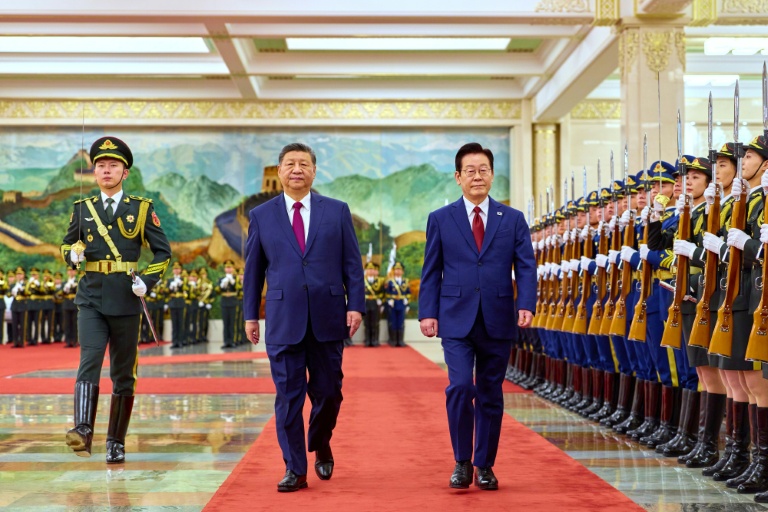
South Korean President Lee Jae Myung called on Chinese leader Xi Jinping to assist in curbing North Korea’s nuclear ambitions during his visit to Beijing this week. This meeting marks the first visit by a South Korean president to China in six years, reflecting a desire for improved relations with the nation that remains South Korea’s largest trading partner.
During discussions on Monday, Lee suggested that a freeze on North Korea’s development of weapons of mass destruction could be achievable under the right conditions. His comments came just one day after North Korea launched two ballistic missiles into the Sea of Japan, underscoring the urgency of the situation.
Seeking Mediation and Peace
Speaking to reporters in Shanghai at the conclusion of his trip, Lee emphasized the need for Beijing’s help in persuading Pyongyang to return to negotiations. He stated, “I would like China to play a mediating role on issues related to the Korean Peninsula, including North Korea’s nuclear programme.”
According to Lee, all existing communication channels with North Korea are currently blocked. He expressed hope that China could act as a mediator for peace, acknowledging the complexities of the situation: “All our channels are completely blocked. We hope China can serve as a mediator — a mediator for peace.”
In response, Xi urged Seoul to exercise “patience” with North Korea, recognizing the strained relations between the two Koreas. Lee conceded that past military actions taken by South Korea might have been perceived as threats by the North, which has contributed to the current tensions.
Proposing a Nuclear Freeze
As part of his strategy, Lee proposed a plan where North Korea would freeze its nuclear programme in exchange for “compensation.” He explained that halting further development of nuclear weapons, refraining from additional production, and stopping the transfer of nuclear materials would constitute a significant achievement. “Just stopping at the current level — no additional production of nuclear weapons, no transfer of nuclear materials abroad, and no further development of ICBMs — would already be a gain,” he noted.
Lee reiterated the long-term goal of achieving a nuclear-free Korean Peninsula, despite North Korea’s declaration of itself as an “irreversible” nuclear state. The relationship between the two Koreas has reached a low point, exacerbated by previous administrations’ approaches and North Korea’s continued missile testing.
On the same day as Lee’s meeting with Xi, North Korea announced that its nuclear forces were prepared for conflict, citing recent geopolitical tensions, particularly referencing U.S. military actions in Venezuela. This has raised alarms within the North Korean leadership, which perceives such events as potential threats to its regime.
For decades, North Korea has justified its nuclear and missile programmes as a deterrent against what it views as threats of regime change from Washington. The continuation of missile testing highlights Pyongyang’s intention to enhance its precision strike capabilities while simultaneously challenging both the United States and South Korea.
As the international community watches closely, Lee’s visit to China represents a critical step in redefining South Korea’s approach to its northern neighbor and seeking a collaborative effort to mitigate the nuclear threat on the Korean Peninsula.

Meta Plans Major Layoffs as AI Costs Surge

Alberta’s Referendum Could Pave Way for U.S. Statehood

Minooka District 201 Plans Enhanced Bilingual Support for Students

Canmore Approves Multiple Development Permits for New Projects

Remembering Bradly Castillo Shearsmith: A Life of Friendship and Joy

BIS Urges Watchdogs to Integrate Synthetic Risk Transfers in Stress Tests

Teva Transforms: Shifting Focus from Generics to Branded Success

Apple Launches AirPods Max 2 with Enhanced Audio Features

Ontario Ends Funding for Seven Supervised Injection Sites

Toyoake City Proposes Daily Two-Hour Smartphone Use Limit

Pedestrian Fatally Injured in Esquimalt Collision on August 14

B.C. Review Reveals Urgent Need for Rare-Disease Drug Reforms

Dark Adventure Game “Bye Sweet Carole” Set for October Release

Konami Revives Iconic Metal Gear Solid Delta Ahead of Release

Victoria’s Pop-Up Shop Shines Light on B.C.’s Wolf Cull

Jimmy Lai’s Defense Challenges Charges Under National Security Law

Snapmaker U1 Color 3D Printer Redefines Speed and Sustainability

Apple Expands Self-Service Repair Program to Canada
-
 Science1 year ago
Toyoake City Proposes Daily Two-Hour Smartphone Use Limit
-
 Top Stories1 year ago
Pedestrian Fatally Injured in Esquimalt Collision on August 14
-
 Health1 year ago
B.C. Review Reveals Urgent Need for Rare-Disease Drug Reforms
-
 Technology1 year ago
Dark Adventure Game “Bye Sweet Carole” Set for October Release
-
 Technology1 year ago
Konami Revives Iconic Metal Gear Solid Delta Ahead of Release
-
 Lifestyle1 year ago
Victoria’s Pop-Up Shop Shines Light on B.C.’s Wolf Cull
-
 World1 year ago
Jimmy Lai’s Defense Challenges Charges Under National Security Law
-
 Technology1 year ago
Snapmaker U1 Color 3D Printer Redefines Speed and Sustainability
-
 Technology1 year ago
Apple Expands Self-Service Repair Program to Canada
-

 Technology1 year ago
AION Folding Knife: Redefining EDC Design with Premium Materials
-

 Technology1 year ago
Solve Today’s Wordle Challenge: Hints and Answer for August 19
-

 Business1 year ago
Gordon Murray Automotive Unveils S1 LM and Le Mans GTR at Monterey