
World
U.S. Arctic Ambitions: Greenland’s Role in Global Power Dynamics

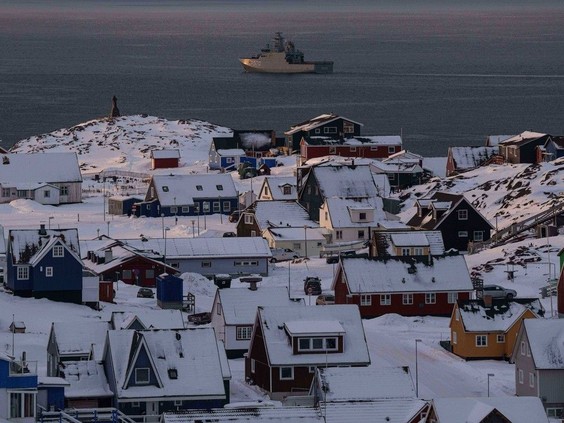
Donald Trump has stirred international discussions with claims of a potential deal involving Greenland, highlighting the strategic significance of the territory in Arctic security. This announcement coincided with a retreat from his earlier threats to increase tariffs on European countries that oppose U.S. interests. In a bold assertion, Trump declared that the post-1945 global order is shifting, emphasizing that nations must now consider a price for safety and security.
Tim Reilly, a polar security expert based in the United Kingdom, urges observers to understand this situation through the lens of American priorities, even if they do not align with Trump’s views. While acknowledging Trump’s unpredictable nature, Reilly emphasizes the need for a broader perspective on Greenland’s sovereignty and its implications for global security, particularly in the context of U.S.-China relations.
Reilly suggests a shift in focus is necessary, arguing that Europe is often mired in a 19th-century mindset concerning sovereignty and territorial claims. He points out that Canadian Prime Minister Mark Carney recently noted at the World Economic Forum in Davos that the established rules-based order is eroding amid rising great-power competition.
This evolving geopolitical landscape compels European nations to reassess their understanding of U.S. ambitions in the Arctic. Reilly, a former associate of the Scott Polar Research Institute at the University of Cambridge, recalls his involvement in reviewing the recent U.S. Arctic policy, which heavily emphasizes space capabilities. He predicts significant changes to NATO strategies may occur by 2026, reshaping the dynamics of Arctic security.
The perspective of Greenlanders is also pivotal, as Reilly believes their aspirations for independence could gain traction, particularly if the U.S. solidifies its presence in the region. He notes that Greenlanders have historically sought independence but lacked the financial resources to pursue it. Should independence become a viable option, the implications may extend beyond Greenland, potentially inspiring similar movements among Indigenous populations globally.
Reilly highlights the complexities surrounding U.S. interests in Greenland. He identifies that while the U.S. could access the territory without full ownership, establishing a permanent presence is crucial for its strategic goals. He likens this approach to that of a wealthy individual preferring to purchase property rather than rely on temporary accommodations for a long-term investment.
According to Trump, a potential agreement with NATO could pave the way for U.S. military bases in Greenland, although Denmark has firmly rejected any suggestion that Greenland’s sovereignty is negotiable. Reilly warns that the competition among superpowers is ruthless, with the U.S. aiming to undermine potential trade agreements between China and the European Union.
He elaborates on America’s strategic denial, emphasizing the need to prevent China and Russia from increasing their foothold in the Arctic. As the European Union focuses on NATO, Reilly asserts that the Trump administration prioritizes updating NORAD (North American Aerospace Defense Command) to counter modern threats.
Current radar systems are inadequate against hypersonic missiles, which travel at speeds of up to Mach 10. Reilly explains that Greenland’s geographical advantages could enhance defense capabilities, providing a strategic location for missile defense installations.
Beyond military applications, Greenland also presents significant opportunities for space-related infrastructure. Reilly outlines the potential for satellite systems and technology development, underscoring how control over the Arctic can grant access to vital resources across three continents.
In this context, Reilly characterizes the global landscape as increasingly bipolar, with the U.S. and China at the forefront of competition. He warns that nations may soon need to align with one of these powers, leaving little room for middle ground.
While there are exceptions, such as Taiwan’s semiconductor industry, which serves both the U.S. and China, the broader trend suggests a narrowing of options for smaller nations. Reilly acknowledges the complexity of these dynamics and the need for nations to navigate their positions carefully.
As discussions surrounding Greenland’s future unfold, the implications for Arctic security and global power relations remain profound. The evolving situation underscores the importance of understanding the motivations behind U.S. actions and the potential consequences for both Greenland and the international community.

Meta Plans Major Layoffs as AI Costs Surge

Alberta’s Referendum Could Pave Way for U.S. Statehood

Minooka District 201 Plans Enhanced Bilingual Support for Students

Canmore Approves Multiple Development Permits for New Projects

Remembering Bradly Castillo Shearsmith: A Life of Friendship and Joy

BIS Urges Watchdogs to Integrate Synthetic Risk Transfers in Stress Tests

Teva Transforms: Shifting Focus from Generics to Branded Success

Apple Launches AirPods Max 2 with Enhanced Audio Features

Ontario Ends Funding for Seven Supervised Injection Sites

Toyoake City Proposes Daily Two-Hour Smartphone Use Limit

Pedestrian Fatally Injured in Esquimalt Collision on August 14

B.C. Review Reveals Urgent Need for Rare-Disease Drug Reforms

Dark Adventure Game “Bye Sweet Carole” Set for October Release

Konami Revives Iconic Metal Gear Solid Delta Ahead of Release

Victoria’s Pop-Up Shop Shines Light on B.C.’s Wolf Cull

Jimmy Lai’s Defense Challenges Charges Under National Security Law

Snapmaker U1 Color 3D Printer Redefines Speed and Sustainability

Apple Expands Self-Service Repair Program to Canada
-
 Science1 year ago
Toyoake City Proposes Daily Two-Hour Smartphone Use Limit
-
 Top Stories1 year ago
Pedestrian Fatally Injured in Esquimalt Collision on August 14
-
 Health1 year ago
B.C. Review Reveals Urgent Need for Rare-Disease Drug Reforms
-
 Technology12 months ago
Dark Adventure Game “Bye Sweet Carole” Set for October Release
-
 Technology1 year ago
Konami Revives Iconic Metal Gear Solid Delta Ahead of Release
-
 Lifestyle1 year ago
Victoria’s Pop-Up Shop Shines Light on B.C.’s Wolf Cull
-
 World1 year ago
Jimmy Lai’s Defense Challenges Charges Under National Security Law
-
 Technology1 year ago
Snapmaker U1 Color 3D Printer Redefines Speed and Sustainability
-
 Technology1 year ago
Apple Expands Self-Service Repair Program to Canada
-

 Technology1 year ago
AION Folding Knife: Redefining EDC Design with Premium Materials
-

 Technology1 year ago
Solve Today’s Wordle Challenge: Hints and Answer for August 19
-

 Business1 year ago
Gordon Murray Automotive Unveils S1 LM and Le Mans GTR at Monterey