
Education
Quebec’s School Cellphone Ban Boosts Focus and Social Skills

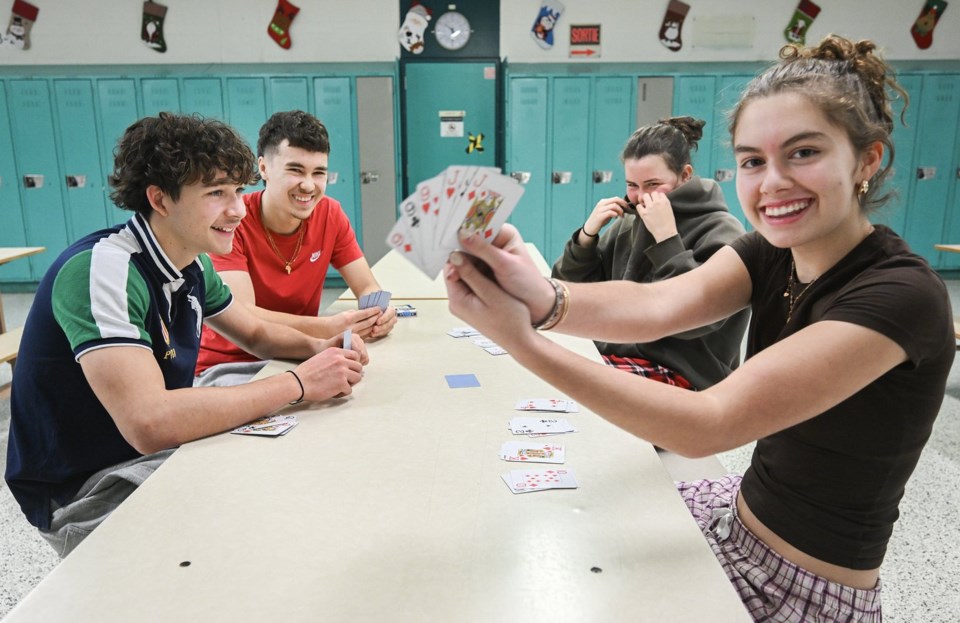
Quebec’s recent expansion of its school cellphone ban has garnered positive feedback from both students and school administrators, who claim it has significantly enhanced concentration and social interactions among students. The policy, which prohibits cellphone use during the entire school day, including breaks, was implemented in January 2024 and has transformed the social landscape in schools across the province.
At École Monseigneur-A.-M.-Parent high school, located on Montreal’s South Shore, students enjoy a vibrant atmosphere during lunch breaks. As the student radio station plays festive music, students engage in activities like playing cards, foosball, and board games, a stark contrast to the previous norm of scrolling through their phones. Grade 11 student Constance Boie expressed her enthusiasm for the change, noting, “Before, people were on their phones a lot…but now they play together or talk to each other.”
Fellow student Shelby Miclette, who identifies as “quite introverted,” shared her experience of becoming more socially engaged due to the ban. “It’s brought me out of my shell a little,” she stated. The impact of the policy is evident as students are encouraged to interact more, fostering a sense of community.
The new regulations, which apply to all elementary and high schools in Quebec, have been welcomed by many educators. Mélanie Lacourse, principal of École Monseigneur-A.-M.-Parent, has observed significant improvements in students’ social skills and overall academic performance. “It’s a friendlier atmosphere… and sometimes, yes, noisier,” she remarked, adding that students are more active and less isolated during school hours.
At the nearby Séminaire St-François, principal feedback mirrors Lacourse’s observations. The principal noted a marked increase in students’ social interactions. “You can hear the change in the hallways; there is much more talking and laughing,” he said. While there was initial resistance from older students, he reported that the transition to the ban has generally gone smoothly.
Clinical psychologist Linda S. Pagani, affiliated with Montreal’s Sainte-Justine hospital research centre, supported the ban’s benefits. She highlighted how excessive cellphone use can hinder academic learning and personality development. “Cellphones are so distracting that they delay all the tasks that teenagers need to do to build their identity,” Pagani explained. She emphasized the importance of handwritten notes in consolidating learning, suggesting that limiting digital distractions can enhance cognitive engagement.
The cellphone ban has also prompted discussions among administrators regarding the use of tablets in classrooms. Boisvert, another administrator, indicated that while tablets can serve educational purposes, they also present challenges in management and supervision. His school plans to transition to laptops next year to address these concerns.
As schools across Quebec adapt to the cellphone ban, the early results suggest a positive shift in student interactions and academic focus. With continued evaluation and adjustments to digital device usage, educators hope to maintain the enhanced social environment that has emerged since the policy’s implementation.

Meta Plans Major Layoffs as AI Costs Surge

Alberta’s Referendum Could Pave Way for U.S. Statehood

Minooka District 201 Plans Enhanced Bilingual Support for Students

Canmore Approves Multiple Development Permits for New Projects

Remembering Bradly Castillo Shearsmith: A Life of Friendship and Joy

BIS Urges Watchdogs to Integrate Synthetic Risk Transfers in Stress Tests

Teva Transforms: Shifting Focus from Generics to Branded Success

Apple Launches AirPods Max 2 with Enhanced Audio Features

Ontario Ends Funding for Seven Supervised Injection Sites

Toyoake City Proposes Daily Two-Hour Smartphone Use Limit

Pedestrian Fatally Injured in Esquimalt Collision on August 14

B.C. Review Reveals Urgent Need for Rare-Disease Drug Reforms

Dark Adventure Game “Bye Sweet Carole” Set for October Release

Konami Revives Iconic Metal Gear Solid Delta Ahead of Release

Victoria’s Pop-Up Shop Shines Light on B.C.’s Wolf Cull

Jimmy Lai’s Defense Challenges Charges Under National Security Law

Snapmaker U1 Color 3D Printer Redefines Speed and Sustainability

Apple Expands Self-Service Repair Program to Canada
-
 Science1 year ago
Toyoake City Proposes Daily Two-Hour Smartphone Use Limit
-
 Top Stories1 year ago
Pedestrian Fatally Injured in Esquimalt Collision on August 14
-
 Health1 year ago
B.C. Review Reveals Urgent Need for Rare-Disease Drug Reforms
-
 Technology1 year ago
Dark Adventure Game “Bye Sweet Carole” Set for October Release
-
 Technology1 year ago
Konami Revives Iconic Metal Gear Solid Delta Ahead of Release
-
 Lifestyle1 year ago
Victoria’s Pop-Up Shop Shines Light on B.C.’s Wolf Cull
-
 World1 year ago
Jimmy Lai’s Defense Challenges Charges Under National Security Law
-
 Technology1 year ago
Snapmaker U1 Color 3D Printer Redefines Speed and Sustainability
-
 Technology1 year ago
Apple Expands Self-Service Repair Program to Canada
-

 Technology1 year ago
AION Folding Knife: Redefining EDC Design with Premium Materials
-

 Technology1 year ago
Solve Today’s Wordle Challenge: Hints and Answer for August 19
-

 Business1 year ago
Gordon Murray Automotive Unveils S1 LM and Le Mans GTR at Monterey